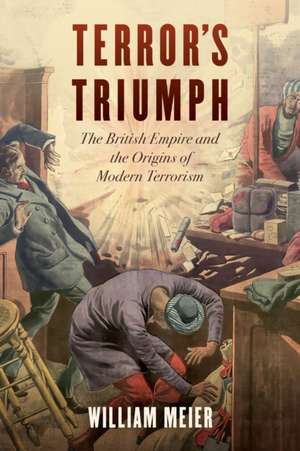
Terror's Triumph: The British Empire and the Origins of Modern Terrorism
Autor William Meieren Limba Engleză Paperback – 27 noi 2024
Preț: 223.47 lei
Preț vechi: 276.77 lei
-19%
Puncte Express: 335
Carte tipărită la comandă
Livrare economică 17 noiembrie-01 decembrie
Livrare prin curier în România Termenul estimat este afișat lângă disponibilitate.
Transport gratuit de la 400.00 lei Plată online sau ramburs, în funcție de opțiunile comenzii.
Retur gratuit în 14 zile Comandă securizată și suport în română.
Specificații
ISBN-13: 9798881801960
Pagini: 342
Ilustrații: 21 BW Illustrations
Dimensiuni: 150 x 226 x 22 mm
Greutate: 0.46 kg
Editura: Bloomsbury Publishing
Colecția Rowman & Littlefield
Locul publicării:New York, United States
Pagini: 342
Ilustrații: 21 BW Illustrations
Dimensiuni: 150 x 226 x 22 mm
Greutate: 0.46 kg
Editura: Bloomsbury Publishing
Colecția Rowman & Littlefield
Locul publicării:New York, United States
Cuprins
Table of Contents
List of Figures
Prologue
Part I: The Pacification of Ireland
Introduction to Part I
Chapter 1: The Invention of Terrorism in Nineteenth-Century Britain
Devil in the Heart of the Nation, 1868-1870
Darkest Westmeath, 1871
William Forster's Experiment
The Iconography of Terror
Chapter 2: Effects of the Explosion
Terrorism Transplanted
Edward Jenkinson, Indo-Englishman
War or Crime?
London Calling
Dynamite and Empire
Edward Jenkinson, Home Ruler at Heart
Part II: Terrorism and the End of Empire, 1900-1960
Introduction to Part II
Chapter 3: Dangerous Hybrids in India
Fanaticism
Bringing on the Bombs, 1905-08
Dangerous Hybrids
Honest John's Riddle
Chapter 4: A Monstrous System, 1914-21
The First Reprisal
"Don't Forget the Reprisals"
"Prussianism in our Midst"
Ireland
India
Counter-Terrorism
The Soul of Empire, 1920-21
Chapter 5: Communal Terrorism in the Empire, 1921-1948
Pogroms
"Politics of a Subject Race," 1924-1938
"Not Our Fault, But Yours:" Communal Terrorism, 1940-48
Chapter 6: Last Lessons: Terrorism and Decolonization, 1948-60
Reoccupation
Malaya: Emergency Measures to Salvage Prestige
Kenya: Revising the "White Man's Burden"
Cyprus: The Ghosts of Terrorism Past
"The Ebb is Close at Hand"
Part III: Homecoming, 1968-Present
Introduction to Part III
Chapter 7: International Terrorism: Troubles Beyond Borders, 1968-1988
Blowing up Civilization, 1968-72
Ulster: The Last Stage of Decolonization, 1968-72
The Word Made Law (I): Northern Irish Terrorism
The Word Made Law (II): International Terrorism
International Terrorism, 1984-1988
Epilogue: Welcome to Londonistan
Bibliography
List of Figures
Prologue
Part I: The Pacification of Ireland
Introduction to Part I
Chapter 1: The Invention of Terrorism in Nineteenth-Century Britain
Devil in the Heart of the Nation, 1868-1870
Darkest Westmeath, 1871
William Forster's Experiment
The Iconography of Terror
Chapter 2: Effects of the Explosion
Terrorism Transplanted
Edward Jenkinson, Indo-Englishman
War or Crime?
London Calling
Dynamite and Empire
Edward Jenkinson, Home Ruler at Heart
Part II: Terrorism and the End of Empire, 1900-1960
Introduction to Part II
Chapter 3: Dangerous Hybrids in India
Fanaticism
Bringing on the Bombs, 1905-08
Dangerous Hybrids
Honest John's Riddle
Chapter 4: A Monstrous System, 1914-21
The First Reprisal
"Don't Forget the Reprisals"
"Prussianism in our Midst"
Ireland
India
Counter-Terrorism
The Soul of Empire, 1920-21
Chapter 5: Communal Terrorism in the Empire, 1921-1948
Pogroms
"Politics of a Subject Race," 1924-1938
"Not Our Fault, But Yours:" Communal Terrorism, 1940-48
Chapter 6: Last Lessons: Terrorism and Decolonization, 1948-60
Reoccupation
Malaya: Emergency Measures to Salvage Prestige
Kenya: Revising the "White Man's Burden"
Cyprus: The Ghosts of Terrorism Past
"The Ebb is Close at Hand"
Part III: Homecoming, 1968-Present
Introduction to Part III
Chapter 7: International Terrorism: Troubles Beyond Borders, 1968-1988
Blowing up Civilization, 1968-72
Ulster: The Last Stage of Decolonization, 1968-72
The Word Made Law (I): Northern Irish Terrorism
The Word Made Law (II): International Terrorism
International Terrorism, 1984-1988
Epilogue: Welcome to Londonistan
Bibliography
Recenzii
Meier's provocative re-interpretation locates terrorism's origins in colonial violence and traces its evolution within the framework of the British Empire. He convincingly argues that British officials and media categorized violent resistance to imperial repression as terrorism, an illegitimate form of violence which justified increasingly brutal counter-measures. By focusing on historical context, particularly the role of imperial rule in perpetuating violence, Meier provides a welcome alternative to standard studies of terrorism emphasizing tactics, technology and ideology. Terror's Triumph's combination of meticulous scholarship, sharp analysis and straightforward prose makes it a particularly valuable contribution to both the history of terrorism and the history of Empire.
Terror's Triumph offers a lively, trenchant, impressively wide-ranging genealogy of terrorism as a concept and counterterrorism as a technique of rule in the British Empire. It is especially astute in its analysis of how the popular press constructed the image of the terrorist as someone who was fundamentally un-British, and in its discussion of how British actions often fostered or provoked the very violence they sought to quell. While Meier is consistently critical of British actions and policies throughout the empire, this is no black-and-white morality tale. Rather, he helps illuminate the muddled and often conflicting motives of the men who ran the empire and the nationalists who sought to overturn it. The result is a persuasive and highly readable contribution to debates about the legacies of the British Empire, and one that deserves a wide audience.
Terror's Triumph offers a lively, trenchant, impressively wide-ranging genealogy of terrorism as a concept and counterterrorism as a technique of rule in the British Empire. It is especially astute in its analysis of how the popular press constructed the image of the terrorist as someone who was fundamentally un-British, and in its discussion of how British actions often fostered or provoked the very violence they sought to quell. While Meier is consistently critical of British actions and policies throughout the empire, this is no black-and-white morality tale. Rather, he helps illuminate the muddled and often conflicting motives of the men who ran the empire and the nationalists who sought to overturn it. The result is a persuasive and highly readable contribution to debates about the legacies of the British Empire, and one that deserves a wide audience.