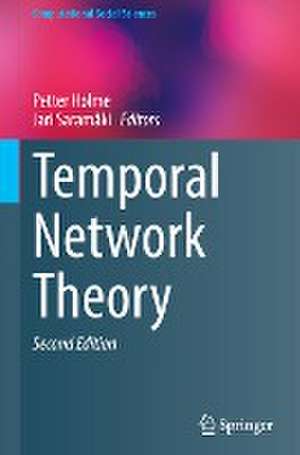
Temporal Network Theory: Computational Social Sciences
Editat de Petter Holme, Jari Saramäkien Limba Engleză Hardback – 21 noi 2023
Observăm în această a doua ediție a Temporal Network Theory o rafinare necesară a instrumentelor matematice utilizate pentru a descrie sisteme care evoluează rapid în timp. Accentul cade pe componenta analitică, de la modelarea prin lanțuri Markov și structuri comunitare, până la vizualizarea proceselor pe rețele temporale și studiul fluxurilor de informație prin arbori de tip „fastest path”. Subliniem importanța noilor capitole introduse, care explorează intersecția dintre teoria rețelelor și învățarea automată (machine learning), oferind cititorului un cadru teoretic actualizat pentru gestionarea seturilor de date de tip „big data”. Structura volumului este una progresivă: începe cu o hartă a abordărilor teoretice, trece prin definiții fundamentale ale grafurilor de tip stream sau eveniment, și culminează cu aplicații riguroase în epidemiologie și dinamica rețelelor sociale. Această ediție extinde cadrul propus de Temporal Networks de Petter Holme cu date noi din cercetările ultimului deceniu, transformând viziunea statică asupra rețelelor într-una dinamică, unde momentul interacțiunii este la fel de critic ca existența legăturii în sine. Spre deosebire de Temporal Network Epidemiology, care se concentrează strict pe răspândirea agenților patogeni, lucrarea de față menține o perspectivă interdisciplinară, fiind relevantă atât pentru optimizarea logisticii, cât și pentru înțelegerea proceselor biologice complexe. Credem că rigoarea cu care sunt tratate hărțile de conectivitate și seriile de timp face din acest volum o resursă indispensabilă pentru cercetătorii care doresc să depășească limitele analizei grafurilor statice.
Din seria Computational Social Sciences
- 15%
 Preț: 670.14 lei
 - 20%
 Preț: 787.92 lei
 - 20%
 Preț: 1059.07 lei
 -
 Preț: 490.85 lei
 - 18%
 Preț: 1158.11 lei
 - 20%
 Preț: 672.94 lei
 -
 Preț: 405.36 lei
 -
 Preț: 369.36 lei
 -
 Preț: 419.49 lei
 - 15%
 Preț: 505.72 lei
 - 20%
 Preț: 1146.45 lei
 - 20%
 Preț: 705.45 lei
 - 15%
 Preț: 672.70 lei
 - 20%
 Preț: 232.19 lei
 -
 Preț: 406.37 lei
 - 18%
 Preț: 872.04 lei
 - 20%
 Preț: 349.54 lei
 - 20%
 Preț: 788.37 lei
 - 15%
 Preț: 716.78 lei
 - 20%
 Preț: 694.59 lei
 - 15%
 Preț: 666.11 lei
 -
 Preț: 403.54 lei
 - 20%
 Preț: 1212.24 lei
 - 15%
 Preț: 665.01 lei
 -
 Preț: 447.26 lei
 - 20%
 Preț: 686.40 lei
 - nou
 Preț: 508.55 lei
Preț: 998.90 lei
Preț vechi: 1218.17 lei
-18%
Carte disponibilă
Livrare economică 13-27 noiembrie
Specificații
ISBN-10: 3031303989
Pagini: 500
Ilustrații: XI, 485 p. 140 illus., 120 illus. in color.
Dimensiuni: 160 x 241 x 31 mm
Greutate: 0.95 kg
Ediția:Second Edition 2023
Editura: Springer
Colecția Computational Social Sciences
Seria Computational Social Sciences
Locul publicării:Cham, Switzerland
De ce să citești această carte
Recomandăm această carte cercetătorilor și studenților la masterat sau doctorat care doresc să stăpânească fundamentul teoretic al rețelelor dinamice. Cititorul câștigă acces la metodologii avansate de analiză a datelor temporale, esențiale în machine learning și modelarea sistemelor complexe. Este un instrument critic pentru oricine lucrează cu fluxuri de date masive unde ordinea și durata interacțiunilor determină comportamentul global al sistemului.
Despre autor
Petter Holme și Jari Saramäki sunt recunoscuți drept pionieri ai științei rețelelor, contribuind fundamental la definirea conceptului de rețea temporală. Petter Holme, cu o activitate vastă în fizica sistemelor complexe, a publicat lucrări de referință care au mutat paradigma de la grafuri statice la reprezentări matematice ce încorporează timpul ca variabilă intrinsecă. Jari Saramäki este un expert în științe sociale computaționale, axat pe analiza structurilor comunitare și a dinamicii umane. Împreună, aceștia au coordonat unele dintre cele mai influente volume din seria Computational Social Sciences de la Springer.
Descriere scurtă
Over the past 20 years, network theory has proven to be one of the most powerful tools for studying and analyzing complex systems. Temporal network theory is perhaps the most recent significant development in the field in recent years, with direct applications to many of the “big data” sets. This book appeals to students, researchers, and professionals interested in theory and temporal networks—a field that has grown tremendously over the last decade.
This second edition of Temporal NetworkTheory extends the first with three chapters highlighting recent developments in the interface with machine learning.
Cuprins
Notă biografică
Jari Saramäki is a professor of computational science at Aalto University, Finland. His research focuses on complex systems and networks, with applications ranging from computational social science to network neuroscience and biomedicine.