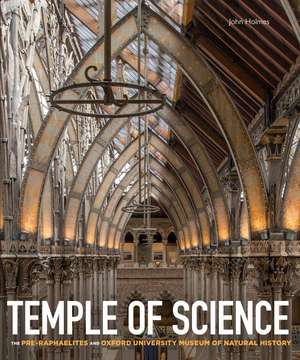
Temple of Science
Autor John Holmesen Limba Engleză Hardback – 17 noi 2020
Built between 1855 and 1860, the Oxford University Museum of Natural History is the extraordinary result of close collaboration between artists and scientists. The architect Benjamin Woodward consulted with two groups on the design and decoration of the building: a panel of Oxford scientists and dons, and the society of artists known as the Pre-Raphaelite Brotherhood. The museum's decorative art was modeled on the Pre-Raphaelites' principle of meticulous observation of nature, itself indebted to science. The structure was an experiment in using architecture and art to communicate natural history, modern science, and natural theology. Temple of Science sets out the history of the campaign to build the museum before taking the reader on a tour of the art found in the museum itself. It looks at the façade and the central court, the natural history carvings and marble columns illustrating different geological strata, and the meticulously carved sculptures of influential scientists. With unique insights and lavish illustrations, Temple of Science tells the story of one of the most remarkable collaborations between scientists and artists in European art.
Preț: 312.34 lei
Puncte Express: 469
Carte disponibilă
Livrare economică 29 octombrie-12 noiembrie
Livrare express 14-20 octombrie pentru 59.84 lei
Livrare prin curier în România Termenul estimat este afișat lângă disponibilitate.
Transport gratuit de la 400.00 lei Plată online sau ramburs, în funcție de opțiunile comenzii.
Retur gratuit în 14 zile Comandă securizată și suport în română.
Specificații
ISBN-13: 9781851245567
ISBN-10: 1851245561
Pagini: 192
Ilustrații: 100 color plates
Dimensiuni: 258 x 218 x 23 mm
Greutate: 1.03 kg
Editura: Bodleian Library
ISBN-10: 1851245561
Pagini: 192
Ilustrații: 100 color plates
Dimensiuni: 258 x 218 x 23 mm
Greutate: 1.03 kg
Editura: Bodleian Library
V-ar putea interesa
-
 BlueprintsMarcus Du SautoyPreț: 123.84 lei
 -
 -33%Preț: 782.65 lei1164.11 lei
 -
 Art + Science NowStephen Wilson-21%Preț: 155.99 lei196.91 lei
 -
 Preț: 74.66 lei
 -
 Year with Gilbert WhiteJenny UglowPreț: 194.49 lei
 -
 Architecture For CultureBeatrice GrenierPreț: 330.95 lei
 -
 Jaguar GroupIsadora Reisner-20%Preț: 171.78 lei215.08 lei
 -
 Organic Modernism: From the British Bauhaus to CyberneticsDr. Charissa N. Terranova-26%Preț: 208.89 lei280.79 lei
 -
 Versailles: Science & SplendourAnna FerrariPreț: 232.49 lei
 -
 -25%Preț: 175.98 lei233.12 lei
 -
 Nigel HallJon WoodPreț: 451.04 lei
 -
 Paul HuxleyJeremy Lewison-15%Preț: 421.27 lei495.60 lei
 -
 The Historic Heart of Oxford UniversityGeoffrey TyackPreț: 312.52 lei
 -
 Bodleian Library Souvenir GuideGeoffrey TyackPreț: 63.03 lei
 -
 Oxford Libraries ArchitectureGeoffrey TyackPreț: 455.58 lei
 -
 Pre-raphaelite SistersJan MarshPreț: 198.93 lei
 -
 -39%Preț: 93.48 lei152.69 lei
 -
 -40%Preț: 89.44 lei148.73 lei
 -
 AnimaliaAndrew Brown-19%Preț: 74.51 lei92.24 lei
 -
 -40%Preț: 91.65 lei151.59 lei
Notă biografică
John Holmes is professor of Victorian Literature and Culture at the University of Birmingham.
Recenzii
“In this beautifully illustrated volume, John Holmes, the leading authority on the Pre-Raphaelites and science, equally at home with the visual arts and the written word, uncovers, with élan, the history, artistry, and wider significance of this quite extraordinary Gesamtkunstwerk.”
"Over the course of seven chapters, Holmes succeeds not only in recovering the story behind this boldly original building, but also in advancing a persuasive argument about collaboration and fellowship between the arts and sciences in nineteenth-century Britain."