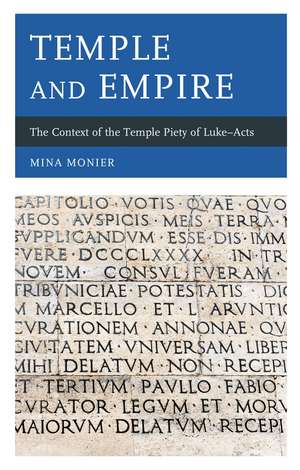
Temple and Empire: The Context of the Temple Piety of Luke—Acts
Autor Mina Monieren Limba Engleză Hardback – 13 noi 2020
Preț: 583.08 lei
Preț vechi: 863.91 lei
-33%
Puncte Express: 875
Carte tipărită la comandă
Livrare economică 07-21 decembrie
Livrare prin curier în România Termenul estimat este afișat lângă disponibilitate.
Transport gratuit pentru acest produs Plată online sau ramburs, în funcție de opțiunile comenzii.
Retur gratuit în 14 zile Comandă securizată și suport în română.
Specificații
ISBN-13: 9781978707443
ISBN-10: 1978707444
Pagini: 250
Ilustrații: 7 tables;
Dimensiuni: 154 x 232 x 20 mm
Greutate: 0.51 kg
Editura: Bloomsbury Publishing
Colecția Fortress Academic
Locul publicării:New York, United States
ISBN-10: 1978707444
Pagini: 250
Ilustrații: 7 tables;
Dimensiuni: 154 x 232 x 20 mm
Greutate: 0.51 kg
Editura: Bloomsbury Publishing
Colecția Fortress Academic
Locul publicării:New York, United States
Cuprins
1.Introduction
2.Pietas: A Historical Background
3.Pietas in First Clement
4.Pietas in Luke-Acts
Excursus 1. Surviving the Temple's Destruction in Jewish Texts Contemporary with Luke
Excursus 2. The Epistle of Barnabas's Attitude to the Temple's Destruction
2.Pietas: A Historical Background
3.Pietas in First Clement
4.Pietas in Luke-Acts
Excursus 1. Surviving the Temple's Destruction in Jewish Texts Contemporary with Luke
Excursus 2. The Epistle of Barnabas's Attitude to the Temple's Destruction
Recenzii
In this brilliant study, Mina Monier argues that the Temple piety of Luke-Acts fits well both with 1 Clement and the cultural environment of Rome in the Trajanic period, a time in which there was a strong focus on pietas, maintaining ancestral customs and keeping peace and concord. While illuminating the cultural milieu in which Luke-Acts was forged, he provides new perspectives on the complex way the Temple is portrayed.
In this ambitious work, Mina Monier seeks to show how Luke's positive engagement, both in his Gospel and Acts, with the image of the Jewish temple consciously reflects wider concerns of the Roman world of which he was a part. According to Luke, Christians, in spite of their apparent separation from Judaism, remain a people committed to the temple and exemplars therefore of the Roman principle of Pietas. Monier's work contributes in a stimulating and original way to the image of Luke-Acts as a work of apologetic and by extension to the larger subject of the inculturation of ancient Christianity.
An important contribution to scholarship on early Christian views of the Temple, Mina Monier's Temple and Empire illustrates how Luke's narrative appeals to the Temple as the quintessential symbol of ancestral Judean piety served to secure social and ideological capital on behalf of an emergent "Christianity." Monier's careful study shows that Luke's narrative re-tells the "Christian" story in close alignment with Trajanic-era Roman religious assumptions of ancestral customs and Temple-piety, serving to historically contextualize Luke's literary project, illuminate the social and political worlds within which the third evangelist lived and moved, and facilitate further scholarly discussion on the role of the Temple in early Judaism and Christianity.
In this ambitious work, Mina Monier seeks to show how Luke's positive engagement, both in his Gospel and Acts, with the image of the Jewish temple consciously reflects wider concerns of the Roman world of which he was a part. According to Luke, Christians, in spite of their apparent separation from Judaism, remain a people committed to the temple and exemplars therefore of the Roman principle of Pietas. Monier's work contributes in a stimulating and original way to the image of Luke-Acts as a work of apologetic and by extension to the larger subject of the inculturation of ancient Christianity.
An important contribution to scholarship on early Christian views of the Temple, Mina Monier's Temple and Empire illustrates how Luke's narrative appeals to the Temple as the quintessential symbol of ancestral Judean piety served to secure social and ideological capital on behalf of an emergent "Christianity." Monier's careful study shows that Luke's narrative re-tells the "Christian" story in close alignment with Trajanic-era Roman religious assumptions of ancestral customs and Temple-piety, serving to historically contextualize Luke's literary project, illuminate the social and political worlds within which the third evangelist lived and moved, and facilitate further scholarly discussion on the role of the Temple in early Judaism and Christianity.