
Telling Blackness: Young Liberians and the Raciosemiotics of Contemporary Black Diaspora: Oxford Studies in Language and Race
Autor Krystal A. Smallsen Limba Engleză Paperback – 23 apr 2025

Preț: 151.32 lei
Preț vechi: 187.70 lei
-19%
Puncte Express: 227
Carte disponibilă
Livrare economică 06-11 noiembrie
Livrare prin curier în România Termenul estimat este afișat lângă disponibilitate.
Transport gratuit de la 400.00 lei Plată online sau ramburs, în funcție de opțiunile comenzii.
Retur gratuit în 14 zile Comandă securizată și suport în română.
Specificații
ISBN-13: 9780197697580
ISBN-10: 0197697585
Pagini: 312
Dimensiuni: 157 x 239 x 20 mm
Greutate: 0.48 kg
Editura: Oxford University Press
Colecția OUP USA
Seria Oxford Studies in Language and Race
Locul publicării:New York, United States
ISBN-10: 0197697585
Pagini: 312
Dimensiuni: 157 x 239 x 20 mm
Greutate: 0.48 kg
Editura: Oxford University Press
Colecția OUP USA
Seria Oxford Studies in Language and Race
Locul publicării:New York, United States
V-ar putea interesa
-
 Black in BluesImani PerryPreț: 98.14 lei
 -
 This Is Not a Small VoiceSonia SanchezPreț: 77.90 lei
 -
 Preț: 162.49 lei
 -
 When It's Darkness on the DeltaW. Ralph EubanksPreț: 205.84 lei
 -
 Black Studies in Europe: An Anthology of Soil and SeedsNicole GrégoirePreț: 253.02 lei
 -
 Disentangled: Why Black Hair Can't Be Just HairJohanna Lukate-27%Preț: 88.47 lei120.81 lei
 -
 -27%Preț: 88.34 lei120.51 lei
 -
 Darkening BlacknessNorman AjariPreț: 141.36 lei
 -
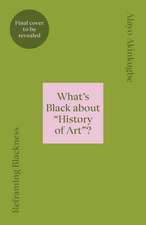 Reframing BlacknessAlayo AkinkugbePreț: 142.73 lei
 -
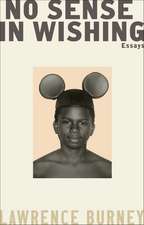 No Sense in Wishing: EssaysLawrence Burney-19%Preț: 115.34 lei142.92 leiRecomandat
 -
 Black ClimatesSelina NwuluPreț: 138.26 lei
 -
 The Black BoxHenry Louis GatesPreț: 77.82 lei
 -
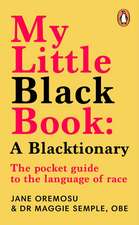 My Little Black Book: A BlacktionaryJane Oremosu-20%Preț: 50.02 lei62.84 lei
 -
 To Be Young, Gifted and BlackKadiatu Kanneh-MasonPreț: 122.39 lei
 -
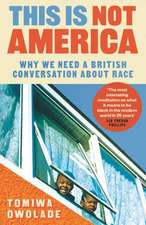 This is Not AmericaTomiwa OwoladePreț: 80.13 lei
 -
 Moving Blackness: Black Circulation, Racism, and Relations of HomespaceLisa B. Y. CalventePreț: 167.24 lei
 -
 Moving Blackness: Black Circulation, Racism, and Relations of HomespaceLisa B. Y. Calvente-15%Preț: 686.10 lei807.18 lei
 -
 Unwelcome Shores: Black Refugees in AmericaBernadette Ludwig PhDPreț: 291.72 lei
Recenzii
At once a visionary reconceptualization of racialized expressive praxis, a spellbinding ethnographic account of transnational Black life, and a profound invitation to perceive newfound possibilities for relationality, Telling Blackness is a pathbreaking intellectual, affective, and political achievement. The raciosemiotic approach that Krystal Smalls develops throughout the book is an indispensable theoretical and methodological contribution to linguistic anthropology and Black Studies, as well as a moving enactment of the transformative capacities of diasporic storytelling that she honors through her work.
Mixing sophisticated theoretical interventions (into diaspora studies, racial analysis, black feminism, and linguistics) with scrupulous ethnographic attention to the supple humanity of her young Liberian interlocutors, Smalls uses Telling Blackness to narrate a powerful and under-appreciated social scientific story about how Africana subjects live, relate, and communicate in ways that outstrip attempts to denigrate and demonize them. An insightful work full of anthropological and semiotic insights on every single page, Telling Blackness helps to recalibrate conventional assumptions about racialization in the 21st century.
Telling Blackness is a brilliant transnational account of Liberian youth as they navigate the politics of history, race, and language through migration. In vibrant and lyrical language Krystal Smalls presents us an ethnographic study of Black immigrants in the U.S. that provides a corrective to the sociological studies of racial identification to empathetically expose how racializing structural processes shape immigrant "Black life in an antiBlack world." The analysis in Telling Blackness takes seriously the global status of Blackness as it draws meaning across space and time, oceans and land, and processes and discourses. This is a transformative text that makes key contributions to anthropology and African diaspora studies.
Telling Blackness is reminiscent of a blues song that refuses to tell, to disclose, to breathe forth a singular metanarrative about Blackness trapped in the procrustean white gaze of anti-Blackness. Its epistemological approach reveals a shared emic between multiple voices and voicings that exceed any given symbolization, instantiated semiotic performance, or modes of being-Black-in-the-world. Smalls brilliantly attends to Black peoples' mundane ways of creating home, nurturing joy, building community, bearing witness, testifying across space and time. Signifying through words and the re-telling of Black embodied actions, she demonstrates the refusal of Black people to die, to be silenced or erased.
Mixing sophisticated theoretical interventions (into diaspora studies, racial analysis, black feminism, and linguistics) with scrupulous ethnographic attention to the supple humanity of her young Liberian interlocutors, Smalls uses Telling Blackness to narrate a powerful and under-appreciated social scientific story about how Africana subjects live, relate, and communicate in ways that outstrip attempts to denigrate and demonize them. An insightful work full of anthropological and semiotic insights on every single page, Telling Blackness helps to recalibrate conventional assumptions about racialization in the 21st century.
Telling Blackness is a brilliant transnational account of Liberian youth as they navigate the politics of history, race, and language through migration. In vibrant and lyrical language Krystal Smalls presents us an ethnographic study of Black immigrants in the U.S. that provides a corrective to the sociological studies of racial identification to empathetically expose how racializing structural processes shape immigrant "Black life in an antiBlack world." The analysis in Telling Blackness takes seriously the global status of Blackness as it draws meaning across space and time, oceans and land, and processes and discourses. This is a transformative text that makes key contributions to anthropology and African diaspora studies.
Telling Blackness is reminiscent of a blues song that refuses to tell, to disclose, to breathe forth a singular metanarrative about Blackness trapped in the procrustean white gaze of anti-Blackness. Its epistemological approach reveals a shared emic between multiple voices and voicings that exceed any given symbolization, instantiated semiotic performance, or modes of being-Black-in-the-world. Smalls brilliantly attends to Black peoples' mundane ways of creating home, nurturing joy, building community, bearing witness, testifying across space and time. Signifying through words and the re-telling of Black embodied actions, she demonstrates the refusal of Black people to die, to be silenced or erased.
Notă biografică
Krystal A. Smalls is Assistant Professor at the University of Illinois Urbana-Champaign.