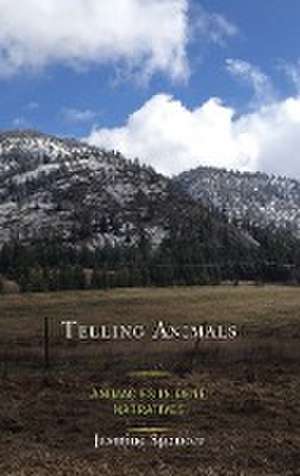
Telling Animals: Animacies in Dene Narratives
Autor Jasmine Spenceren Limba Engleză Hardback – 27 iun 2022
Preț: 517.53 lei
Preț vechi: 768.68 lei
-33%
Puncte Express: 776
Carte tipărită la comandă
Livrare economică 26 octombrie-09 noiembrie
Livrare prin curier în România Termenul estimat este afișat lângă disponibilitate.
Transport gratuit pentru acest produs Plată online sau ramburs, în funcție de opțiunile comenzii.
Retur gratuit în 14 zile Comandă securizată și suport în română.
Specificații
ISBN-13: 9781793619730
ISBN-10: 1793619735
Pagini: 202
Ilustrații: 6 b/w illustrations;4 tables;
Dimensiuni: 159 x 229 x 21 mm
Greutate: 0.47 kg
Editura: Bloomsbury Publishing
Colecția Lexington Books
Locul publicării:New York, United States
ISBN-10: 1793619735
Pagini: 202
Ilustrații: 6 b/w illustrations;4 tables;
Dimensiuni: 159 x 229 x 21 mm
Greutate: 0.47 kg
Editura: Bloomsbury Publishing
Colecția Lexington Books
Locul publicării:New York, United States
Cuprins
Introduction: Histories
Chapter One: "When you hear me sing": Tanager and Robin on How to Live as Birds of Homophony in Dene Bird Stories and Songs
Chapter Two: "I will be popular with the Campfire People, so ha, ha, ha": Porcupine and Lynx on How to Love in K'tl'egh'i Sukdu/A Dena'ina Legacy
Chapter Three: "What will you do now?": Wolverine and Wolf on How to Die in "The Man Who Sought a Song," told by Elisse Ahnassay
Chapter Four: "If it floats, we will all live forever": Coyote and Badger on How to Live Again in Diné Bahane': The Navajo Creation Story
Conclusion: Histologies
Chapter One: "When you hear me sing": Tanager and Robin on How to Live as Birds of Homophony in Dene Bird Stories and Songs
Chapter Two: "I will be popular with the Campfire People, so ha, ha, ha": Porcupine and Lynx on How to Love in K'tl'egh'i Sukdu/A Dena'ina Legacy
Chapter Three: "What will you do now?": Wolverine and Wolf on How to Die in "The Man Who Sought a Song," told by Elisse Ahnassay
Chapter Four: "If it floats, we will all live forever": Coyote and Badger on How to Live Again in Diné Bahane': The Navajo Creation Story
Conclusion: Histologies
Recenzii
Telling Animals is a sophisticated, accessible, and engaging study of textualized Dene orature, showing how Indigenous animal stories demonstrate much-needed respect for the entire more-than-human world. Written from a linguistic and ethnographic perspective, this book has much to offer scholars of critical animal studies and ecocriticism, helping us to understand the language of and about animals.
"Jasmine Spencer's study of Dene narratives is transcendent in many ways, reaching across linguistic and disciplinary boundaries as she invites readers to engage with narrative in order to imagine a new kind of life (as she puts it). This imagining is manifest throughout the book as she develops her central thesis that animal characters are a form of embodied deixis with the power to create meaning at multiple levels of grammar and discourse. Her work is an important contribution to the study of Dene languages, with implications for contemporary efforts to revitalize particular languages as well as for academic disciplines as diverse as Anthropology, Linguistics, and Native American and Indigenous Studies."
Telling Animals: Animacies in Dene Narratives stands out as a critical scholarly contribution to the study of Indigenous oral literature from a comparative perspective. The book also offers a compelling exploration of Indigenous philosophies in relation to the ecology. Jasmine Spencer's scholarship is superb, emerging from a deep and comparative sense of the language and literature of the Athabascan peoples in their spread from Alaska to the Southwest, while also including the Pacific coast of the United States and Canada. Telling Animals is poignant and should resonate with language revitalization efforts around the world, going beyond Athabaskan country.
Drawing upon key foundational texts in animism studies and indigenous cosmology, Spencer's rich text compares subtle linguistic constructions of personhood and human-animal relations across several historical Athabaskan language literatures, demonstrating a cohesiveness of Dene ontology and worldview in far-flung kindred groups. Historically, the field of Athabaskan comparative studies has perhaps been too focused either on historical reconstruction for its own sake at the expense of a more holistic understanding, or alternatively, interpreting Athabaskan religion and culture through the distorting lens of Western behavioral sciences. Spencer has made the commendable decision to focus instead on the efficacious centering of animism and ecological materialities in language revitalization efforts, filling a void in comparative Athabaskan studies, and appropriately centering Dene concerns and values. Spencer's volume is thus a very timely contribution to Athabaskan studies and animism studies.
"Jasmine Spencer's study of Dene narratives is transcendent in many ways, reaching across linguistic and disciplinary boundaries as she invites readers to engage with narrative in order to imagine a new kind of life (as she puts it). This imagining is manifest throughout the book as she develops her central thesis that animal characters are a form of embodied deixis with the power to create meaning at multiple levels of grammar and discourse. Her work is an important contribution to the study of Dene languages, with implications for contemporary efforts to revitalize particular languages as well as for academic disciplines as diverse as Anthropology, Linguistics, and Native American and Indigenous Studies."
Telling Animals: Animacies in Dene Narratives stands out as a critical scholarly contribution to the study of Indigenous oral literature from a comparative perspective. The book also offers a compelling exploration of Indigenous philosophies in relation to the ecology. Jasmine Spencer's scholarship is superb, emerging from a deep and comparative sense of the language and literature of the Athabascan peoples in their spread from Alaska to the Southwest, while also including the Pacific coast of the United States and Canada. Telling Animals is poignant and should resonate with language revitalization efforts around the world, going beyond Athabaskan country.
Drawing upon key foundational texts in animism studies and indigenous cosmology, Spencer's rich text compares subtle linguistic constructions of personhood and human-animal relations across several historical Athabaskan language literatures, demonstrating a cohesiveness of Dene ontology and worldview in far-flung kindred groups. Historically, the field of Athabaskan comparative studies has perhaps been too focused either on historical reconstruction for its own sake at the expense of a more holistic understanding, or alternatively, interpreting Athabaskan religion and culture through the distorting lens of Western behavioral sciences. Spencer has made the commendable decision to focus instead on the efficacious centering of animism and ecological materialities in language revitalization efforts, filling a void in comparative Athabaskan studies, and appropriately centering Dene concerns and values. Spencer's volume is thus a very timely contribution to Athabaskan studies and animism studies.