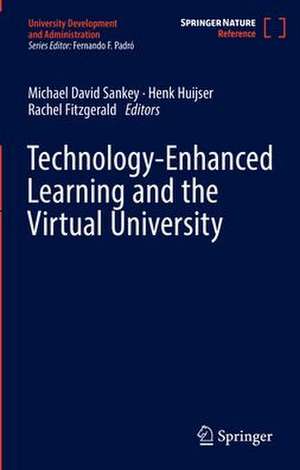
Technology-Enhanced Learning and the Virtual University: University Development and Administration
Editat de Michael David Sankey, Henk Huijser, Rachel Fitzgeralden Limba Engleză Hardback – 21 sep 2023
Subliniem apariția primei ediții (2023) a volumului Technology-Enhanced Learning and the Virtual University, o lucrare de referință care sintetizează transformările profunde ale învățământului superior în contextul digitalizării. Ne-a atras atenția modul în care editorii, Michael David Sankey, Henk Huijser și Rachel Fitzgerald, reușesc să transforme conceptul de „universitate virtuală” dintr-o proiecție teoretică într-o realitate administrativă și pedagogică palpabilă. Volumul debutează cu stabilirea unei viziuni strategice, punând accent pe alinierea planurilor directoare cu politicile și procedurile de asigurare a calității.
Notăm cu interes structura riguroasă a celor 654 de pagini, care ghidează cititorul de la fundamentele guvernării tehnologice până la aplicarea teoriilor de învățare moderne, precum conectivismul. Cartea explorează rolul esențial al analizelor de date (analytics) în sprijinirea personalului și a studenților, oferind totodată modele de dezvoltare profesională adaptate noilor paradigme. Considerăm acest titlu o alternativă necesară la The Virtual University? de Kevin Robins pentru cursurile de administrare a educației superioare, având avantajul unei perspective actualizate asupra tehnologiilor emergente și a integrării lor sistemice, depășind simpla analiză a managerialismului.
Față de abordările clasice, această lucrare din seria University Development and Administration integrează dimensiunea echității sociale în dezvoltarea universității virtuale. În comparație cu Shaping the University of the Future de Stephen James Marshall, care se concentrează pe forțele strategice globale, volumul de față oferă un instrumentar mult mai aplicat pentru implementarea schimbării la nivel de infrastructură și curriculum, fiind esențial pentru înțelegerea modului în care elementele sistemului universitar interacționează în era globalizării.
Preț: 1618.77 lei
Preț vechi: 1974.11 lei
-18%
Carte disponibilă
Livrare economică 16-30 mai
Specificații
ISBN-10: 9819941687
Pagini: 654
Ilustrații: XLI, 654 p. 20 illus., 10 illus. in color.
Dimensiuni: 155 x 235 mm
Greutate: 1.34 kg
Ediția:1st ed. 2023
Editura: Springer Nature Singapore
Colecția Springer
Seria University Development and Administration
Locul publicării:Singapore, Singapore
De ce să citești această carte
Această lucrare este indispensabilă administratorilor universitari, cercetătorilor în educație și factorilor de decizie care doresc să implementeze soluții de învățare asistată de tehnologie. Cititorul câștigă o înțelegere sistemică a modului în care infrastructura, calitatea academică și teoriile pedagogice se unesc pentru a crea o universitate virtuală sustenabilă. Este un ghid complet care transformă provocările globalizării în oportunități de inovare curriculară.
Despre autor
Michael David Sankey, Henk Huijser și Rachel Fitzgerald sunt experți recunoscuți în domeniul tehnologiilor educaționale și al administrării învățământului superior. Aceștia au coordonat acest volum sub egida Springer, reunind perspective multidisciplinare despre transformarea universităților. Contribuția lor se concentrează pe intersecția dintre pedagogie, tehnologie și managementul schimbării, oferind soluții practice pentru instituțiile care navighează tranziția către modele de livrare digitală și hibridă, în contextul creșterii competiției globale pentru credențiale academice.
Descriere scurtă
Cuprins
Notă biografică
Associate Professor Henk Huijser holds a PhD in Screen and Media Studies, and has been an Academic Developer involved in Learning and Teaching in Higher Education since 2005 at the University of Southern Queensland, Bahrain Polytechnic, Bachelor Institute of Indigenous Tertiary Education, and Xi’an Jiaotong-Liverpool University (XJTLU) in Suzhou, China. Henk has been a Curriculum and Learning Designer in the Learning and Teaching Unit at Queensland University of Technology since 2017. Henk has published extensively in the field of learning and teaching in higher education, including (with Megan Kek) Problem-based Learning into the Future: Imagining an Agile PBL Ecology for Learning (2017, Springer) and as the Lead Editor of Student Support Services: Exploring Impact on Student Engagement, Experience and Learning (2022, Springer). He is an Associate Editor of the International Journal for Academic Development, the Australasian Journal of Educational Technology, and a Co-Editor of the Journal of Peer Learning. More information at: https://orcid.org/0000-0001-9699-4940
Rachel Fitzgerald (PhD, SFHEA) is Deputy Associate Dean (Academic) for the Faculty of Business, Economics and Law at the University of Queensland. Rachel has extensive experience driving future-orientated higher education. With comprehensive expertise in online and blended learning, Rachel has achieved global recognition for her contributions to the innovation of education through digital learning and curriculum design. She has published widely on digital learning innovation and online education and is deeply immersed in research that harnesses technology for enhancing learning. More information can be found at: https://orcid.org/0000-0003-2905-6895