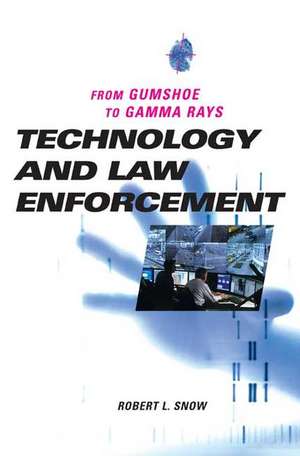
Technology and Law Enforcement: From Gumshoe to Gamma Rays
Autor Robert L. Snowen Limba Engleză Hardback – 30 iul 2007
This book takes readers through every major branch of law enforcement and shows how technology has radically changed police department operations during the last two decades. It also shows how these changes continue today as technology advances and refines techniques already in practice. Beginning with the Night Stalker case, the author illustrates how the use and reliance on new technologies in solving crimes has made policing and detective work more accurate and efficient in capturing and convicting criminals (and courts more recently in releasing innocents convicted of crimes). Capitalizing on the interest in all things forensic, this book illuminates the behind the scenes technologies that go into solving crimes and keeping dangerous criminals off the street. Snow covers DNA and fingerprint technologies, vehicle technologies, undercover work, bomb detection, and other methods. Using many real life examples and first hand anecdotes, he shows how technology has become part and parcel of criminal justice efforts to solve crimes.
Preț: 295.58 lei
Preț vechi: 378.05 lei
-22%
Puncte Express: 443
Carte tipărită la comandă
Livrare economică 08-22 iunie
Specificații
ISBN-13: 9780275993344
ISBN-10: 0275993345
Pagini: 208
Dimensiuni: 156 x 235 x 23 mm
Greutate: 0.48 kg
Editura: Bloomsbury Publishing
Colecția Praeger
Locul publicării:New York, United States
ISBN-10: 0275993345
Pagini: 208
Dimensiuni: 156 x 235 x 23 mm
Greutate: 0.48 kg
Editura: Bloomsbury Publishing
Colecția Praeger
Locul publicării:New York, United States
V-ar putea interesa
-
 -21%Preț: 357.13 lei454.77 lei
 -
 Blackstone's PCSO HandbookBryn Caless-13%Preț: 216.72 lei248.13 lei
 -
 -27%Preț: 65.47 lei89.63 lei
 -
 Global Environment of PolicingDarren Palmer-18%Preț: 889.80 lei1085.11 lei
 -
 Policing Public DisorderDavid WaddingtonPreț: 409.04 lei
 -
 Handbook of PolicingTim Newburn-8%Preț: 573.73 lei623.62 lei
 -
 Police Work: Principles and PracticeColin Rogers-15%Preț: 441.05 lei518.88 lei
 -
 Policing and Criminal JusticeChristopher BlakePreț: 326.87 lei
 -
 Study Skills for Policing StudentsRichard MalthousePreț: 383.04 lei
 -
 Interview Exercises for the Police Recruit Assessment ProcessRichard MalthousePreț: 278.77 lei
 -
 Preț: 282.07 lei
 -
 Morris, H: Up Tae My Neck in PaperworkHarry Morris-19%Preț: 44.87 lei55.57 lei
 -
 Preț: 211.36 lei
 -
 The FileTimothy Garton Ash-21%Preț: 70.57 lei88.77 lei
 -
 Global PolicingBen BowlingPreț: 378.14 lei
Recenzii
Advances in technology have provided assistance to society in numerous ways. The same is true in the field of law enforcement. Snow provides an overview of police-related technological advances in a concise yet descriptive and interesting manner that includes real-life examples and firsthand anecdotes..the author addresses modern-day police technology beginning with academy training and progressing through police vehicles, dispatch, uniformed officers, and detectives. He also discusses modern-day SWAT and bomb squads, lie detection, fingerprinting, DNA, and the wide-scale use of computers. Snow concludes by praising the importance of technology in policing while also suggesting that great care must be taken to avoid abuse and infringements to constitutional rights. In summary, while the passing of time may diminish this work's value, given the constant advances in technology, at present it is a good addition to libraries needing an overview of current technology in law enforcement. Recommended. General readers, lower- and upper-division undergraduates, two-year technical programs, and professionals/practitioners.
Snow, Commander of the homicide branch in the Indianapolis Police Department, takes an accessible tour through the new tools of law enforcement, starting with new officer training methodologies and improvements to vehicles used in police work, from SWAT trucks to lab vans. He describes improved communication and dispatch, increased expectations for technical expertise from personnel, better lie detection and evidence processing, DNA analysis and computerized forensics, not only to analyze physical evidence but to evaluate financial records, create perpetrator profiles, and create prevention and intervention strategies.
Snow, Commander of the homicide branch in the Indianapolis Police Department, takes an accessible tour through the new tools of law enforcement, starting with new officer training methodologies and improvements to vehicles used in police work, from SWAT trucks to lab vans. He describes improved communication and dispatch, increased expectations for technical expertise from personnel, better lie detection and evidence processing, DNA analysis and computerized forensics, not only to analyze physical evidence but to evaluate financial records, create perpetrator profiles, and create prevention and intervention strategies.