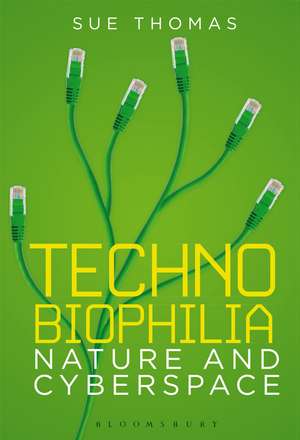
Technobiophilia: Nature and Cyberspace
Autor Sue Thomasen Limba Engleză Hardback – 26 sep 2013
Technobiophilia: Nature and Cyberspace offers new insights on what is commonly known as 'work-life balance'. It explores ways to make our peace with technology-induced anxiety and achieve a 'tech-nature balance' through practical experiments designed to enhance our digital lives indoors, outdoors, and online.
The book draws on a long history of literature on nature and technology and breaks new ground as the first to link the two. Its accessible style will attract the general reader, whilst the clear definition of key terms and concepts throughout should appeal to undergraduates and postgraduates of new media and communication studies, internet studies, environmental psychology, and human-computer interaction. www.technobiophilia.com
Preț: 490.28 lei
Preț vechi: 711.54 lei
-31%
Puncte Express: 735
Carte tipărită la comandă
Livrare economică 02-16 decembrie
Livrare prin curier în România Termenul estimat este afișat lângă disponibilitate.
Transport gratuit pentru acest produs Plată online sau ramburs, în funcție de opțiunile comenzii.
Retur gratuit în 14 zile Comandă securizată și suport în română.
Specificații
ISBN-13: 9781849660419
ISBN-10: 1849660417
Pagini: 272
Dimensiuni: 156 x 234 x 25 mm
Greutate: 0.56 kg
Ediția:New.
Editura: Bloomsbury Publishing
Colecția Bloomsbury Academic
Locul publicării:London, United Kingdom
ISBN-10: 1849660417
Pagini: 272
Dimensiuni: 156 x 234 x 25 mm
Greutate: 0.56 kg
Ediția:New.
Editura: Bloomsbury Publishing
Colecția Bloomsbury Academic
Locul publicării:London, United Kingdom
V-ar putea interesa
-
 Just Add NatureRebecca FrankPreț: 72.07 lei
 -
 Heavily MeditatedDave AspreyPreț: 123.34 lei
 -
 Your Stone Age Brain in the Screen AgeRichard E. CytowicPreț: 211.48 lei
 -
 Shared WisdomAlex PentlandPreț: 153.35 lei
 -
 The Nature FixFlorence WilliamsPreț: 94.29 lei
 -
 Offline HumansNatalie AlzatePreț: 127.00 lei
 -
 Against the MachinePaul KingsnorthPreț: 193.57 lei
 -
 Preț: 122.17 lei
 -
 Preț: 135.12 lei
 -
 Digital ExhaustionPaul LeonardiPreț: 123.50 lei
 -
 The Biophilia HypothesisStephen R. KellertPreț: 374.25 lei
 -
 -19%Preț: 87.10 lei107.49 lei
 -
 ResetElain KasketPreț: 78.49 lei
 -
 Nature and the MindMarc BermanPreț: 122.36 lei
 -
 -17%Preț: 234.05 lei283.39 lei
 -
 Circle of the Snake, TheGrafton TannerPreț: 99.19 lei
 -
 Nature Embedded Mind, TheJulie BramsPreț: 84.66 lei
 -
 Human NatureKate MarvelPreț: 136.91 lei
 -
 The Wild WithinBrigit Anna McNeillPreț: 108.67 lei
 -
 How Metaphors shape BiotechnologyStefan Dübel-8%Preț: 488.70 lei531.19 lei
Cuprins
List of Illustrations
Acknowledgments
Preface
Chapter 1. A place so new that some things still lack names
Chapter 2. How nature soothes our connected minds
Chapter 3. Cybernetic meadows: The California connection
Chapter 4. An enormous, unbounded world
Chapter 5. Organisms
Chapter 6. Living deliberately
Notes
Bibliography
Index
Acknowledgments
Preface
Chapter 1. A place so new that some things still lack names
Chapter 2. How nature soothes our connected minds
Chapter 3. Cybernetic meadows: The California connection
Chapter 4. An enormous, unbounded world
Chapter 5. Organisms
Chapter 6. Living deliberately
Notes
Bibliography
Index
Recenzii
Sue Thomas has taken a very personal and broadly interdisciplinary look at one of the most important issues of our time -- the tension between the natural and digital worlds. This book provides a useful lens for seeing where we are, who we are, and where humans, our digital creations, and the natural world are heading. We need to learn to make fulfilling lives without abandoning either the world of technology or the world of biology. Technobiophlia shows the way.
At a time when our technological environment has become so intricate, omnipresent and autonomous that we have started to perceive it as a nature of its own, such sensibilities are desperately needed.
The book is about a powerful subliminal urge by our entire species to hang onto our connection to the natural world, as we are pulled deeper into the digital age...It is good to find someone like Thomas who loves nature but is not an anti-technologist. Her book is the beginning of a line of thinking that needs to be expanded by those who are deeply concerned about the effects of our addiction to technology. The book reinforces the idea that if human problems are exacerbated by technology, as they certainly are, doesn't it make sense to use technology to ameliorate human problems...Thomas book is filled with well-documented, transdisciplinary, theoretical arguments for the many researchers who should begin working in this field;, but it is a good read for general audiences...I kept reading because I want to see where the personal story leads. What happens to her suggest some things that we ought to make happen for ourselves far more often than we do.
At a time when our technological environment has become so intricate, omnipresent and autonomous that we have started to perceive it as a nature of its own, such sensibilities are desperately needed.
The book is about a powerful subliminal urge by our entire species to hang onto our connection to the natural world, as we are pulled deeper into the digital age...It is good to find someone like Thomas who loves nature but is not an anti-technologist. Her book is the beginning of a line of thinking that needs to be expanded by those who are deeply concerned about the effects of our addiction to technology. The book reinforces the idea that if human problems are exacerbated by technology, as they certainly are, doesn't it make sense to use technology to ameliorate human problems...Thomas book is filled with well-documented, transdisciplinary, theoretical arguments for the many researchers who should begin working in this field;, but it is a good read for general audiences...I kept reading because I want to see where the personal story leads. What happens to her suggest some things that we ought to make happen for ourselves far more often than we do.