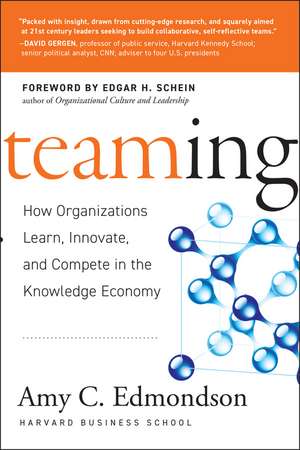
Teaming - How Organizations Learn, Innovate and Compete in the Knowledge Economy
Autor Amy C. Edmondsonen Limba Engleză Hardback – 3 apr 2012
Ceea ce diferențiază Teaming de restul literaturii de management este mutarea accentului de la „echipă” ca entitate statică la „teaming” ca activitate dinamică. Notăm cu interes că Amy C. Edmondson nu tratează colaborarea ca pe o stare de fapt, ci ca pe un proces continuu de învățare sub presiune. În timp ce The Essentials of Teamworking v-a oferit bazele teoretice despre structura grupurilor, Teaming oferă instrumentele practice pentru a naviga într-un mediu unde componența echipelor se schimbă rapid, iar obiectivele sunt în permanentă evoluție. Descoperim aici o analiză riguroasă a motivelor pentru care grupurile eșuează să învețe natural: frica de a greși, ierarhiile rigide și acumularea selectivă de informații. Această lucrare reprezintă pilonul central al cercetărilor autoarei, precedând și fundamentând temele din Die angstfreie Organisation, unde conceptul de securitate psihologică este explorat în profunzime. Structura cărții este una progresivă: prima parte definește „teaming-ul” ca un imperativ de învățare și execuție, în timp ce partea a doua se concentrează pe organizarea propriu-zisă pentru învățare, abordând puterea „framing-ului” și crearea unui spațiu sigur pentru schimbul de idei. Analiza este susținută de studii de caz din sectoare critice, de la eficiența Toyota la inovația IDEO, demonstrând că succesul organizațional depinde de capacitatea grupurilor mici de a procesa eșecul și de a-l transforma în avantaj competitiv. Cartea nu se limitează la teorie, ci oferă pași concreți pentru liderii care doresc să elimine barierele cognitive și sociale ce blochează performanța colectivă.
Preț: 185.59 lei
Carte disponibilă
Livrare economică 02-16 noiembrie
Livrare express 16-22 octombrie pentru 38.65 lei
Specificații
ISBN-10: 078797093X
Pagini: 352
Ilustrații: Illustrations
Dimensiuni: 164 x 240 x 30 mm
Greutate: 0.57 kg
Ediția:New.
Editura: John Wiley & Sons, Inc.
Locul publicării:Hoboken, United States
V-ar putea interesa
-
 Crush It!Gary VaynerchukPreț: 109.98 lei
 -
 Team of TeamsStanley McChrystalPreț: 84.83 lei
 -
 -40%Preț: 46.49 lei77.11 lei
 -
 Team: Getting Things Done with OthersDavid Allen-26%Preț: 101.79 lei137.24 lei
 -
 -19%Preț: 63.20 lei78.26 lei
 -
 Overcoming The Five Dysfunctions of a TeamPatrick LencioniPreț: 130.59 lei
 -
 Preț: 106.46 lei
 -
 Teaming to InnovateAmy C. EdmondsonPreț: 128.84 lei
 -
 Leading Teams - 10 Challenges : 10 SolutionsMandy FlintPreț: 130.71 lei
 -
 90 Days to Level Up Your TeamworkAmy C EdmondsonPreț: 123.99 lei
 -
 Preț: 136.63 lei
 -
 The Collective EdgeColin M. Fisher-22%Preț: 95.04 lei122.53 leiRecomandat
 -
 Preț: 134.02 lei
 -
 The Skillful Team LeaderElisa MacDonaldPreț: 220.34 lei
 -
 ModelsMark MansonPreț: 89.73 lei
 -
 Psychological Safety (HBR Emotional Intelligence Series)Harvard Business ReviewPreț: 90.62 lei
 -
 Right Kind of WrongAmy Edmondson-25%Preț: 64.88 lei86.46 lei
De ce să citești această carte
Recomandăm această carte liderilor care gestionează proiecte complexe unde colaborarea interdisciplinară este vitală. Cititorul va învăța cum să transforme o cultură a fricii de eșec într-una de învățare accelerată prin „execution-as-learning”. Este un ghid esențial pentru a înțelege de ce echipele inteligente pot lua decizii proaste și cum poate fi construită securitatea psihologică necesară inovației reale în organizațiile moderne.
Despre autor
Amy C. Edmondson este profesor de leadership și management la catedra Novartis din cadrul Harvard Business School. Activitatea sa academică se concentrează pe învățarea organizațională și managementul operațiunilor, fiind recunoscută la nivel mondial pentru pionieratul în domeniul securității psihologice la locul de muncă. Prin cursurile predate în programele MBA și Executive Education, Edmondson a influențat modul în care liderii globali abordează dinamica grupurilor și managementul schimbării, transformând cercetarea academică în strategii aplicabile pentru companii de top.
Notă biografică
Amy C. Edmondson is the Novartis Professorof Leadership and Management at the Harvard Business School, where she teaches coursesin leadership, organizational learning, andoperations management in the MBA andExecutive Education programs.
Cuprins
Foreword by Edgar H. Schein xiIntroduction 1Part One Teaming1 A New Way of Working 11Teaming Is a Verb 12Organizing to Execute 15The Learning Imperative 19Learning to Team, Teaming to Learn 24Organizing to Learn 26Execution-as-Learning 30The Process Knowledge Spectrum 32A New Way of Leading 38Leadership Summary 42Lessons and Actions 422 Teaming to Learn, Innovate, and Compete 45The Teaming Process 50Four Pillars of Effective Teaming 51The Benefi ts of Teaming 56Social and Cognitive Barriers to Teaming 60When Conflict Heats Up 67Leadership Actions That Promote Teaming 75Leadership Summary 78Lessons and Actions 79Part Two Organizing To Learn3 The Power of Framing 83Cognitive Frames 84Framing a Change Project 89The Leader's Role 93Team Members' Roles 96The Project Purpose 99A Learning Frame Versus an Execution Frame 102Changing Frames 104Leadership Summary 111Lessons and Actions 1124 Making It Safe to Team 115Trust and Respect 118Psychological Safety for Teaming and Learning 125The Effect of Hierarchy on Psychological Safety 131Cultivating Psychological Safety 135Leadership Summary 145Lessons and Actions 1465 Failing Better to Succeed Faster 149The Inevitability of Failure 150The Importance of Small Failures 151Why It's Diffi cult to Learn from Failure 154Failure Across the Process Knowledge Spectrum 160Matching Failure Cause and Context 164Developing a Learning Approach to Failure 168Strategies for Learning from Failures 170Leadership Summary 182Lessons and Actions 1836 Teaming Across Boundaries 185Teaming Despite Boundaries 191Visible and Invisible Boundaries 193Three Types of Boundaries 197Teaming Across Common Boundaries 201Leading Communication Across Boundaries 212Leadership Summary 215Lessons and Actions 216Part Three Execution-as-learning7 Putting Teaming and Learning to Work 221Execution-as-Learning 222Using the Process Knowledge Spectrum 229Facing a Shifting Context at Telco 234Learning That Never Ends 240Keeping Learning Alive 252Leadership Summary 254Lessons and Actions 2568 Leadership Makes It Happen 257Leading Teaming in Routine Production at Simmons 258Leading Teaming in Complex Operations at Children'sHospital 265Leading Teaming for Innovation at IDEO 276Leadership Summary 283Moving Forward 285Notes 289Acknowledgments 309About the Author 313Index 315
Descriere
New breakthrough thinking in organizational learning, leadership, and changeContinuous improvement, understanding complex systems, and promoting innovation are all part of the landscape of learning challenges today's companies face. Amy Edmondson shows that organizations thrive, or fail to thrive, based on how well the small groups within those organizations work. In most organizations, the work that produces value for customers is carried out by teams, and increasingly, by flexible team-like entities. The pace of change and the fluidity of most work structures means that it's not really about creating effective teams anymore, but instead about leading effective teaming.Teaming shows that organizations learn when the flexible, fluid collaborations they encompass are able to learn. The problem is teams, and other dynamic groups, don't learn naturally. Edmondson outlines the factors that prevent them from doing so, such as interpersonal fear, irrational beliefs about failure, groupthink, problematic power dynamics, and information hoarding. With Teaming, leaders can shape these factors by encouraging reflection, creating psychological safety, and overcoming defensive interpersonal dynamics that inhibit the sharing of ideas. Further, they can use practical management strategies to help organizations realize the benefits inherent in both success and failure.* Presents a clear explanation of practical management concepts for increasing learning capability for business results* Introduces a framework that clarifies how learning processes must be altered for different kinds of work* Explains how Collaborative Learning works, and gives tips for how to do it well* Includes case-study research on Intermountain healthcare, Prudential, GM, Toyota, IDEO, the IRS, and both Cincinnati and Minneapolis Children's Hospitals, among othersBased on years of research, this book shows how leaders can make organizational learning happen by building teams that learn.