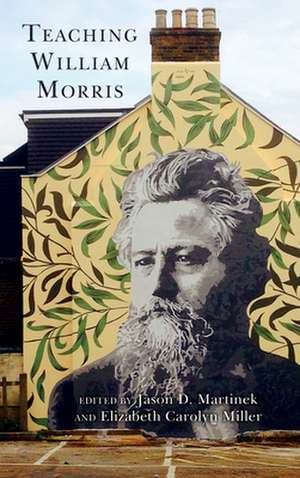
Teaching William Morris
Editat de Jason D. Martinek, Elizabeth Carolyn Milleren Limba Engleză Hardback – 16 oct 2019
Preț: 585.07 lei
Preț vechi: 865.09 lei
-32%
Puncte Express: 878
Carte tipărită la comandă
Livrare economică 08-22 decembrie
Livrare prin curier în România Termenul estimat este afișat lângă disponibilitate.
Transport gratuit pentru acest produs Plată online sau ramburs, în funcție de opțiunile comenzii.
Retur gratuit în 14 zile Comandă securizată și suport în română.
Specificații
ISBN-13: 9781683930730
ISBN-10: 1683930738
Pagini: 320
Ilustrații: 15 b/w illustrations;
Dimensiuni: 157 x 235 x 22 mm
Greutate: 0.62 kg
Editura: Fairleigh Dickinson University Press
Locul publicării:New York, United States
ISBN-10: 1683930738
Pagini: 320
Ilustrații: 15 b/w illustrations;
Dimensiuni: 157 x 235 x 22 mm
Greutate: 0.62 kg
Editura: Fairleigh Dickinson University Press
Locul publicării:New York, United States
Descriere
A prolific artist, writer, designer, and political activist, William Morris remains remarkably powerful and relevant today. But how do you teach someone like Morris who made significant contributions to several different fields of study? And how, within the exigencies of the modern educational system, can teachers capture the interdisciplinary spirit of Morris, whose various contributions hang so curiously together? Teaching William Morris gathers together the work of nineteen Morris scholars from a variety of fields, offering a wide array of perspectives on the challenges and the rewards of teaching William Morris. Across this book's five sections-"Pasts and Presents," "Political Contexts," "Literature," "Art and Design," and "Digital Humanities"-readers will learn the history of Morris's place in the modern curriculum, the current state of the field for teaching Morris's work today, and how this pedagogical effort is reaching well beyond the college classroom.
Cuprins
Acknowledgments
Introduction: "The Earthly Paradox": Teaching William Morris
Jason D. Martinek and Elizabeth Carolyn Miller
Part I: Pasts and Presents
1. "Teaching Morris in Chicago, c. 1900"
Elizabeth Helsinger
2. "Naturalizing the Dignity of Labor: The Hull-House Labor Museum and William Morris's Influence on the American Settlement House Movement"
Elizabeth Grennan Browning
3. "Time Travelling with William Morris"
John Plotz
4. "'Work and Fun' and 'Education at its Finest:' Teaching Morris at Kelmscott House,"
Helen Elleston
5. "The Medievalism of William Morris: Teaching Through Tolkien"
KellyAnn Fitzpatrick
Part II: Political Contexts
6. "A Dream of William Cobbett? Teaching Morris's John Ball in an Interdisciplinary Course on Victorian Radicalism"
Linda Hughes and William M. Meier
7. "'Vive La Commune!' The Imaginary of the Paris Commune and the Arts and Crafts Movement"
Morna O'Neill
8. "'Living in Heaven': Hope and Change in News from Nowhere"
David Latham
Part III: Literat
Introduction: "The Earthly Paradox": Teaching William Morris
Jason D. Martinek and Elizabeth Carolyn Miller
Part I: Pasts and Presents
1. "Teaching Morris in Chicago, c. 1900"
Elizabeth Helsinger
2. "Naturalizing the Dignity of Labor: The Hull-House Labor Museum and William Morris's Influence on the American Settlement House Movement"
Elizabeth Grennan Browning
3. "Time Travelling with William Morris"
John Plotz
4. "'Work and Fun' and 'Education at its Finest:' Teaching Morris at Kelmscott House,"
Helen Elleston
5. "The Medievalism of William Morris: Teaching Through Tolkien"
KellyAnn Fitzpatrick
Part II: Political Contexts
6. "A Dream of William Cobbett? Teaching Morris's John Ball in an Interdisciplinary Course on Victorian Radicalism"
Linda Hughes and William M. Meier
7. "'Vive La Commune!' The Imaginary of the Paris Commune and the Arts and Crafts Movement"
Morna O'Neill
8. "'Living in Heaven': Hope and Change in News from Nowhere"
David Latham
Part III: Literat
Recenzii
Teaching William Morris, an excellent new essay collection edited by Jason D. Martinek and Elizabeth Carolyn Miller, is in fact more broadly useful to Morris scholars than its title implies. The book explores the ways in which teaching can take one's research in unexpected and exciting new directions. This valuable volume provides both instruction and inspiration.
Divided into five sections, this volume from editors Martinek (New Jersey City Univ.) and Miller (Univ. of California, Davis) presents a range of perspectives from 20 scholars on the life and work of William Morris. The editors have approached Morris's work holistically, addressing the multidimensional aspects of his many fields of study in the Victorian era. Although most of the essays reinforce the notion that Morris is difficult to teach, undergraduate and graduate students will benefit from his oeuvre as they analyze his conscious rejections of social, aesthetic, and political forms in his literary writings. Morris's critical hope will help students imagine a better world. In sum, teachers will find all 19 chapters packed with ideas and valuable notes that extend beyond an instructor's basic knowledge. For example, chapter 19 in the book's final section, titled "Digital Humanities," uses the William Morris Archive as well as artifacts of the Arts and Crafts movement employing Google images to demonstrate that technology and art overlap. Ultimately, by studying Morris students can glean new connections to the past that offer inspiration for the present. This text is especially valuable for interprofessional study.
Summing Up: Highly recommended. Upper-division undergraduates, graduate students, and professionals.
Jason D. Martinek and Elizabeth Carolyn Miller's edited collection Teaching William Morris makes good on just about everything it promises, which is no small feat given the range and diversity of Morris's interests and artistic endeavors. The collection aims to provide the "connective tissue" missing from so many approaches to teaching Morris that focus on a part rather than the whole of his work (3). As its title makes clear, this is a book about teaching Morris, and it offers a rich set of essays that cover multiple sites of teaching-from university extension programs in the early twentieth century, to the Hull-House Labor Museum in Chicago and workshops at the Kelmscott House Museum in Hammersmith for school-aged children, to undergraduate and graduate courses at a variety of postsecondary institutions-and multiple paths and modes for introducing students to Morris and capturing the expansiveness of his career.
Divided into five sections, this volume from editors Martinek (New Jersey City Univ.) and Miller (Univ. of California, Davis) presents a range of perspectives from 20 scholars on the life and work of William Morris. The editors have approached Morris's work holistically, addressing the multidimensional aspects of his many fields of study in the Victorian era. Although most of the essays reinforce the notion that Morris is difficult to teach, undergraduate and graduate students will benefit from his oeuvre as they analyze his conscious rejections of social, aesthetic, and political forms in his literary writings. Morris's critical hope will help students imagine a better world. In sum, teachers will find all 19 chapters packed with ideas and valuable notes that extend beyond an instructor's basic knowledge. For example, chapter 19 in the book's final section, titled "Digital Humanities," uses the William Morris Archive as well as artifacts of the Arts and Crafts movement employing Google images to demonstrate that technology and art overlap. Ultimately, by studying Morris students can glean new connections to the past that offer inspiration for the present. This text is especially valuable for interprofessional study.
Summing Up: Highly recommended. Upper-division undergraduates, graduate students, and professionals.
Jason D. Martinek and Elizabeth Carolyn Miller's edited collection Teaching William Morris makes good on just about everything it promises, which is no small feat given the range and diversity of Morris's interests and artistic endeavors. The collection aims to provide the "connective tissue" missing from so many approaches to teaching Morris that focus on a part rather than the whole of his work (3). As its title makes clear, this is a book about teaching Morris, and it offers a rich set of essays that cover multiple sites of teaching-from university extension programs in the early twentieth century, to the Hull-House Labor Museum in Chicago and workshops at the Kelmscott House Museum in Hammersmith for school-aged children, to undergraduate and graduate courses at a variety of postsecondary institutions-and multiple paths and modes for introducing students to Morris and capturing the expansiveness of his career.