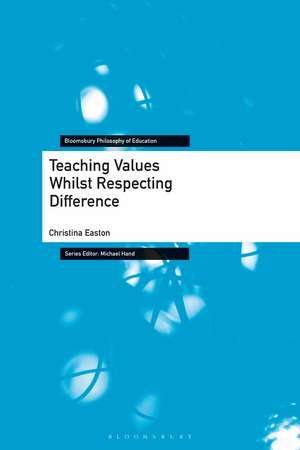
Teaching Values Whilst Respecting Difference: Bloomsbury Philosophy of Education
Autor Christina Eastonen Limba Engleză Hardback – 9 mar 2026


Preț: 583.59 lei
Preț vechi: 864.20 lei
-32%
Puncte Express: 875
Carte disponibilă
Livrare economică 07-21 noiembrie
Livrare prin curier în România Termenul estimat este afișat lângă disponibilitate.
Transport gratuit pentru acest produs Plată online sau ramburs, în funcție de opțiunile comenzii.
Retur gratuit în 14 zile Comandă securizată și suport în română.
Specificații
ISBN-13: 9781350255180
ISBN-10: 1350255181
Pagini: 256
Ilustrații: 10 bw illus
Dimensiuni: 160 x 236 x 20 mm
Greutate: 0.54 kg
Editura: Bloomsbury Publishing
Colecția Bloomsbury Academic
Seria Bloomsbury Philosophy of Education
Locul publicării:London, United Kingdom
ISBN-10: 1350255181
Pagini: 256
Ilustrații: 10 bw illus
Dimensiuni: 160 x 236 x 20 mm
Greutate: 0.54 kg
Editura: Bloomsbury Publishing
Colecția Bloomsbury Academic
Seria Bloomsbury Philosophy of Education
Locul publicării:London, United Kingdom
Cuprins
Series Editors Preface
Introduction
1. The liberal dilemma
2. 'British values' in schools: The politics and the policies
3. Liberalism and civic education: A critical analysis
4. Thin comprehensive liberalism
5. The content of values education
6. Deciding the content of the wider curriculum
7. Respectful classroom discussion
8. Responding to harmful student speech
9. Approaching the teaching of liberal values in schools: Rethinking the 'British values' policy
Conclusion
References
Index
Introduction
1. The liberal dilemma
2. 'British values' in schools: The politics and the policies
3. Liberalism and civic education: A critical analysis
4. Thin comprehensive liberalism
5. The content of values education
6. Deciding the content of the wider curriculum
7. Respectful classroom discussion
8. Responding to harmful student speech
9. Approaching the teaching of liberal values in schools: Rethinking the 'British values' policy
Conclusion
References
Index
Recenzii
Christina Easton's theory of teaching controversial values combines sophisticated philosophical analysis with the wisdom of an experienced teacher. This excellent book should be read by politicians and policy makers as well as philosophers of education.
This book deals with some of the most hotly disputed problems that pervade the educational systems of liberal democracies. Easton's conception of a thin comprehensive liberalism and her approach to teaching liberal democratic values will serve as a major reference in philosophical debates in the years to come.
Christina Easton draws on her expertise as a political theorist and experience as a teacher to provide a wide-ranging, thorough, and illuminating analysis of values education and liberal political philosophy. Easton puts her novel analytic framework to practical use with a forensic look at the real world problems it must apply to. It is a timely showcase of what applied analytic political theory can do. I learned a great deal from reading the book and I am grateful to her for writing it.
The combination of theoretical depth and very clear, specific policy upshots and proposals is unusual and refreshing, and I learnt a lot from it.
Rich, thoughtful, and timely, this book offers a philosophically compelling and practically grounded account of how liberal values should be taught in schools serving societies marked by deep diversity. Easton combines careful argument with practical recommendations that deserve serious attention from theorists, policymakers, and educators alike.
The great strength of Christina Easton's insightful book is the way in which it draws upon a sophisticated liberal theory - what she calls 'thin comprehensive liberalism' - to provide an illuminating appraisal of schools' statutory duty to promote British values, and to show how we can justify cultivating important civic virtues through the education system.
This book deals with some of the most hotly disputed problems that pervade the educational systems of liberal democracies. Easton's conception of a thin comprehensive liberalism and her approach to teaching liberal democratic values will serve as a major reference in philosophical debates in the years to come.
Christina Easton draws on her expertise as a political theorist and experience as a teacher to provide a wide-ranging, thorough, and illuminating analysis of values education and liberal political philosophy. Easton puts her novel analytic framework to practical use with a forensic look at the real world problems it must apply to. It is a timely showcase of what applied analytic political theory can do. I learned a great deal from reading the book and I am grateful to her for writing it.
The combination of theoretical depth and very clear, specific policy upshots and proposals is unusual and refreshing, and I learnt a lot from it.
Rich, thoughtful, and timely, this book offers a philosophically compelling and practically grounded account of how liberal values should be taught in schools serving societies marked by deep diversity. Easton combines careful argument with practical recommendations that deserve serious attention from theorists, policymakers, and educators alike.
The great strength of Christina Easton's insightful book is the way in which it draws upon a sophisticated liberal theory - what she calls 'thin comprehensive liberalism' - to provide an illuminating appraisal of schools' statutory duty to promote British values, and to show how we can justify cultivating important civic virtues through the education system.
Notă biografică
Christina Easton is Assistant Professor in the Ethics of Non-Violence at the University of Birmingham, UK. Her research explores ethical and political questions, particularly around education and disagreement. Her research has been published in leading journals including Philosophy, American Political Science Review, Theory and Research in Education, the Journal of Philosophy of Education, and the Journal of Applied Philosophy. She co-edited The Future of Education: Reimagining its Aims and Responsibilities (OUP, 2026) and co-authored Critical Religious Education in Practice (Routledge, 2019). Her work has been featured in TV, radio and the press, including TRT World, the Times Literary Supplement and the Metro. Before going into academic research, Christina taught philosophy and religious studies in secondary schools for eight years.