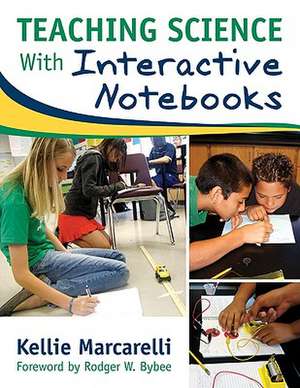
Teaching Science With Interactive Notebooks
Autor Kellie Marcarellien Limba Engleză Paperback – 18 mai 2010
Observăm că pilonul central al acestui ghid practic este transformarea elevului dintr-un receptor pasiv într-un „proprietar” al propriei învățări prin intermediul caietelor interactive. Kellie Marcarelli nu se limitează la teorie, ci propune o structură riguroasă, ghidând profesorul și părintele pas cu pas prin primele șapte zile critice de implementare a acestei metode. Remarcăm atenția deosebită acordată proceselor metacognitive, unde caietul devine un spațiu de procesare a gândirii critice, nu doar un suport pentru notițe. Cartea este organizată logic, începând cu motivarea elevilor și continuând cu utilizarea caietului în timpul investigațiilor practice și al discuțiilor colective. Ca și My Steam Notebook, lucrarea reușește să educe și să disciplineze mintea tânărului cercetător fără a fi didactică, oferind în plus un cadru metodologic pentru cadrele didactice. Un element distinctiv este accentul pus pe „discursul responsabil” (accountable talk), care pregătește terenul pentru însemnările din caiet prin dialog științific structurat. Merită menționat că volumul include resurse reproductibile, facilitând aplicarea imediată la clasă sau acasă, în contextul educației de tip homeschooling pentru copiii de gimnaziu.
Preț: 288.50 lei
Carte tipărită la comandă
Livrare economică 04-18 decembrie
Specificații
ISBN-10: 1412954037
Pagini: 194
Ilustrații: Illustrations
Dimensiuni: 216 x 280 x 11 mm
Greutate: 0.5 kg
Ediția:1
Editura: Corwin
Locul publicării:Thousand Oaks, United States
V-ar putea interesa
-
 Teaching Other Subjects Through English (CLIL)Sheelagh DellerPreț: 207.18 lei
 -
 -28%Preț: 35.54 lei49.04 lei
 -
 A Creative Approach to Teaching ScienceNicky Waller-40%Preț: 90.35 lei150.64 lei
 -
 The Science of EarthquakesKidcapsPreț: 89.93 lei
 -
 -21%Preț: 360.93 lei457.05 lei
 -
 BGE S1–S3 Science: Third and Fourth LevelsPhil Wootton-21%Preț: 162.90 lei206.98 lei
 -
 -19%Preț: 125.53 lei155.48 lei
 -
 AQA A-level Chemistry Workbook 1Nora Henry-21%Preț: 74.19 lei93.77 lei
 -
 AQA A-level Chemistry Workbook 2Nora Henry-21%Preț: 74.24 lei93.80 lei
 -
 Invasion of the Daddy Long LegsDacia K. JacksonPreț: 66.74 lei
 -
 Isaac Newton and Physics for Kids: His Life and Ideas with 21 ActivitiesKerrie Logan HollihanPreț: 125.53 lei
 -
 Tracks, Scats and SignsLeslie DendyPreț: 47.65 lei
 -
 Fun with NatureMel BoringPreț: 136.86 lei
 -
 -18%Preț: 1069.31 lei1304.04 lei
 -
 Preț: 233.27 lei
De ce să citești această carte
Recomandăm această carte educatorilor și părinților care doresc să cultive gândirea științifică la copiii de vârstă gimnazială. Cititorul câștigă un sistem complet de organizare a studiului, transformând simpla luare de notițe într-un proces creativ și analitic. Este un instrument esențial pentru a-i ajuta pe elevi să vizualizeze progresul lor academic și să internalizeze concepte complexe de fizică și chimie prin scriere și desen.
Despre autor
Kellie Marcarelli este o voce respectată în educația științifică, activând ca profesoară de fizică și chimie și șefă de departament la Pershing Middle School din San Diego. Experiența sa vastă se extinde dincolo de sala de clasă, fiind implicată în formarea cadrelor didactice prin programe precum California Math and Science Partnership. Expertiza sa în evaluarea curriculumului și în coordonarea târgurilor de știință și inginerie se reflectă în abordarea pragmatică și structurată a volumului Teaching Science With Interactive Notebooks.
Descriere scurtă
This book can enrich learning in any science classroom and supports the effort to make students the owners of their own learning. Interactive notebooks are natural differentiators that allow students to learn standards-based content and demonstrate that learning in individualized ways.
Recenzii
"Highly recommend this book to science teachers who want to do science notebooks but fear the drudgery that sometimes is associated with them. The interactive notebooks that Marcarelli creates not only are interesting for the teacher but also fun and motivating for students."
"Marcarelli’s book provides teachers with research-based strategies that actively engage students in their own learning. With interactive notebooks, students learn how to collect and organize scientific information and how to communicate and refine their thinking. Moreover, students take ownership and pride in their work. This book is a valuable tool that every science teacher should have.
"A powerful reference that will be full of my sticky notes and used daily."
“In an era when science teachers are being asked more and more to teach writing skills and build science literacy, this book presents an engaging and creative way to answer that challenge and encourage the use of higher-order thinking skills.”
"Whether they are doing hands-on investigation, synthesizing a piece of text, or researching online, my students do the work of scientists by creating something every day in their science notebooks. The notebooks are veritable portfolios of their thinking. My students take pride in collecting daily evidence of their work and are better able to organize, focus, and reflect on their learning in the notebook spread. Because I am planning with the notebook in mind, my lessons are clearer and the structure allows us to focus on the learning at hand. I can’t imagine not using them. This is not rocket science, just good teaching!”
“Easy to read, with good examples and illustrations. The rationale is spelled out for every step, the setup for the interactive notebook is clearly explained, and you can hear the enthusiasm of the author, which makes the reader enthusiastic about trying the strategy.”
"Interactive notebooks are awesome. This book gives you step-by-step instructions on what they are, their many uses, and day to day instructions on getting them up and running smoothly in your classroom."
Cuprins
Preface
Acknowledgments
About the Author
1. Introduction
2. Organizing Notebooks for Learning
3. Gaining Student Buy In and Ownership
4. Using Notebooks During Investigations
5. Getting Started: The First Three Days
6. Using the Notebooks: Days Four to Seven
7. Learning Through Writing
8. Learning Through Discussion
9. Conclusion
Resource A: Reproducibles
Resource B: Crosscurricular Connections
References and Further Reading
Index