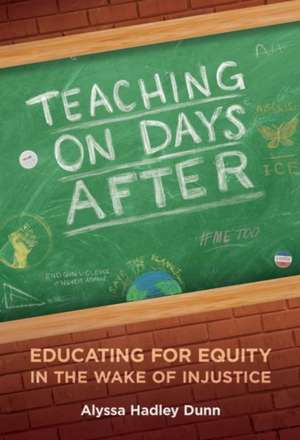
Teaching on Days After
Autor Alyssa Hadley Dunnen Limba Engleză Paperback – 3 dec 2021
Book Features:
- Narratives from teachers and students that represent a diverse range of identities, locations, grade levels, and content areas.
- Examples of days after that teachers remember, including 9/11, elections, natural disasters, gun violence, police brutality, social uprisings, Supreme Court decisions, immigration policies, and more.
- Examples of days after that K-12 and college-aged students remember, including what their teachers did and didn't do and how they experienced these moments.
Preț: 279.42 lei
Puncte Express: 419
Carte disponibilă
Livrare economică 29 octombrie-12 noiembrie
Livrare express 15-21 octombrie pentru 30.16 lei
Livrare prin curier în România Termenul estimat este afișat lângă disponibilitate.
Transport gratuit de la 400.00 lei Plată online sau ramburs, în funcție de opțiunile comenzii.
Retur gratuit în 14 zile Comandă securizată și suport în română.
Specificații
ISBN-13: 9780807766217
ISBN-10: 0807766216
Pagini: 240
Dimensiuni: 157 x 231 x 15 mm
Greutate: 0.34 kg
Editura: Teachers College Press
ISBN-10: 0807766216
Pagini: 240
Dimensiuni: 157 x 231 x 15 mm
Greutate: 0.34 kg
Editura: Teachers College Press
Notă biografică
Alyssa Hadley Dunn is an associate professor in the Department of Teacher Education at Michigan State University, and author of Teachers Without Borders? The Hidden Consequences of International Teachers in U.S. Schools.
Descriere
What should teachers do on the days after major events, tragedies, and traumas, especially when injustice is involved? This beautifully written book features teacher narratives and youth-authored student spotlights that reveal what classrooms do and can look like in the wake of these critical moments.
Cuprins
Contents Acknowledgments ix
1. Introduction 1
Days After That I Remember, as Student and Teacher 4
Teachable Moments in Service of Justice 8
On Silence 9
What This Book Is About 10
Why Teaching on Days After Matters—and Why Now 12
What Is “Days After Pedagogy”? 13
How This Book Is Organized 14
2. Guiding Frameworks 16
Guiding Frameworks in Context: Today’s Classrooms as Spaces for Days After Pedagogy 16
Asset-Based and Justice-Oriented Pedagogies 18
A Sociopolitical Education 22
Trauma Responsiveness and Socioemotional Learning in the Classroom 27
Conclusion 31
Theories in Practice: A Letter From a Teacher to His Students 31
Student Spotlight: Days After School Shootings 34
Marlena Young, Deidre Gorkowski, Marjorie Wiese
3. Toward a Purpose for Freedom: Why Teach on Days After 42
Days After Pedagogy Supports Student Agency and Voice 43
Days After Pedagogy Works Against Oppression 48
Days After Teaching Redefines “Relevance” 50
Disrupting Whiteness: Pushing Against “Two Sides” on Days After 51
Days After Pedagogy Responds to Trauma in a Meaningful Way 54
Days After Pedagogy Is a Form of Trauma-Responsive Teaching 55
Days After Pedagogy Offers a Space for Transformative Learning 59
Days After Pedagogy Is Sustaining for Students and Teachers 64
Conclusion 67
Student Spotlight: Days After Community Struggle 68
Roxy Mashkawiziikwe Sprowl, Ella Ritter
4. Putting Students First: Who We’re Teaching on Days After 72
Days After Pedagogy Is About Knowing Students Deeply 75
Days After Pedagogy Is for All Ages 76
Days After Pedagogy Is for All Content Areas 83
Days After Pedagogy Uses Student-Centered and Humanizing Lessons 86
Conclusion 88
Student Spotlight: Days After the COVID-19 Pandemic 89
Sudeshna Flores
5. Educators: Who Is Doing the Teaching on Days After? 91
Days After Pedagogy Requires Teachers to Be Vulnerable 92
Days After Pedagogy Pushes Teachers to Be Curricular Risk-Takers 97
Days After Pedagogy Pushes Teachers to Work Through Fears and Challenges 104
Days After Pedagogy Necessitates That Teachers Negotiate Their Positionality 109
Conclusion 116
Student Spotlight: Days After Political Upheaval 117
Corabella Dover, Ana Lucia Ontiveros
6. The Intersections of Teaching and Politics on Days After 119
Days After Elections 120
Days After Gun Violence 128
Days After Environmental Crises 134
Days After Gender Injustice 138
Student Spotlight: Days After Racial Injustice 141
Camille Dotson, Gabrielle Dotson
7. The Intersections of Teaching, Racism, and White Supremacy on Days After 144
Days After Racial Violence 145
Days After White Supremacist Events 149
Days After Immigration Injustice 154
Days After Local Racial Injustice 158
Conclusion 163
8. From “Totally Out of Touch” to “They’ve Got My Back”: Administrators on Days After 164
Silence and Silencing 165
What Administrative Support Can Look Like 167
How Administrators Connected (or Didn’t) Days After Pedagogy and Equity-Centered Trauma-Informed Education 170
Conclusion 171
9. Conclusion 172
Part 1: Institutionalizing a Space for Days After Pedagogy 172
Part 2: Where Do We Go From Here? Some Final Advice for Teaching on Days After 177
Epilogue: From January 2021 to December 2025 183
Appendix A: A Letter to Educators and Children 185
Appendix B: Methods 187
Appendix C: The Day After: An Ethnodrama About Teachers’ Decision-Making Amidst Silencing School Policies 196
References 216
Index 223
About the Author 229
1. Introduction 1
Days After That I Remember, as Student and Teacher 4
Teachable Moments in Service of Justice 8
On Silence 9
What This Book Is About 10
Why Teaching on Days After Matters—and Why Now 12
What Is “Days After Pedagogy”? 13
How This Book Is Organized 14
2. Guiding Frameworks 16
Guiding Frameworks in Context: Today’s Classrooms as Spaces for Days After Pedagogy 16
Asset-Based and Justice-Oriented Pedagogies 18
A Sociopolitical Education 22
Trauma Responsiveness and Socioemotional Learning in the Classroom 27
Conclusion 31
Theories in Practice: A Letter From a Teacher to His Students 31
Student Spotlight: Days After School Shootings 34
Marlena Young, Deidre Gorkowski, Marjorie Wiese
3. Toward a Purpose for Freedom: Why Teach on Days After 42
Days After Pedagogy Supports Student Agency and Voice 43
Days After Pedagogy Works Against Oppression 48
Days After Teaching Redefines “Relevance” 50
Disrupting Whiteness: Pushing Against “Two Sides” on Days After 51
Days After Pedagogy Responds to Trauma in a Meaningful Way 54
Days After Pedagogy Is a Form of Trauma-Responsive Teaching 55
Days After Pedagogy Offers a Space for Transformative Learning 59
Days After Pedagogy Is Sustaining for Students and Teachers 64
Conclusion 67
Student Spotlight: Days After Community Struggle 68
Roxy Mashkawiziikwe Sprowl, Ella Ritter
4. Putting Students First: Who We’re Teaching on Days After 72
Days After Pedagogy Is About Knowing Students Deeply 75
Days After Pedagogy Is for All Ages 76
Days After Pedagogy Is for All Content Areas 83
Days After Pedagogy Uses Student-Centered and Humanizing Lessons 86
Conclusion 88
Student Spotlight: Days After the COVID-19 Pandemic 89
Sudeshna Flores
5. Educators: Who Is Doing the Teaching on Days After? 91
Days After Pedagogy Requires Teachers to Be Vulnerable 92
Days After Pedagogy Pushes Teachers to Be Curricular Risk-Takers 97
Days After Pedagogy Pushes Teachers to Work Through Fears and Challenges 104
Days After Pedagogy Necessitates That Teachers Negotiate Their Positionality 109
Conclusion 116
Student Spotlight: Days After Political Upheaval 117
Corabella Dover, Ana Lucia Ontiveros
6. The Intersections of Teaching and Politics on Days After 119
Days After Elections 120
Days After Gun Violence 128
Days After Environmental Crises 134
Days After Gender Injustice 138
Student Spotlight: Days After Racial Injustice 141
Camille Dotson, Gabrielle Dotson
7. The Intersections of Teaching, Racism, and White Supremacy on Days After 144
Days After Racial Violence 145
Days After White Supremacist Events 149
Days After Immigration Injustice 154
Days After Local Racial Injustice 158
Conclusion 163
8. From “Totally Out of Touch” to “They’ve Got My Back”: Administrators on Days After 164
Silence and Silencing 165
What Administrative Support Can Look Like 167
How Administrators Connected (or Didn’t) Days After Pedagogy and Equity-Centered Trauma-Informed Education 170
Conclusion 171
9. Conclusion 172
Part 1: Institutionalizing a Space for Days After Pedagogy 172
Part 2: Where Do We Go From Here? Some Final Advice for Teaching on Days After 177
Epilogue: From January 2021 to December 2025 183
Appendix A: A Letter to Educators and Children 185
Appendix B: Methods 187
Appendix C: The Day After: An Ethnodrama About Teachers’ Decision-Making Amidst Silencing School Policies 196
References 216
Index 223
About the Author 229