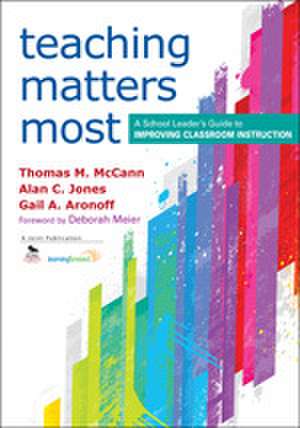
Teaching Matters Most: A School Leader’s Guide to Improving Classroom Instruction
Autor Thomas M. McCann, Alan C. Jones, Gail A. Aronoffen Limba Engleză Electronic book text – 2013
Preț: 198.80 lei
Puncte Express: 298
Indisponibil temporar
Doresc să fiu notificat când acest titlu va fi disponibil:
Se trimite...
Specificații
ISBN-13: 9781452269771
ISBN-10: 1452269777
Pagini: 208
Dimensiuni: 178 x 254 mm
Ediția:1
Editura: SAGE Publications
Colecția Corwin
Locul publicării:Thousand Oaks, United States
ISBN-10: 1452269777
Pagini: 208
Dimensiuni: 178 x 254 mm
Ediția:1
Editura: SAGE Publications
Colecția Corwin
Locul publicării:Thousand Oaks, United States
V-ar putea interesa
-
 Preț: 184.62 lei
 -
 -29%Preț: 182.53 lei257.80 lei
 -
 Key Concepts for Understanding CurriculumColin MarshPreț: 433.98 lei
 -
 Cultures of CurriculumPamela Bolotin Joseph-15%Preț: 467.33 lei549.81 lei
 -
 The Course SyllabusJudith Grunert O'BrienPreț: 233.24 lei
 -
 -19%Preț: 315.10 lei389.35 lei
 -
 Shaping the College CurriculumLisa R LattucaPreț: 389.03 lei
 -
 Curriculum Studies in the Lifelong Learning SectorJonathan TummonsPreț: 313.42 lei
 -
 The Power of PedagogyJenny Leach-15%Preț: 663.97 lei781.14 lei
 -
 Enriching Curriculum for All StudentsJoseph S. RenzulliPreț: 306.30 lei
 -
 Closing the Teaching GapDonald B. BartaloPreț: 310.25 lei
 -
 Creating Standards-Based Integrated CurriculumSusan M. DrakePreț: 282.03 lei
 -
 Cross-curricular Approaches to Teaching and LearningChris Rowley-15%Preț: 549.92 lei646.96 lei
 -
 Cognition and Curriculum ReconsideredElliot W. EisnerPreț: 195.78 lei
Recenzii
"A
comprehensive
book
that
provides
site
administrators
not
only
the
opportunity
to
reflect
on
their
own
practices
but
challenges
them
to
reconsider
the
daily
operations
of
their
schools.
The
recommendations
meld
theory
and
practice
together
in
an
administrator-friendly
way."
"This is a good book principals can use for faculty book study. It will lead to authentic dialogue about good teaching: how to get to it and how to maintain it."
"This is an excellent book for administrators to build a focused, long-term solution to improve what happens in every classroom on a daily basis."
"A major strength of this book is how it identifies and puts in one place the key elements needed to improve student learning."
"I recommend this book for new principals and superintendents in induction programs. The content will inspire thoughtful discussions and lead to effective action plans."
"InTeaching Matters Most, the authors remind us that to provide students with the highest quality of education, we must refocus on defining the quality of instruction in the classroom and building support systems for the teachers providing that instruction."
"I am grateful to, and appreciative of, the authors ofTeaching Matters Mostfor their efforts to improve student learning through the examination of classroom instruction. The authors offer practical and useful strategies that allow teachers to review their practices through frequent reflections. The book guides staff through activities that focus on their instructional practices for maximum student learning. I believe that study of this book can be a continuous professional development activity for teachers and school leadership teams."
"This is a good book principals can use for faculty book study. It will lead to authentic dialogue about good teaching: how to get to it and how to maintain it."
"This is an excellent book for administrators to build a focused, long-term solution to improve what happens in every classroom on a daily basis."
"A major strength of this book is how it identifies and puts in one place the key elements needed to improve student learning."
"I recommend this book for new principals and superintendents in induction programs. The content will inspire thoughtful discussions and lead to effective action plans."
"InTeaching Matters Most, the authors remind us that to provide students with the highest quality of education, we must refocus on defining the quality of instruction in the classroom and building support systems for the teachers providing that instruction."
"I am grateful to, and appreciative of, the authors ofTeaching Matters Mostfor their efforts to improve student learning through the examination of classroom instruction. The authors offer practical and useful strategies that allow teachers to review their practices through frequent reflections. The book guides staff through activities that focus on their instructional practices for maximum student learning. I believe that study of this book can be a continuous professional development activity for teachers and school leadership teams."
Cuprins
Foreword
by
Deborah
Meier
Preface: Lessons Learned From Experience
A “New” Take in School Improvement
Central Theme
Organization of the Book
What Makes This Book Distinctive
Acknowledgments
About the Authors
1. What are common practices in schools?
What We Found in Classrooms
Truths Hidden in Plain View
Transforming Accountability
New Direction
Are There “Best Practices” in Teaching?
Bringing Best Practices to Scale
Are Some Practices Better Than Others?
The Poverty of Prescribing Best Practices
2. What distinguishes quality teaching?
Three Classrooms, Three Practitioners
A Simple Truth Hidden in Plain View
Disjointed Teaching
Why Teachers Are Frustrated
What Is Quality Teaching?
Observing High-Quality Teaching
Instructional Systems
The Road Less Traveled
3. How do we learn about the quality of our teaching?
How to Make the Case for an Emphasis on Teacher Quality
Three Leadership Requirements
Defining Quality Teaching
How to Engage School Personnel in Devising a Vision of Quality Instruction
Some Rudiments of Quality Teaching
The Importance of Curriculum Coherence
Learning From Students
The Current State of Teaching in Your School
How to Evaluate the Quality of Teaching in Your School
4. What should induction and mentoring look like?
Basic Components of a Teacher Mentor Program
Facing Critical Junctures Together
Planning for New Teachers’ Success
5. What should professional development look like?
What We Know About Professional Development
The Disregarded Truths of Professional Development
The Components of a Professional Learning Culture
Building Blocks of Professional Learning
Leading Professional Learning Communities
6. How can teacher evaluaiton become more meaningful?
“Drive-By” Teacher Evaluation
“Absentee Landords”
Lists and Rubrics Abound
7. How can we sustain a culture of exceptional instruction?
Ten Actions to Sustain High-Quality Teaching
Systems in Place
Sanctity of the Classroom
Envisioning Quality Teaching
Right People in Right Places
Balanced Leadership
Clear and Timely Communication
Standards for Professional Conduct
Collaboration
Reflection and Continuous Improvement
Ongoing Professional Dialogues
8. How do we face our leadership challenges?
Suppressing Distraction
Building Principal’s Knowledge
Building Trust
Influencing Resistant Teachers
Coping With the Pace
Final Thoughts
Resources
A. How Can You Spot a Really Good Teacher?
B. Framework for Observing Classes
C. Student Forum Questions
D. Teacher Interview Questions
References
Index
Preface: Lessons Learned From Experience
A “New” Take in School Improvement
Central Theme
Organization of the Book
What Makes This Book Distinctive
Acknowledgments
About the Authors
1. What are common practices in schools?
What We Found in Classrooms
Truths Hidden in Plain View
Transforming Accountability
New Direction
Are There “Best Practices” in Teaching?
Bringing Best Practices to Scale
Are Some Practices Better Than Others?
The Poverty of Prescribing Best Practices
2. What distinguishes quality teaching?
Three Classrooms, Three Practitioners
A Simple Truth Hidden in Plain View
Disjointed Teaching
Why Teachers Are Frustrated
What Is Quality Teaching?
Observing High-Quality Teaching
Instructional Systems
The Road Less Traveled
3. How do we learn about the quality of our teaching?
How to Make the Case for an Emphasis on Teacher Quality
Three Leadership Requirements
Defining Quality Teaching
How to Engage School Personnel in Devising a Vision of Quality Instruction
Some Rudiments of Quality Teaching
The Importance of Curriculum Coherence
Learning From Students
The Current State of Teaching in Your School
How to Evaluate the Quality of Teaching in Your School
4. What should induction and mentoring look like?
Basic Components of a Teacher Mentor Program
Facing Critical Junctures Together
Planning for New Teachers’ Success
5. What should professional development look like?
What We Know About Professional Development
The Disregarded Truths of Professional Development
The Components of a Professional Learning Culture
Building Blocks of Professional Learning
Leading Professional Learning Communities
6. How can teacher evaluaiton become more meaningful?
“Drive-By” Teacher Evaluation
“Absentee Landords”
Lists and Rubrics Abound
7. How can we sustain a culture of exceptional instruction?
Ten Actions to Sustain High-Quality Teaching
Systems in Place
Sanctity of the Classroom
Envisioning Quality Teaching
Right People in Right Places
Balanced Leadership
Clear and Timely Communication
Standards for Professional Conduct
Collaboration
Reflection and Continuous Improvement
Ongoing Professional Dialogues
8. How do we face our leadership challenges?
Suppressing Distraction
Building Principal’s Knowledge
Building Trust
Influencing Resistant Teachers
Coping With the Pace
Final Thoughts
Resources
A. How Can You Spot a Really Good Teacher?
B. Framework for Observing Classes
C. Student Forum Questions
D. Teacher Interview Questions
References
Index
Descriere
This
book's
three-step
process
outlines
how
to
envision
what
great
teaching
looks
like,
measure
current
instruction
against
that
standard,
and
work
relentlessly
to
improve
instruction
accordingly.