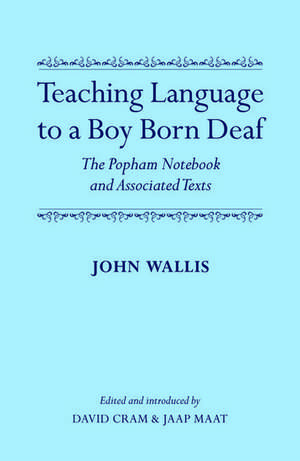
Teaching Language to a Boy Born Deaf: The Popham Notebook and Associated Texts
Autor John Wallis Editat de David Cram, Jaap Maaten Limba Engleză Hardback – 30 noi 2017
Notăm cu interes apariția volumului Teaching Language to a Boy Born Deaf, o lucrare care completează o lacună semnificativă în istoria lingvisticii aplicate și a educației speciale. Până la descoperirea recentă a caietului de însemnări al lui John Wallis în conacul familiei Popham, cercetătorii dispuneau de puține dovezi directe despre metodele practice de instruire utilizate în secolul al XVII-lea. Acest manuscris oferă o perspectivă rară asupra modului în care un savant de talia lui Wallis, cunoscut pentru rigoarea sa în The Arithmetic of Infinitesimals, a aplicat principii logice și analitice pentru a învăța un tânăr născut surd să comunice, într-un context în care miza era însăși moștenirea unui titlu nobiliar.
Găsim în această ediție, îngrijită de David Cram și Jaap Maat, nu doar un document istoric, ci și un instrument de reevaluare a unei dispute celebre între Wallis și William Holder în cadrul Royal Society. Volumul acoperă aceeași arie tematică precum The Proper Way to Educate the Deaf de The Abbé Charles-Michel de l'Epée, dar cu o abordare mult mai timpurie și mai specifică, fiind un manual creat ad-hoc pentru un individ anume, spre deosebire de metodologia instituționalizată a lui de l’Épée. Structura cărții integrează manuscrisul original cu adnotări erudite și eseuri introductive care plasează efortul lui Wallis la intersecția dintre filozofia limbajului și știința experimentală. Față de Distinctions of Reason and Reasonable Distinctions, care explorează biografia intelectuală generală a lui Wallis, acest volum se concentrează strict pe aplicarea teoriilor sale în pedagogia surzilor, oferind o claritate remarcabilă asupra mecanismelor de articulare și înțelegere a semnelor.
Preț: 778.10 lei
Preț vechi: 1146.29 lei
-32%
Carte tipărită la comandă
Livrare economică 27 noiembrie-02 decembrie
Specificații
ISBN-10: 0199677085
Pagini: 344
Dimensiuni: 162 x 240 x 35 mm
Greutate: 0.68 kg
Editura: OUP OXFORD
Colecția OUP Oxford
Locul publicării:Oxford, United Kingdom
De ce să citești această carte
Recomandăm această carte istoricilor științei și lingviștilor interesați de originile educației speciale. Cititorul va descoperi cum au fost folosite logica și observația empirică pentru a depăși bariere senzoriale într-o epocă pre-modernă. Este un studiu de caz fascinant despre succesul pedagogic și implicațiile sale sociale, oferind o perspectivă unică asupra modului în care limbajul definește statutul uman și juridic.
Despre autor
John Wallis (1616-1703) a fost un polimat englez, figură centrală a revoluției științifice și profesor de matematică la Oxford timp de peste jumătate de secol. Deși este recunoscut la nivel mondial pentru contribuțiile sale fundamentale la dezvoltarea calculului infinitesimal, activitatea sa s-a extins considerabil în domeniul criptografiei și al lingvisticii. Membru fondator al Royal Society, Wallis a fost un pionier în predarea limbajului pentru persoanele cu deficiențe de auz, aplicându-și abilitățile analitice pentru a decodifica structura sunetelor vorbite. Această lucrare reflectă versatilitatea sa intelectuală, legând rigoarea matematică de pragmatismul educațional.