
Teaching Language and Literacy: Preschool Through the Elementary Grades
Autor James F. Christie, Billie Jean Enz, Carol Vukelichen Limba Engleză Paperback – 2 mai 2013
Preț: 1093.69 lei
Preț vechi: 1420.38 lei
-23%
Puncte Express: 1641
Carte tipărită la comandă
Livrare economică 03-17 iunie
Specificații
ISBN-13: 9780133066814
ISBN-10: 0133066819
Pagini: 426
Dimensiuni: 175 x 231 x 18 mm
Greutate: 0.57 kg
Ediția:5
Editura: Pearson
ISBN-10: 0133066819
Pagini: 426
Dimensiuni: 175 x 231 x 18 mm
Greutate: 0.57 kg
Ediția:5
Editura: Pearson
V-ar putea interesa
-
 Radical ReflectionsMem FoxPreț: 88.82 lei
 -
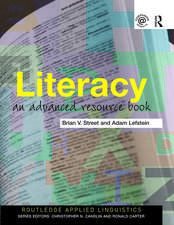 Literacy: An Advanced Resource Book for StudentsBrian V. StreetPreț: 453.30 lei
 -
 -15%Preț: 441.62 lei519.56 lei
 -
 -15%Preț: 474.78 lei558.56 lei
 -
 Preț: 437.13 lei
 -
 -27%Preț: 184.49 lei251.97 lei
 -
 Tiempo Muerto/Dead TimeCarlos RubioPreț: 110.56 lei
Notă biografică
James Christie is a professor of Social and Family Dynamics at Arizona State University, where he teaches courses in Family and Human Development. His research interests include early literacy development and children's play. Dr. Christie has co-authored Helping Young Children Learn Language and Literacy, 3rd ed. (2008) and Play, Development, and Early Education (2005). He has served as co-director of Early Reading First projects in San Luis and Somerton, AZ; Bullhead City, AZ; and Gallup, NM. Billie Jean Enz is an emeritus professor of early childhood education at Arizona State University, where she taught and served as an administrator for 25 years. She has co-authored several texts on mentorship and new teacher development and is the founder of the Beginning Educator Support Team (BEST) program. Her research interests include language and literacy development and family literacy. Dr. Enz has co-authored Helping Young Children Learn Language and Literacy, 4th ed. (2011) and Assessing Preschool Literacy Development (International Reading Association, 2009). She also served as the founding executive director for Educare Arizona. Carol Vukelich is the L. Sandra and Bruce L. Hammonds Professor in Teacher Education, Director of the Delaware Center for Teacher Education, and Deputy Dean of the College of Education and Human Development at the University of Delaware. Her research and teaching interests include children's early literacy development and teachers' professional development, specifically coaching strategies. Dr. Vukelich has served as President of the Association for Childhood Education International and the International Reading Association's Literacy Development in Young Children Special Interest Group. She was a founder of the Delaware Writing Project, and serves as one of its co-directors. In addition to this book, other books by Dr. Vukelich include Helping Young Children Learn Language and Literacy, 3rd ed. (2012); Building a Foundation for Preschool Literacy: Effective Instruction for Children's Reading and Writing Development, 2nd ed., (2009); and Achieving EXCELLENCE in Preschool Literacy Instruction (edited with Laura M. Justice, 2008). She has served as a co-director of three Early Reading First projects. Kathleen Roskos is a professor of educationat John Carroll University, where she teaches courses in reading assessment and instruction. Formerly an elementary classroom teacher, Dr. Roskos has served in a variety of educational roles, including director of federal programs in the public schools, department chair in higher education and Director of the Ohio Literacy Initiative at the Ohio Department of Education from 2000-2002. She has developed and coordinated numerous educational grants, most recently Early Reading First projects in Lorain, OH and Akron, OH. Dr. Roskos studies early literacy development, teacher learning and reading curriculum, and has published articles, chapters and books on these topics. Her current research examines the use of ebooks in early childhood literacy education. She was one of the lead writers of the 2010 Educator Professional Standards of the International Reading Association. Other recent books by Dr. Roskos include The Early Literacy Materials Selector (co-authored with Lisa Lenhart and Brandi Noll), Nurturing Knowledge (co-authored with Susan B. Neuman), and Designing Professional Development in Literacy (co-authored with Catherine Rosemary and Leslie Landreth).
Cuprins
Preface PART ONE: FOUNDATIONS 1. Foundations of Language and Literacy Before Reading This Chapter, Think About ... Focus Questions Language and Literacy: Definitions and Interrelationships The Common Core State Standards A Continuum of Instructional Approaches or "The Reading Wars" A Comprehensive Literacy Instructional Program Summary Linking Knowledge to Practice 2. Oral Language Development Before Reading This Chapter, Think About ... Focus Questions Language Acquisition Theories Linguistic Vocabulary Lesson Observing the Development of Children's Language What Is Normal Language Development? Factors Contributing to Variation in Rate of Language Acquisition Family Focus: Developing Language Over Time Summary Linking Knowledge to Practice 3. Family Literacy Before Reading This Chapter, Think About ... Focus Questions Home Talk: A Natural Context for Learning and Using Language Home Literacy Experiences Family Focus: Parent Workshops Case Studies Summary Linking Knowledge to Practice 4. Facilitating Oral Language Learning Before Reading This Chapter, Think About ... Focus Questions Explicit Vocabulary Instruction Rich Classroom Language Experiences Contexts That Encourage Language Use Language-Centered Activities for Children Promoting Oral Language in the Elementary Grades Family Focus: Sharing the Fun and the Language Learning Strategies for Teaching English Language Learners: Helping Children Develop Conversation and Academic Language Skills Strategies for Children with Special Needs: Speech Delays Summary Linking Knowledge to Practice PART TWO: EARLY LANGUAGE AND LITERACY INSTRUCTION 5. Emergent Literacy Strategies Before Reading This Chapter, Think About ... Focus Questions Print-Rich Classroom Environments Sharing Books with Young Children Shared Writing Family Focus: Sharing Instructional Materials and Offering Guidance Strategies for Teaching English Language Learners: Storybook Time Strategies for Children with Special Needs: Reading Storybooks with Children with Disabilities Summary Linking Knowledge to Practice 6. Teaching Early Reading and Writing Before Reading This Chapter, Think About ... Focus Questions Early Reading Instruction Early Writing Instruction Family Focus: Creating a Book Nook and Author's Corner Strategies for Teaching English Language Learners: Modifying the Classroom Environment Strategies for Children with Special Needs: On Your Mark, Get Set, Go Summary Linking Knowledge to Practice 7. Assessing Early Literacy: Finding Out What Young Children Know and Can Do Before Reading This Chapter, Think About ... Focus Questions Determining What Children Know and Can Do Ongoing Assessment On-Demand Assessment Using Assessment Data to Plan Early Literacy Instruction Family Focus: Sharing Assessment Results With Parents Strategies for Teaching ELLs: Assessing English Language Learners' Language and Literacy Summary Linking Knowledge to Practice PART THREE: ELEMENTARY GRADE LITERACY INSTRUCTION 8. Beginning Reading Instruction: Helping Children Learn to Read Before Reading This Chapter, Think About ... Focus Questions Understanding the Reading Process Overview of Beginning Reading Instruction Elements of Beginning Reading Instruction Strategies for Children with Special Needs Summary Linking Knowledge to Practice 9. Continuing Reading Instruction in Grades 3-5 Before Reading This Chapter, Think About ... Focus Questions The Content of G3 - G5 Reading Instruction Reading Development Ages 9 - 11 The Comprehension Process Teaching Read-to-Learn Skills and Strategies The Reading Program The Reading Lesson Monitoring Reading Progress The Reading Lesson Organizing for Reading Instruction Strategies for Teaching English Language Learners Summary Linking Knowledge to Practice 10. Creating Writers: Teaching Children to Write Well Before Reading This Chapter, Think About ... Focus Questions The Essentials of Teaching Writing Preparing the Classroom Environment The Structure of the Teaching of Writing: The Components of Writing Workshop Using Technology in the Teaching of Writing The Explicit Teaching of Writing Strategies for Teaching English Language Learners Writing Instruction: Strategies for Children with Special Needs Family Focus: Connecting Home and School Summary Linking Knowledge to Practice 11. Teaching the Mechanical Skills of Writing Before Reading This Chapter, Think About ... Focus Questions Spelling Grammar Capitalization and Punctuation Handwriting Strategies for Teaching English Language Learners Family Focus: Helping Children With Spelling Summary Linking Knowledge to Practice 12. Assessment: Determining What Older Students Know and Can Do Before Reading This Chapter, Think About ... Focus Questions An Assessment System High Stakes Assessment of Reading and Writing Achievement Classroom -Based Assessment of Reading Performance Assessing Students' Writing Performance Family Focus: Explaining Tests and Test Scores to Parents Summary Linking Knowledge to Practice References Author Index Subject Index
Recenzii
"The text is thoughtfully designed and easy to navigate with useful and relevant information based on research." - Susan Langwell, Moraine Valley Community College "I really like the thoroughness of this book. It is written at the student's level: it introduces key concepts in descriptive yet clear ways and walks students through complex processes of learning in comprehendible ways." - Cindy Lassonde, SUNY College at Oneonta
Textul de pe ultima copertă
Facilitating children s reading, writing, speaking, and listening development in pre-K through grade 5 is the focus of this highly respected text, now updated in a new Fifth Edition. In it, the authors show how teachers can effectively promote the development of oral and written language and describe numerous scientifically-based instructional practices that have been proven to be successful in supporting children s reading, writing, speaking and listening development. In the first part of the book the authors present a solid foundation of language and literacy learning; look in depth at children s oral language development; discuss family literacy and what children learn about reading and writing in the early years; show how to provide opportunities for reciprocal conversation and discussion; provide additional content on promoting oral language in the elementary grades and present a new section that focuses on vocabulary instruction for young children. The second part of the book discusses language arts instruction at the pre-K and kindergarten levels, and Part 3 focuses on elementary-grade reading and writing instruction and assessing older children s literacy performance. "And in this new edition "
- Teachers learn ways to support the Common Core Standards in language and literacy instruction.
- Aligning with the standards, the scope of this edition s grade level has been reduced from pre-K to grade six, to pre-K to grade five.
- A new author, well-known literary researcher and scholar Kathleen Roskos, has completely revised the chapters on elementary reading. (Chapters 8 and 9)
- Many new references have been added and outdated ones deleted, keeping readers up to date on the latest research.
- Many new "Trade Secrets" illustrate how to apply the book s teaching strategies to specific situations, and how real teachers deal with practical problems that arise in the course of daily life in the classroom.
- More practical, hands-on examples and activities help teachers put research and theory into practice.