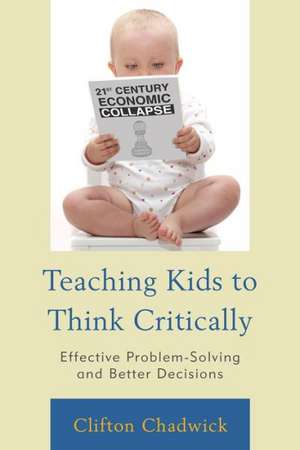
Teaching Kids to Think Critically: Effective Problem-Solving and Better Decisions
Autor Clifton Chadwicken Limba Engleză Paperback – 12 sep 2014
There are five elements involved in good, logical, critical, and creative thinking:
1. The skills involved in effective, efficient, and lasting learning, or commonly referred to as cognitive processing strategies
2. The mastery of logic and structure of what is being learned
3. Awareness of what one knows and does not know, and how one knows and how one thinks
4. The standards or guidelines for the validity and reliability of what one knows, called intellectual standards
5. The knowledge and skills involved in critical thinking and solving problems in different subjects or domains
Preț: 281.16 lei
Preț vechi: 370.76 lei
-24%
Puncte Express: 422
Carte tipărită la comandă
Livrare economică 21 noiembrie-05 decembrie
Livrare prin curier în România Termenul estimat este afișat lângă disponibilitate.
Transport gratuit de la 400.00 lei Plată online sau ramburs, în funcție de opțiunile comenzii.
Retur gratuit în 14 zile Comandă securizată și suport în română.
Specificații
ISBN-13: 9781475810660
ISBN-10: 1475810660
Pagini: 175
Ilustrații: 11 Tables
Dimensiuni: 156 x 223 x 14 mm
Greutate: 0.29 kg
Editura: Bloomsbury Publishing
Colecția Rowman & Littlefield
Locul publicării:New York, United States
ISBN-10: 1475810660
Pagini: 175
Ilustrații: 11 Tables
Dimensiuni: 156 x 223 x 14 mm
Greutate: 0.29 kg
Editura: Bloomsbury Publishing
Colecția Rowman & Littlefield
Locul publicării:New York, United States
V-ar putea interesa
-
 -33%Preț: 588.68 lei872.95 lei
 -
 The Psychology of EducationMartyn LongPreț: 445.04 lei
 -
 Peer-Group Mentoring for Teacher DevelopmentHannu L. T. Heikkinen-15%Preț: 452.80 lei532.71 lei
 -
 Educational Psychology: Concepts, Research and ChallengesChristine M. Rubie-DaviesPreț: 464.26 lei
 -
 Preț: 300.78 lei
 -
 Contemporary Debates in Childhood Education and DevelopmentSebastian SuggatePreț: 432.71 lei
 -
 Preț: 419.51 lei
 -
 -15%Preț: 437.38 lei514.57 lei
 -
 -15%Preț: 495.45 lei582.88 lei
 -
 Preț: 160.42 lei
 -
 Using Psychology in the ClassroomStephen James MintonPreț: 355.93 lei
 -
 Social and Emotional LearningNeil HumphreyPreț: 398.58 lei
 -
 Theory of Mind: Beyond the Preschool YearsScott A. Miller-15%Preț: 419.68 lei493.74 lei
Cuprins
Chapter 1: Introduction
Chapter 2: Learning and the Structure of Knowledge
Chapter 3: Developing Skills for Effective Learning
Chapter 4: Metacognition: Awareness for Thinking
Chapter 5: Disposition, Motivation, and Attitudes: Desire to Think
Chapter 6: Developing and Establishing Intellectual Standards for Teaching
Chapter 7: Problem-Solving Skills
Chapter 8: High Quality Critical Thinking: Wrapping Up!
Chapter 2: Learning and the Structure of Knowledge
Chapter 3: Developing Skills for Effective Learning
Chapter 4: Metacognition: Awareness for Thinking
Chapter 5: Disposition, Motivation, and Attitudes: Desire to Think
Chapter 6: Developing and Establishing Intellectual Standards for Teaching
Chapter 7: Problem-Solving Skills
Chapter 8: High Quality Critical Thinking: Wrapping Up!
Recenzii
This timely book by Dr. Clifton Chadwick is a work of scholarly importance for all who care about the future success of our children. It contains the practical advice and theoretical foundation for helping all children master the critical thinking skills needed in learning and life. For the adults in the lives of these children, the information is clearly presented with interesting examples from multiple disciplines and content areas. This is a must-read for all those interested in helping children acquire the thinking skills needed for learning and life in our rapidly changing 21st century and beyond.
Dr. Chadwick uses Rudyard Kipling's poem about "Six serving men", who "Taught me all I knew"- "What, Why, When, How, Where and Who", to introduce the principles of effectively using questions in teaching and learning. He also applies these principles throughout the book to present a complex subject in a clear format that answers our questions about: what is critical thinking, and why it is important; why schools often fail to teach it; when, how, and where (including in the home) should it be taught, and who can teach it. The book's answer to this last question focuses on "You, the parent", but I believe the book may equally help many teachers.
Clear, concise, and practical, this excellent book is the perfect way to school-proof your child from an educational system that no longer teachers children how to think.
In the age of knowledge work, higher-order thinking skills are more important to success and happiness than ever. However, schools are not very effective in teaching or testing such skills, so children have to rely largely on their parents to teach them. This book offers an innovative conception of five elements of good thinking: logic and structure, learning strategies, metacognition, intellectual standards, and problem solving. A chapter on each element uses plain language to help the reader understand the element, followed by highly useful, practical tips for the reader to stimulate improved thinking in a child. I highly recommend it for all parents and teachers.
Dr. Chadwick uses Rudyard Kipling's poem about "Six serving men", who "Taught me all I knew"- "What, Why, When, How, Where and Who", to introduce the principles of effectively using questions in teaching and learning. He also applies these principles throughout the book to present a complex subject in a clear format that answers our questions about: what is critical thinking, and why it is important; why schools often fail to teach it; when, how, and where (including in the home) should it be taught, and who can teach it. The book's answer to this last question focuses on "You, the parent", but I believe the book may equally help many teachers.
Clear, concise, and practical, this excellent book is the perfect way to school-proof your child from an educational system that no longer teachers children how to think.
In the age of knowledge work, higher-order thinking skills are more important to success and happiness than ever. However, schools are not very effective in teaching or testing such skills, so children have to rely largely on their parents to teach them. This book offers an innovative conception of five elements of good thinking: logic and structure, learning strategies, metacognition, intellectual standards, and problem solving. A chapter on each element uses plain language to help the reader understand the element, followed by highly useful, practical tips for the reader to stimulate improved thinking in a child. I highly recommend it for all parents and teachers.