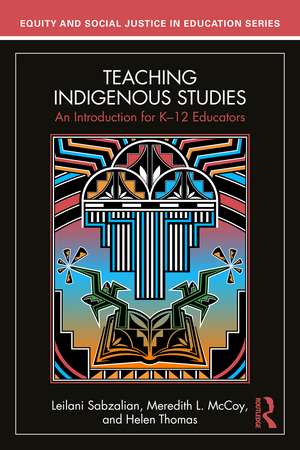
Teaching Indigenous Studies: An Introduction for K–12 Educators: Equity and Social Justice in Education Series
Autor Leilani Sabzalian, Meredith L. McCoy, Helen Thomasen Limba Engleză Paperback – 27 aug 2026
Inside, you will learn about Indigenous pedagogies and how to integrate foundational ideas such as sovereignty, survivance, and relationality into your teaching and curriculum. Through a keywords approach, chapters offer robust conceptual introductions, connections to classroom practice, and a wide array of teaching strategies and resources to help you move your learning into practice.
As you read, you will build strategies to name and disrupt colonialism, recognize and affirm Indigenous identities and knowledges, foster ethical land relations, and identify your roles and responsibilities in relation to decolonization and resurgence.
Din seria Equity and Social Justice in Education Series
-
 Preț: 217.10 lei
 -
 Preț: 228.68 lei
 -
 Preț: 196.37 lei
 -
 Preț: 206.45 lei
 -
 Preț: 203.57 lei
 -
 Preț: 276.87 lei
 -
 Preț: 220.93 lei
 -
 Preț: 218.14 lei
 -
 Preț: 218.75 lei
 -
 Preț: 199.86 lei
 -
 Preț: 217.55 lei
 -
 Preț: 218.19 lei
 -
 Preț: 218.14 lei
 -
 Preț: 219.46 lei
 -
 Preț: 211.65 lei
 -
 Preț: 208.09 lei
 -
 Preț: 200.82 lei
 -
 Preț: 198.25 lei
 -
 Preț: 201.39 lei
 -
 Preț: 206.17 lei
 -
 Preț: 201.28 lei
 -
 Preț: 205.98 lei
 -
 Preț: 217.83 lei
 -
 Preț: 197.76 lei
 -
 Preț: 177.52 lei
 -
 Preț: 215.30 lei
 -
 Preț: 220.60 lei
 -
 Preț: 199.21 lei
 -
 Preț: 196.44 lei
 -
 Preț: 200.79 lei
 -
 Preț: 265.66 lei
 -
 Preț: 218.46 lei
 -
 Preț: 222.85 lei
 -
 Preț: 221.53 lei
 -
 Preț: 227.69 lei
 - nou
 Preț: 201.31 lei
 - nou
 Preț: 200.47 lei
 - 13%
 Preț: 195.32 lei
 - nou
 Preț: 167.93 lei
 - nou
 Preț: 167.45 lei
 - nou
 Preț: 169.80 lei
 - nou
 Preț: 169.67 lei
Preț: 238.33 lei
Nou
Puncte Express: 357
Carte disponibilă
Livrare economică 16-30 noiembrie
Livrare express 30 octombrie-05 noiembrie pentru 35.77 lei
Livrare prin curier în România Termenul estimat este afișat lângă disponibilitate.
Transport gratuit de la 400.00 lei Plată online sau ramburs, în funcție de opțiunile comenzii.
Retur gratuit în 14 zile Comandă securizată și suport în română.
Specificații
ISBN-13: 9781032739403
ISBN-10: 1032739401
Pagini: 442
Ilustrații: 4
Dimensiuni: 152 x 229 mm
Greutate: 0.59 kg
Ediția:1
Editura: Taylor & Francis
Colecția Routledge
Seria Equity and Social Justice in Education Series
Locul publicării:Oxford, United Kingdom
ISBN-10: 1032739401
Pagini: 442
Ilustrații: 4
Dimensiuni: 152 x 229 mm
Greutate: 0.59 kg
Ediția:1
Editura: Taylor & Francis
Colecția Routledge
Seria Equity and Social Justice in Education Series
Locul publicării:Oxford, United Kingdom
Public țintă
Professional Practice & DevelopmentCuprins
1. An Introduction and Guide to Using this Book 2. The Historical Context and Movement for Indigenous Studies Curriculum 3. Indigenous Theories of Learning and Pedagogies of Belonging 4. An Overview of the Keywords 5. Indigenous Futures 6. Lands and Waters 7. Colonialism and Survivance 8. Indigeneity and Relationality 9. Sovereignty and Nationhood 10. Indigenous Knowledges 11. Decolonization and Resurgence 12. The Hope and Promise of Indigenous Studies
Notă biografică
Leilani Sabzalian (Alutiiq/Sugpiaq) is Associate Professor of Indigenous Studies in Education and Co-Director of the Sapsik’ʷałá Program at the University of Oregon, where she focuses on preparing the next generation of Indigenous educators to become teachers within their communities. She also works with K–12 educators to challenge colonialism and teach Indigenous studies and is the author of Indigenous Children’s Survivance in Public Schools.
Meredith L. McCoy (Turtle Mountain Ojibwe descent) is Associate Professor of American Studies and History at Carleton College, where she teaches courses on Indigenous research methods and Indigenous histories. She is the author of On Our Own Terms: Indigenous Histories of School Funding and Policy and co-author of the Indigenous Chicago curriculum for high school students, which documents Chicago as an Indigenous place since time immemorial.
Helen Thomas (Hunkpapa Lakota, Standing Rock Sioux Tribe) is the Professional Learning Manager for the National Indian Education Association. Drawing on experience supporting Native students and educators at the classroom, district, and state levels, she brings together Indigenous education policy, research, and community knowledge in her work with K–12 educators. She supports educators nationwide in implementing practices that are responsible, relational, and grounded in Indigenous priorities.
Meredith L. McCoy (Turtle Mountain Ojibwe descent) is Associate Professor of American Studies and History at Carleton College, where she teaches courses on Indigenous research methods and Indigenous histories. She is the author of On Our Own Terms: Indigenous Histories of School Funding and Policy and co-author of the Indigenous Chicago curriculum for high school students, which documents Chicago as an Indigenous place since time immemorial.
Helen Thomas (Hunkpapa Lakota, Standing Rock Sioux Tribe) is the Professional Learning Manager for the National Indian Education Association. Drawing on experience supporting Native students and educators at the classroom, district, and state levels, she brings together Indigenous education policy, research, and community knowledge in her work with K–12 educators. She supports educators nationwide in implementing practices that are responsible, relational, and grounded in Indigenous priorities.
Recenzii
"Teaching Indigenous Studies is a powerful invitation to educators who are committed (or moving towards committing) to anti-colonial praxis in K-12 education. The authors create spaces within the book for educators to unlearn, reflect, and develop necessary vocabulary and embodiments for personal and professional transformation. This book is a tremendous gift."
— Sarah B. Shear, author of Dismantling Settler Social Studies
"Teaching Indigenous Studies is a vital text for educators navigating contemporary, urgent (mis)understandings of nationhood, sovereignty, justice, and truth. Sabzalian, McCoy, and Thomas invite readers to embrace our “shared responsibility” to “practice hope” by centering resistance, renewal, revitalization, and reclamation in our teaching and learning. With care, courage, and clarity, the authors inspire us to imagine—and build—futures beyond colonialism, alongside our students."
—Christine Rogers Stanton, PhD, Montana State University
— Sarah B. Shear, author of Dismantling Settler Social Studies
"Teaching Indigenous Studies is a vital text for educators navigating contemporary, urgent (mis)understandings of nationhood, sovereignty, justice, and truth. Sabzalian, McCoy, and Thomas invite readers to embrace our “shared responsibility” to “practice hope” by centering resistance, renewal, revitalization, and reclamation in our teaching and learning. With care, courage, and clarity, the authors inspire us to imagine—and build—futures beyond colonialism, alongside our students."
—Christine Rogers Stanton, PhD, Montana State University
Descriere
Challenge colonialism in education and learn ways to incorporate Indigenous studies in your elementary or secondary classroom. This powerful book offers foundational knowledge around the movement for Indigenous studies curriculum in K-12 schools and strategies to support more respectful and responsible teaching of Indigenous studies.