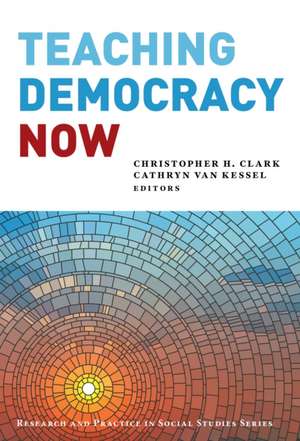
Teaching Democracy Now
Editat de Christopher H Clark, Cathryn van Kesselen Limba Engleză Hardback – 28 aug 2026
This volume provides a frank, research-based appraisal of how to navigate K–12 curriculum while examining the political and social conditions that cause democratic education to falter.
Leading scholars in the field of social studies and civic education move beyond the "paper democracy" of standard textbooks to address modern issues like disinformation, authority, and digital discourse. Educators will find practical, proactive, and reactive strategies to help students develop the habits and skills necessary to resist authoritarianism and defend democratic norms.
This volume offers a holistic approach to civic education with teacher resources for a fractious age. This is an essential guide for those ready to embrace the brave work of instilling democratic values in the "now."
Key Features:
- Strategies for Combatting Disinformation: Offers actionable advice for playing defense against harmful misinformation and community suspicion.
- Real-World Governance: Compares textbook ideals with the undemocratic practices of the real world, such as persistent educational inequalities and the influence of billionaires.
- Discussion-Ready Content: Features tailored prompts for individual reflection, social studies methods courses, or professional development.
- Justice-Centered Pedagogy: Grounds democratic efforts in correcting flawed assumptions and prioritizing justice for those at the margins.
- Holistic Learning: Bridges the gap between political education and often messy political realities.
Preț: 738.80 lei
Preț vechi: 959.48 lei
-23% Nou
Puncte Express: 1108
Carte indisponibilă temporar
Doresc să fiu notificat când acest titlu va fi disponibil:
Se trimite...
Specificații
ISBN-13: 9780807785041
ISBN-10: 0807785040
Pagini: 240
Dimensiuni: 161 x 237 x 20 mm
Greutate: 0.48 kg
Editura: Teachers College Press
ISBN-10: 0807785040
Pagini: 240
Dimensiuni: 161 x 237 x 20 mm
Greutate: 0.48 kg
Editura: Teachers College Press
Cuprins
Contents
Foreword Anne-Lise Halvorsen ixAcknowledgments xi
Introduction: Moving Past the Failure of the Enlightenment Education Project Christopher H. Clark and Cathryn van Kessel 1
PART I: HOW DID IT COME TO THIS? EXPLAINING THE DECLINE OF DEMOCRATIC EDUCATION AND LOOKING TO THE FUTURE
1. The Historical and Contemporary Marginalization of Social Studies in U.S. Education: Implications for Democracy 15
Tina L. Heafner and Paul G. Fitchett
2. Micro-Resistances Against Autocracy: Reconceptualizing the Panopticon to Give Back Power to the People 32
Erin C. Adams
3. Democratic Education and Social Studies Teachers in Unions, Professional Organizations, and Political Movements 46
Christopher C. Martell
4. Teaching for (and Not Just About) Prosocial Political Disobedience 60
Cathryn van Kessel and Rebeka Plots
5. Let Us Become the Radicals They Accuse Us of Being: Naming Power and Thwarting Neutrality in the Ruins of Liberal Democracy 70
Mardi Schmeichel and Alexander Cuenca
PART II: WHAT TO DO WITH THE TIME THAT IS GIVEN TO US? WAYS OF TEACHING DEMOCRACY NOW
6. Teaching for Democracy Under Political Threats 87
Judith L. Pace and Wayne Journell
7. Orientations to Authority-Democracy in the Mind 99
H. James Garrett
8. Countering Patriarchal Authoritarianism Through Feminist Pedagogy: "F*ck the Patriarchy" as Democratic Resistance 109
Rebecca C. Geller and Amelia H. Wheeler
9. The Gift of dis/Abled Knowledge: Thinking With Creativity, Joy, and Care 123
Sandra K. Vanderbilt
10. For the Future: Uprooting Settler Colonialism and the Teaching of "Democracy" in the Midst of Heartbreak and Hope 134
Sarah B. Shear
11. Lifting, Climbing, and Building: Toward a Black Feminist Conceptualization of Citizenship 145
Kristen E. Duncan and Ryan Oto
12. Teaching Democracy at the Intersection of Economics, Ideology, and Future Thinking 155
Debbie Sonu
13. Keeping Queer and Trans Identities (Un)Erased 166
J. B. Mayo Jr.
14. Teaching Who to Trust: Preparing Students to Make Decisions About Credible Digital Sources 176
Elizabeth Reynolds and Sarah McGrew
15. Teaching Democracy in the Age of Gen AI: Advancing Civic Literacy and Agency in Social Studies Education 187
Tina L. Heafner and Daniel Maxwell
Epilogue Christopher H. Clark and Cathryn van Kessel 206
Endnotes 211
Index 213
About the Editors and Contributors 223