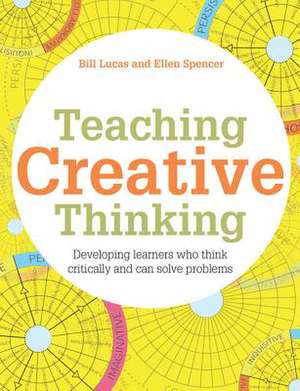
Teaching Creative Thinking
Autor Bill Lucas, Ellen Spenceren Limba Engleză Paperback – 26 sep 2017
Recomandăm acest volum ca referință profesională esențială pentru cadrele didactice din învățământul primar și secundar, precum și pentru studenții de la masteratele de pedagogie. Observăm că Teaching Creative Thinking nu se rezumă la o simplă pledoarie teoretică, ci propune o schimbare de paradigmă: trecerea de la acumularea de informații la formarea unor capacități durabile. Descoperim aici fundamentul seriei Pedagogy for a Changing World, unde autorii Bill Lucas și Ellen Spencer demistifică creativitatea, transformând-o dintr-un concept abstract într-un set de cinci obiceiuri mentale concrete și evaluabile. Structura lucrării este remarcabil de riguroasă, combinând cercetarea academică de ultimă oră cu un ghid practic de implementare. Reținem integrarea unor metode precum învățarea bazată pe probleme sau experimentarea ludică, toate susținute de studii de caz din școli care au adoptat deja aceste inovații. Cititorii familiarizați cu Teaching Creative and Critical Thinking in Schools de Russell Grigg vor aprecia aici accentul pus pe 'dispositional teaching' și pe strategiile specifice de evaluare a progresului, oferind un cadru mai aplicat pentru pregătirea elevilor în vederea noilor standarde internaționale PISA. Față de lucrările anterioare ale lui Bill Lucas, cum este Pocket PAL: Involving Parents in Schools, acest volum extinde viziunea educațională de la implicarea părinților către o reformă profundă a experienței de învățare la clasă, pregătind terenul pentru volumele ulterioare ale seriei, precum Zest for Learning.
Preț: 141.81 lei
Carte disponibilă
Livrare economică 02-16 noiembrie
Livrare express 16-22 octombrie pentru 31.17 lei
Specificații
ISBN-10: 1785832360
Pagini: 216
Dimensiuni: 181 x 221 x 17 mm
Greutate: 0.46 kg
Editura: Crown House Publishing
V-ar putea interesa
-
 Expansive EducationBill Lucas-27%Preț: 194.56 lei266.20 lei
 -
 Memories of a Georgia TeacherMartha Mizell PuckettPreț: 380.91 lei
 -
 Book of SpellsBill LucasPreț: 91.62 lei
 -
 -21%Preț: 305.93 lei388.27 lei
 -
 Preț: 150.52 lei
 -
 When She LeadsKatrina RileyPreț: 140.74 lei
 -
 Creative Thinking in SchoolsBill LucasPreț: 200.10 lei
 -
 -42%Preț: 78.58 lei134.60 lei
 -
 Discover Your Hidden TalentsBill Lucas-44%Preț: 149.04 lei266.33 lei
 -
 Primary School Mathematics DictionarySteven RhodesPreț: 90.56 lei
 -
 Primary School English DictionarySteven RhodesPreț: 94.11 lei
 -
 The Christian's Guide To College AdmissionsGlenda DuranoPreț: 112.58 lei
 -
 TABE Math Exercise BookReza NazariPreț: 125.05 lei
 -
 ISEE Upper Level Math Exercise BookReza NazariPreț: 124.54 lei
 -
 ISEE Lower Level Math Exercise BookReza NazariPreț: 124.32 lei
 -
 SSAT Lower Level Math Exercise BookReza NazariPreț: 114.32 lei
 -
 Preț: 349.01 lei
 -
 Educational Planning and Management: FinancingBoureima Jacques KiPreț: 399.23 lei
 -
 -15%Preț: 638.81 lei751.54 lei
De ce să citești această carte
Această carte se adresează profesorilor și liderilor școlari care doresc să depășească modelul tradițional de predare. Cititorul câștigă un set de instrumente validate prin cercetare pentru a cultiva gândirea critică și creativă, esențiale în economia secolului XXI. Este un manual practic ce oferă soluții concrete pentru integrarea creativității în curriculumul zilnic, asigurând elevilor competențele necesare pentru a reuși într-o lume în continuă schimbare.
Despre autor
Bill Lucas este profesor de învățare la Universitatea din Winchester și codirector al Centrului pentru Învățare în Lumea Reală. Cu o carieră vastă ca lider școlar și CEO al Campaign for Learning, Lucas este o autoritate recunoscută în pedagogia modernă. Împreună cu Ellen Spencer, a dezvoltat modele educaționale care pun accent pe dispozițiile de învățare și pe capacitățile practice. Opera sa reflectă un angajament constant față de inovarea sistemelor de învățământ, fiind consultant pentru numeroase instituții internaționale în domeniul evaluării competențelor creative.
Descriere scurtă
Teaching Creative Thinking: Developing Learners Who Generate Ideas and Can Think Critically defines and demystifies the essence of creative thinking, and offers action-oriented and research-informed suggestions as to how it can best be developed in learners.
Where once it was enough to know and do things, young people now need more than subject knowledge in order to thrive: they need capabilities. Teaching Creative Thinking is the first title in the three-part Pedagogy for a Changing World series, founded upon Lucas and Spencer's philosophy of dispositional teaching a pedagogical approach which aims to cultivate in learners certain dispositions that evidence suggests are going to be valuable to them both at school and in later life.
A key capability is creative thinking, and, in 2021, one of the guardians of global comparative standards, PISA, is recognising its importance by making creative thinking the 'innovative assessment domain' to supplement their testing of 15-year-olds' core capabilities in English, maths and science. Creative thinkers are inquisitive, collaborative, imaginative, persistent and disciplined and schools which foster these habits of mind in learners need to be creative in engaging children and young people by embedding creativity into their everyday educational experiences.
In this extensive enquiry into the nature and nurture of creative thinking, the authors explore the effectiveness of various pedagogical approaches including problem-based learning, growth mindset, playful experimentation and the classroom as a learning community and provide a wealth of tried-and-tested classroom strategies that will boost learners' critical and creative thinking skills. The book is structured in an easy-to-access format, combining a comprehensive listing of practical ideas to stimulate lesson planning with expert guidance on integrating them into your practice, followed by plenty of inventive suggestions as to how learners' progress can be assessed and tracked along the way by both the pupil and the teacher. The authors then go further to offer exemplars of success by presenting case studies of schools' innovations in adopting these approaches, and dedicate a chapter to dispelling any pressing doubts that teachers may have by exposing the potential pitfalls and offering advice on how to avoid them.
Venturing beyond the classroom setting, Teaching Creative Thinking also delves into the ways in which a school can work towards the provision of co-curricular experiences such as partnering with a range of external community groups and better engage its leadership team and pupils' parents with the idea of creative thinking in order to support learners with opportunities to grow. The authors offer many examples which will inspire schools to do just this, and collate these ideas into building a framework for learning that equips young people in schools today with the twenty-first century skills and capabilities that will enable them to thrive in the workforce of tomorrow.
Replete with research-led insight and ready-to-use strategies, Teaching Creative Thinking is a powerful call to action and a practical handbook for all teachers and leaders, in both primary and secondary settings, who want to embed a capabilities approach in their schools.
Notă biografică
Professor Bill Lucas is Director of the Centre for Real-World Learning at the University of Winchester and, with Ellen Spencer, the originator of a model of creativity in use in schools across the world. A global thought-leader, Bill was co-chair of the PISA 2022 test of creative thinking and curates the Creativity Exchange website.