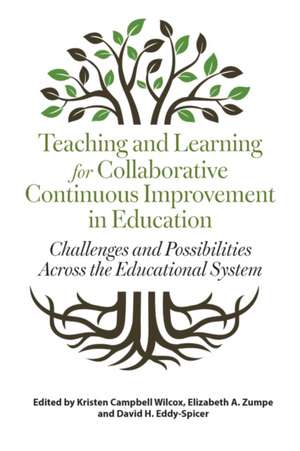
Teaching and Learning for Collaborative Continuous Improvement in Education
Editat de Kristen Wilcox, Elizabeth Zumpe, David H Eddy-Spiceren Limba Engleză Paperback – 3 aug 2026
What sets this book apart is its collaborative approach to knowledge sharing. Rather than prescribing one-size-fits-all solutions, the editors and authors position themselves as colleagues and peers, sharing hard-won lessons from their own improvement journeys. Each chapter follows a systematic structure that includes contextual background, theoretical foundations, learning objectives and approaches, documented results, and honest reflections on lingering questions—providing readers with both inspiration and actionable guidance.
The book's organization reflects its commitment to addressing real-world complexity. Following an introductory chapter that maps the current terrain of CCIE teaching and learning, subsequent sections dive deep into specific challenges: designing CCIE learning experiences for different audiences, adapting approaches for varying purposes, and leveraging different modalities effectively. Rich case studies and illustrative examples demonstrate how theory translates into practice across diverse educational contexts. This comprehensive resource serves multiple audiences simultaneously. Higher education faculty will find research-based approaches to curriculum design and pedagogy. Professional developers will discover strategies for building organizational capacity using theoretically-grounded and tested approaches. State education leaders will gain insights into system-wide implementation approaches. Most importantly, all readers will find concrete tools for learning with and from each other—breaking down the isolation that too often hampers improvement efforts. The book concludes with a look to the future—highlighting emerging trends and future opportunities in CCIE teaching and learning, while supplementary materials provide readers with immediately usable resources. For anyone committed to spreading the knowledge and skills that drive educational change, this book offers both the vision and the tools to transform how we teach, learn, and improve together. It represents an essential contribution to the growing field of improvement science in education—and a vital resource for the professionals working to make that science accessible, applicable, and impactful across the entire educational ecosystem.
Perfect for courses such as: Continuous Quality Improvement in Education and Human Services; Networked Improvement Communities; Improvement Science Capstone; Leadership for Continuous Improvement; Leadership Experiences, Application and Development; Leadership for Equity for Equity and Improvement; Instructional Leadership; Doctoral Seminar: Dynamics of Improving Schools and Districts; and Supervision of Instruction
Preț: 305.11 lei
Nou
Puncte Express: 458
Carte disponibilă
Livrare economică 19 octombrie-02 noiembrie
Livrare prin curier în România Termenul estimat este afișat lângă disponibilitate.
Transport gratuit de la 400.00 lei Plată online sau ramburs, în funcție de opțiunile comenzii.
Retur gratuit în 14 zile Comandă securizată și suport în română.
Specificații
ISBN-13: 9781975508210
ISBN-10: 1975508211
Pagini: 300
Dimensiuni: 152 x 228 x 24 mm
Greutate: 0.54 kg
Editura: Myers Education Press
ISBN-10: 1975508211
Pagini: 300
Dimensiuni: 152 x 228 x 24 mm
Greutate: 0.54 kg
Editura: Myers Education Press
Notă biografică
Dr. Kristen C. Wilcox is a Professor in the Educational Policy and Leadership Department at the University at Albany and serves as Research & Development Director of NYKids.org, a groundbreaking University-School Improvement Hub that bridges research and practice to improve educational outcomes. As an accomplished educator and scholar, Dr. Wilcox teaches graduate courses in instructional leadership, research methods, and continuous quality improvement in education and human services, preparing the next generation of educational leaders through her innovative approaches to teaching and mentorship. Dr. Wilcox has established herself as a leading bridging and translational scholar who connects research, policy, and practice. Her work addresses critical questions about the complex relationships between educational policy, leadership effectiveness, curriculum development, and instructional excellence. Her research focuses on understanding the variability in children's and youth's educational experiences, examining how factors such as culture, language, and economic disadvantage influence student outcomes and success trajectories. Her scholarly contributions have been recognized through publication in premier educational journals including the Journal of Educational Change, Peabody Journal of Education, Educational Administration Quarterly, and Teachers College Record. Dr. Wilcox has authored and co-authored numerous books that provide practical, research-based guidance for educational practitioners. Her notable publications include Innovation in Odds-beating Schools, Best Practices from High Performing High Schools, and Best Practices from High Performing Middle Schools. Beyond these major works, she has contributed to numerous edited volumes, book chapters, research briefs, newsletters, and blog posts, many of which are featured on the NYKids website and serve as essential resources for educators nationwide. Dr. Wilcox's research has directly informed the development of improvement science-based resources and practical tools that support system-wide educational transformation. She actively shares these evidence-based strategies with practicing professionals through institutes, workshops, and professional development sessions throughout New York State and beyond, ensuring that research findings translate into meaningful classroom and school-level improvements.
Elizabeth Zumpe is an assistant professor of Educational Leadership and Policy Studies at the University of Oklahoma. Her research focuses on the development of collective agency and problem-solving mindsets for continuous improvement in schools and districts facing adversity. Through her work, she aims to understand how educators and researchers across the educational system develop collaborative capabilities to solve educational problems. Some of her work focuses on the dynamics of improvement-focused research-practice partnerships (RPPs) and how researchers develop identities for partnership-based research. Elizabeth also studies the development of alternative Ed.D. programs in universities focused on practitioner inquiry and improvement science. Her work has been published AERA Open, American Journal of Education, Journal of Educational Change, Leadership and Policy in Schools, Frontiers in Education, and School Administrator. A former K-12 public school teacher for over a decade with National Board Certification, Elizabeth holds a Ph.D. in Education from the University of California, Berkeley.
Elizabeth Zumpe is an assistant professor of Educational Leadership and Policy Studies at the University of Oklahoma. Her research focuses on the development of collective agency and problem-solving mindsets for continuous improvement in schools and districts facing adversity. Through her work, she aims to understand how educators and researchers across the educational system develop collaborative capabilities to solve educational problems. Some of her work focuses on the dynamics of improvement-focused research-practice partnerships (RPPs) and how researchers develop identities for partnership-based research. Elizabeth also studies the development of alternative Ed.D. programs in universities focused on practitioner inquiry and improvement science. Her work has been published AERA Open, American Journal of Education, Journal of Educational Change, Leadership and Policy in Schools, Frontiers in Education, and School Administrator. A former K-12 public school teacher for over a decade with National Board Certification, Elizabeth holds a Ph.D. in Education from the University of California, Berkeley.
Cuprins
Acknowledgments
Foreword
Introduction
Section I: Designing for Diverse Learners
Chapter 1. Continuous Quality Improvement and Leadership Development in Early Childhood Education Programs
• John J. Hall and Shannon M. Calderone
Chapter 2. The Core Practice Test Kitchen: A Model for Collaborative Professional Learning through Small, Facilitated Instructional Improvement Teams
• Isobel Stevenson, Andrew Volkert, Thomas Nobili, and Rydell Harrison
Chapter 3. Designing Collaborative Learning Within and Across Districts for Equity-Centered Systems Change
• Alison Fox Resnick, Caitlin Farrell, Kim Wright, Marc Stein, Paula Arce-Trigatti, Terrenda White, Faith Stroud, Gregg Moffitt, Rosalind Ray, Bonifacio Sanchez, and Mickie Sebenoler
Chapter 4. Developing Learning-Focused Leaders Through Design-Based School Improvement: Lessons Learned Across Germany and the United States
• Elizabeth Zumpe, Corrine Aramburo, Nils Reubke, Julia Winter, and Nina Bremm
Chapter 5. Better Paths to Belonging: Designing Learning Experiences to Build Capacity for Critical CCIE
• Megan MacDonald, Katrina Struloeff, Kyra Williams, and Sasha Mejia-Bradford
Section II: Addressing Critical Learning Challenges
Chapter 6. Balancing Data and Reflection: Supporting Teachers in Meaningful PDSA Cycles for Instructional Improvement
• Alison Brockhouse, Rachel Ruggirello, and Gloria Pfeifer
Chapter 7. Practical Measurement as a Tool in Collaborative Continuous Improvement in Education: A Case Study of a Measure of Teacher Professional Learning
• Rebecca Perry, Angela Knotts, Andrew Brannegan, and Sola Takahashi
Chapter 8. Learning to Heal: A Conceptual Framework for Humanizing Collaborative Continuous Improvement in Education
• Manuelito Biag
Chapter 9. When Equity is Not Invoked: Transfer of an EdD Program's Equity Curricula to Generalized Practice
• David A. R. Trautman, Maxwell M. Yurkofsky, and Randy W. Hetherington
Chapter 10. Converging and Tensioning: Alignment Practices in Continuous Improvement in Education
• Carlos Sandoval, Jonathan R. Dolle, and Rebecca Colina Neri
Chapter 11. Navigating the Tensions of Continuous Improvement: Balancing Accountability, Teacher Autonomy, and Collaboration in an Australian High School
• Catherine Challen
Section III: Using Different Modalities
Chapter 12. Designing and Sustaining an IPT EdD Program for Practitioners: Modalities, Strategies, and Lessons Learned in Collaborative Continuous Improvement
• Lauren Adlof and Holley Handley
Chapter 13. Learn, Model, Apply: A Framework for Collaborative Improvement in Administration Preparation Programs
• Michelle M. Beavers
Chapter 14. Supporting Local Educational Innovation through Collaborative, Continuous Improvement: Self-Directed/Community-Supported Learning in MOOCs
• Donald J. Peurach, Aysha Jerald, and Jacob M. Aguinaga
Chapter 15. Teaching Improvement Science in Online EdD Programs: Reducing Geographic Inequities in Leadership Preparation
• Sarah Zuckerman and Daniella Hall Sutherland
Conclusion
About the Editors and Authors
Index
NOTE: Table of Contents subject to change up until publication date.
Foreword
Introduction
Section I: Designing for Diverse Learners
Chapter 1. Continuous Quality Improvement and Leadership Development in Early Childhood Education Programs
• John J. Hall and Shannon M. Calderone
Chapter 2. The Core Practice Test Kitchen: A Model for Collaborative Professional Learning through Small, Facilitated Instructional Improvement Teams
• Isobel Stevenson, Andrew Volkert, Thomas Nobili, and Rydell Harrison
Chapter 3. Designing Collaborative Learning Within and Across Districts for Equity-Centered Systems Change
• Alison Fox Resnick, Caitlin Farrell, Kim Wright, Marc Stein, Paula Arce-Trigatti, Terrenda White, Faith Stroud, Gregg Moffitt, Rosalind Ray, Bonifacio Sanchez, and Mickie Sebenoler
Chapter 4. Developing Learning-Focused Leaders Through Design-Based School Improvement: Lessons Learned Across Germany and the United States
• Elizabeth Zumpe, Corrine Aramburo, Nils Reubke, Julia Winter, and Nina Bremm
Chapter 5. Better Paths to Belonging: Designing Learning Experiences to Build Capacity for Critical CCIE
• Megan MacDonald, Katrina Struloeff, Kyra Williams, and Sasha Mejia-Bradford
Section II: Addressing Critical Learning Challenges
Chapter 6. Balancing Data and Reflection: Supporting Teachers in Meaningful PDSA Cycles for Instructional Improvement
• Alison Brockhouse, Rachel Ruggirello, and Gloria Pfeifer
Chapter 7. Practical Measurement as a Tool in Collaborative Continuous Improvement in Education: A Case Study of a Measure of Teacher Professional Learning
• Rebecca Perry, Angela Knotts, Andrew Brannegan, and Sola Takahashi
Chapter 8. Learning to Heal: A Conceptual Framework for Humanizing Collaborative Continuous Improvement in Education
• Manuelito Biag
Chapter 9. When Equity is Not Invoked: Transfer of an EdD Program's Equity Curricula to Generalized Practice
• David A. R. Trautman, Maxwell M. Yurkofsky, and Randy W. Hetherington
Chapter 10. Converging and Tensioning: Alignment Practices in Continuous Improvement in Education
• Carlos Sandoval, Jonathan R. Dolle, and Rebecca Colina Neri
Chapter 11. Navigating the Tensions of Continuous Improvement: Balancing Accountability, Teacher Autonomy, and Collaboration in an Australian High School
• Catherine Challen
Section III: Using Different Modalities
Chapter 12. Designing and Sustaining an IPT EdD Program for Practitioners: Modalities, Strategies, and Lessons Learned in Collaborative Continuous Improvement
• Lauren Adlof and Holley Handley
Chapter 13. Learn, Model, Apply: A Framework for Collaborative Improvement in Administration Preparation Programs
• Michelle M. Beavers
Chapter 14. Supporting Local Educational Innovation through Collaborative, Continuous Improvement: Self-Directed/Community-Supported Learning in MOOCs
• Donald J. Peurach, Aysha Jerald, and Jacob M. Aguinaga
Chapter 15. Teaching Improvement Science in Online EdD Programs: Reducing Geographic Inequities in Leadership Preparation
• Sarah Zuckerman and Daniella Hall Sutherland
Conclusion
About the Editors and Authors
Index
NOTE: Table of Contents subject to change up until publication date.