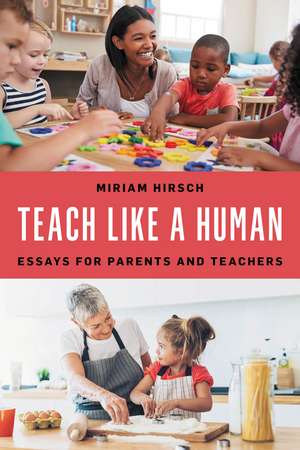
Teach Like a Human: Essays for Parents and Teachers
Autor Miriam Hirschen Limba Engleză Hardback – 15 oct 2020
Standards based teaching strategies with its culture of testing will never solve the problem of teaching all children according to their needs. Physical, social, and emotional health are each important aspects of human development and children need strong relationships, positive role models, good friends, and high expectations from people who care about them. It truly all matters.
Peppered with humor, metaphor and narrative, this book illuminates how educators, both parents and teachers, can galvanize experiences to deepen character, insight, empathy and joy in the people and things around us. To teach like a human means to teach with consciousness of what it means to be human, by focusing on qualitative aspects of life with sensitivity and strategy.
Preț: 219.85 lei
Preț vechi: 298.15 lei
-26%
Puncte Express: 330
Carte tipărită la comandă
Livrare economică 05-19 decembrie
Livrare prin curier în România Termenul estimat este afișat lângă disponibilitate.
Transport gratuit de la 400.00 lei Plată online sau ramburs, în funcție de opțiunile comenzii.
Retur gratuit în 14 zile Comandă securizată și suport în română.
Specificații
ISBN-13: 9781475857214
ISBN-10: 1475857217
Pagini: 100
Dimensiuni: 160 x 229 x 16 mm
Greutate: 0.3 kg
Editura: Bloomsbury Publishing
Colecția Rowman & Littlefield
Locul publicării:New York, United States
ISBN-10: 1475857217
Pagini: 100
Dimensiuni: 160 x 229 x 16 mm
Greutate: 0.3 kg
Editura: Bloomsbury Publishing
Colecția Rowman & Littlefield
Locul publicării:New York, United States
V-ar putea interesa
-
 The Power of LoveSimone BogerPreț: 78.93 lei
 -
 El KybalionTres IniciadosPreț: 51.95 lei
 -
 MindfulnessJoe BaileyPreț: 67.53 lei
 -
 Five Senses MeditationMarta TuchowskaPreț: 73.64 lei
 -
 Mindfulness and Meditation Ultimate GuideLisa KimberlyPreț: 61.67 lei
 -
 Tartu Hetkeen Varityskirja AikuisilleAnna StenmarkPreț: 63.39 lei
 -
 Meditation for BeginnersMichael DinuriPreț: 60.27 lei
 -
 Cultivating MindfulnessKham RelPreț: 97.56 lei
 -
 Ganz Im JetztAnna StenmarkPreț: 56.71 lei
 -
 MindfulnessJennifer N. SmithPreț: 100.43 lei
 -
 Dhyana YogaDr Andrea Scarsi Msc D.Preț: 118.80 lei
 -
 ConsiderationsColin WrightPreț: 80.54 lei
 -
 Preț: 106.36 lei
 -
 Massage TherapyJessica ThompsonPreț: 116.07 lei
 -
 The Joy of MeditationJoe BaileyPreț: 67.92 lei
 -
 A Subconscious State of Mind 11Gold, A. O.Preț: 33.01 lei
 -
 Unleash Your Primal PowerLeanna Manuel Psy. D.Preț: 103.83 lei
 -
 Talking to the Herbs & Crystals Too!Liz ChristianPreț: 108.24 lei
 -
 6 Steps to MindfulnessLeigh, DanPreț: 66.21 lei
 -
 Jewel in the MudHarmony KentPreț: 103.97 lei
 -
 Don't Worry EverReverend Mike WannerPreț: 34.13 lei
 -
 Preț: 40.60 lei
 -
 Quien camina a tu lado: Las 24 etapas hacia tu verdadera identidadIciar Sanchez MonteroPreț: 131.45 lei
 -
 Rethinking good governanceVinod RaiPreț: 57.78 lei
 -
 Preț: 57.60 lei
Cuprins
Foreword
Introduction
Part I. For Parents (& Teachers)
Chapter 1: The Mathematics of Motherhood
Chapter 2: The Parent as Curriculum Developer
Chapter 3: Lessons from Mrs. Bird
Chapter 4: Contending with Sibling Rivalry: Insights from Jewish Texts
Chapter 5: Reading Schools: A Primer
Part II. For Teachers (& Parents)
Chapter 6: Reclaiming the Art of Listening
Chapter 7: Out of the Box and Between the Lines
Chapter 8: Sifting the Metaphor: Teaching as a Culinary Art
Chapter 9: "More Beauty in a Rock:" What we don't teach & how it matters
Chapter 10: Teach Like a Human: The Reality Gap in Educator Preparation
Conclusion
Introduction
Part I. For Parents (& Teachers)
Chapter 1: The Mathematics of Motherhood
Chapter 2: The Parent as Curriculum Developer
Chapter 3: Lessons from Mrs. Bird
Chapter 4: Contending with Sibling Rivalry: Insights from Jewish Texts
Chapter 5: Reading Schools: A Primer
Part II. For Teachers (& Parents)
Chapter 6: Reclaiming the Art of Listening
Chapter 7: Out of the Box and Between the Lines
Chapter 8: Sifting the Metaphor: Teaching as a Culinary Art
Chapter 9: "More Beauty in a Rock:" What we don't teach & how it matters
Chapter 10: Teach Like a Human: The Reality Gap in Educator Preparation
Conclusion
Recenzii
With COVID-19 turning everything upside down, parents and others raising children are even more important as partners in their children's education. Hirsch, who has taught educator preparation, stresses that parents and teachers need to remember that they're teaching what it means to be human along with historical facts, math functions, and grammar rules. . . . Both parents and teachers will be encouraged by Hirsch's commonsense suggestions and practical tips. This accessible book offers practical ways for family and educators to work together toward the ultimate goal of a child's growth and happiness.
COVID-19 has changed everything . . . Teaching went online, and work and home boundaries shifted, as many parents found themselves attempting to balance the roles of parent, school facilitator, and at-home employee. . . . New questions created in teaching create uncertainty on old ways and practices. Hirsch states that teacher must come into the room with the same open questions and wonder that children feel and experience in order to fuel a continuously learning mindset in their classroom . . . Hirsch's book may prove helpful to those who have had to learn to balance teaching or facilitating with parenting since March 2020.
What's the best way to teach? What does "the research" say? Those questions have dominated our educational discourse for the past two decades. But the quest for evidence-based approaches to teaching and learning has diverted us from the larger question of why we should teach--or learn--at all. Miriam Hirsch provides some clear and inspired answers in this smart little book, re-connecting us with the spirit and passion that brought so many of us into the world of education in the first place.
Miriam Hirsch's new book provides an artful view of education and parenting in which the wonders of teaching and learning are understood as creative processes. In a voice replete with experience, compassion, and genuine inquiry, Dr. Hirsch suggests we turn to the very human arena of the arts to learn how to imagine beyond the given and discover and create meaning.
Hirsch's work provides encouragement for teachers and teacher educators to embrace an expanded notion of creativity, one that goes beyond incorporating the arts into academic content areas but also illustrates the need to think creatively across all educational activities such as lesson planning and content delivery. Creativity here is linked to how deeply and widely we question, encourage questioning in others, and engage our deepest senses of curiosity and connection in relation to students' experience within our curriculum.
Hirsch has written a valuable addition to the literature addressing parents and teachers who are reaching for a more humane, imaginative, meaningful and engaging approach to teaching and learning. This book addresses the importance of interacting with the individual child and attending to their experiences and perspectives while introducing them to complexity and wonder of the world around them.
Importantly, Hirsch grounds her guidance in the works of such educational philosophers as John Dewey and Maxine Greene. Some of her watchwords throughout the text such as imagination, curiosity and personal connection reflect their teachings. Hirsch encourages "imaginative relationships between the arts and life" believing that this is fundamental to nurturing a empathetic relationship between one self and the world.
Speaking to an audience that embraces the perspective and interests of both the parent and the emergent, pre-service teacher. What these constituents want to offer school-aged children, she points out, is often in direct conflict with requirements of the school system at large undermining the essential capacities of what it means to be human.
COVID-19 has changed everything . . . Teaching went online, and work and home boundaries shifted, as many parents found themselves attempting to balance the roles of parent, school facilitator, and at-home employee. . . . New questions created in teaching create uncertainty on old ways and practices. Hirsch states that teacher must come into the room with the same open questions and wonder that children feel and experience in order to fuel a continuously learning mindset in their classroom . . . Hirsch's book may prove helpful to those who have had to learn to balance teaching or facilitating with parenting since March 2020.
What's the best way to teach? What does "the research" say? Those questions have dominated our educational discourse for the past two decades. But the quest for evidence-based approaches to teaching and learning has diverted us from the larger question of why we should teach--or learn--at all. Miriam Hirsch provides some clear and inspired answers in this smart little book, re-connecting us with the spirit and passion that brought so many of us into the world of education in the first place.
Miriam Hirsch's new book provides an artful view of education and parenting in which the wonders of teaching and learning are understood as creative processes. In a voice replete with experience, compassion, and genuine inquiry, Dr. Hirsch suggests we turn to the very human arena of the arts to learn how to imagine beyond the given and discover and create meaning.
Hirsch's work provides encouragement for teachers and teacher educators to embrace an expanded notion of creativity, one that goes beyond incorporating the arts into academic content areas but also illustrates the need to think creatively across all educational activities such as lesson planning and content delivery. Creativity here is linked to how deeply and widely we question, encourage questioning in others, and engage our deepest senses of curiosity and connection in relation to students' experience within our curriculum.
Hirsch has written a valuable addition to the literature addressing parents and teachers who are reaching for a more humane, imaginative, meaningful and engaging approach to teaching and learning. This book addresses the importance of interacting with the individual child and attending to their experiences and perspectives while introducing them to complexity and wonder of the world around them.
Importantly, Hirsch grounds her guidance in the works of such educational philosophers as John Dewey and Maxine Greene. Some of her watchwords throughout the text such as imagination, curiosity and personal connection reflect their teachings. Hirsch encourages "imaginative relationships between the arts and life" believing that this is fundamental to nurturing a empathetic relationship between one self and the world.
Speaking to an audience that embraces the perspective and interests of both the parent and the emergent, pre-service teacher. What these constituents want to offer school-aged children, she points out, is often in direct conflict with requirements of the school system at large undermining the essential capacities of what it means to be human.