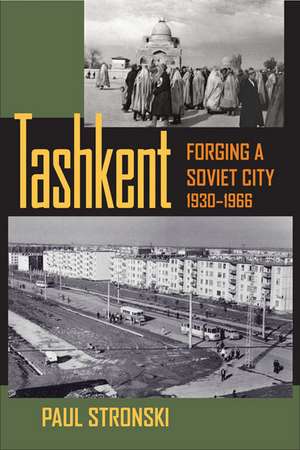
Tashkent: Forging a Soviet City, 1930–1966: Central Eurasia in Context
Autor Paul Stronskien Limba Engleză Paperback – 19 sep 2010
Deși Tashkent nu vine însoțit de resurse digitale multimedia, valoarea sa documentară este susținută de o metodologie riguroasă de cercetare în arhivele din Moscova și Uzbekistan. Apreciem modul în care Paul Stronski reușește să reconstruiască nu doar arhitectura unui oraș, ci și mecanismele sociale prin care autoritățile sovietice au încercat să transforme o metropolă majoritar musulmană într-o vitrină a progresului socialist. Găsim în această lucrare o analiză detaliată a modului în care planificarea urbană — de la bulevarde largi și fântâni, până la spitale și fabrici — a fost utilizată ca instrument de inginerie socială.
Spre deosebire de alte studii regionale, această monografie urmărește evoluția orașului prin etape istorice critice, de la epurările staliniste până la efortul de război, culminând cu seismul devastator din 1966. Ca și Despite Cultures, care explorează construcția statului sovietic în Tadjikistan prin prisma violenței și modernizării, volumul de față subliniază tensiunea dintre tradițiile etnice locale și ideologia impusă de centru. Totuși, Paul Stronski se diferențiază prin concentrarea pe spațiul urban ca 'grădină înfloritoare' și pe modul în care legitimitatea regimului a fost, în cele din urmă, acceptată de populație. Comparativ cu From Socialist to Post-Socialist Cities, care privește spre tranziția actuală, această carte oferă fundamentul istoric necesar pentru a înțelege cum a fost forjată identitatea unei capitale din Asia Centrală sub presiunea uniformizării arhitecturale și culturale.
Din seria Central Eurasia in Context
- 15%
 Preț: 542.08 lei
 -
 Preț: 443.78 lei
 -
 Preț: 359.74 lei
 -
 Preț: 250.43 lei
 -
 Preț: 371.89 lei
 -
 Preț: 387.43 lei
 -
 Preț: 424.42 lei
 -
 Preț: 387.43 lei
 -
 Preț: 388.79 lei
 -
 Preț: 388.79 lei
 -
 Preț: 426.92 lei
 -
 Preț: 422.07 lei
 -
 Preț: 388.79 lei
 -
 Preț: 385.36 lei
 -
 Preț: 428.47 lei
 -
 Preț: 390.18 lei
 -
 Preț: 426.92 lei
 -
 Preț: 424.42 lei
 -
 Preț: 388.79 lei
 -
 Preț: 386.51 lei
Preț: 426.92 lei
Carte tipărită la comandă
Livrare economică 30 noiembrie-14 decembrie
Specificații
ISBN-10: 082296113X
Pagini: 368
Dimensiuni: 152 x 229 x 23 mm
Greutate: 0.51 kg
Ediția:1
Editura: University of Pittsburgh Press
Colecția University of Pittsburgh Press
Seria Central Eurasia in Context
V-ar putea interesa
-
 Cold ResistanceCarlysle L. JohnsonPreț: 92.00 lei
 -
 Herzog Martin V. ZoranskyJohann WilhelmPreț: 348.28 lei
 -
 Preț: 286.08 lei
 -
 Preț: 254.78 lei
 -
 Preț: 269.19 lei
 -
 Preț: 254.31 lei
 -
 Esquisses historiques des principaux événemens de la Révolution française T. 1Jacques-Antoine DulaurePreț: 238.89 lei
 -
 L'histoire de France racontée par les contemporains . T. 2Louis DussieuxPreț: 239.75 lei
 -
 L'histoire de France racontée par les contemporains . T. 4Louis DussieuxPreț: 231.92 lei
 -
 Henri de Valois Et La Pologne En 1572. T. 2Emmanuel Henri Victurnien NoaillesPreț: 230.86 lei
 -
 Histoire religieuse de la Révolution française. T. 3, 3e éd. - 1919Pierre De La GorcePreț: 261.79 lei
 -
 Journal Inédit Du Duc de Croÿ (1718-1784). T. 1Emmanuel de Croy-SolrePreț: 254.52 lei
 -
 Correspondance Inédite de Victor-François, Duc de Broglie Avec Le Prince Xavier de Saxe T2Victor-François de BrogliePreț: 277.26 lei
 -
 Collection des mémoires relatifs à l'histoire de France 41-43. Mémoires de Mlle de Montpensier. 4Anne-Marie-Louise-Henriette MontpensierPreț: 231.79 lei
 -
 Chartes et documents pour servir à l'histoire de l'abbaye de CharrouxPierre de MonsabertPreț: 285.10 lei
 -
 Preț: 238.51 lei
 -
 Souvenirs historiques sur la révolution de 1830Auguste Simon Louis BérardPreț: 231.32 lei
 -
 Histoire d'Angleterre. T. 11David HumePreț: 239.36 lei
 -
 Histoire d'Angleterre. T. 8David HumePreț: 238.77 lei
 -
 Histoire d'Angleterre. T. 3David HumePreț: 239.36 lei
 -
 Preț: 285.30 lei
De ce să citești această carte
Recomandăm această carte cercetătorilor și pasionaților de istorie urbană care doresc să înțeleagă cum ideologia politică modifică spațiul fizic. Cititorul câștigă o perspectivă rară asupra Asiei Centrale, descoperind cum un oraș 'feudal' a devenit un laborator social. Este un studiu esențial despre rezistență, adaptare și modul în care arhitectura poate servi drept propagandă, oferind date concrete dintr-o zonă geografică adesea ignorată de istoriografia occidentală.
Despre autor
Paul Stronski este un specialist recunoscut în istoria Rusiei și a Eurasiei, aducând în lucrările sale o expertiză vastă acumulată prin cercetări de teren și analiză politică. În volumul Tashkent, el valorifică accesul la arhivele rusești și uzbece pentru a oferi o imagine nuanțată a politicii sovietice în Asia Centrală. Activitatea sa academică se concentrează pe intersecția dintre planificarea urbană, identitatea etnică și mecanismele de control ale statului socialist, fiind un contributor important în cadrul seriei Central Eurasia in Context.
Descriere scurtă
The Soviets planned to transform Tashkent from a “feudal city” of the tsarist era into a “flourishing garden,” replete with fountains, a lakeside resort, modern roadways, schools, hospitals, apartment buildings, and of course, factories. The city was intended to be a shining example to the world of the successful assimilation of a distinctly non-Russian city and its citizens through the catalyst of socialism. As Stronski reveals, the physical building of this Soviet city was not an end in itself, but rather a means to change the people and their society.
Stronski analyzes how the local population of Tashkent reacted to, resisted, and eventually acquiesced to the city’s socialist transformation. He records their experiences of the Great Terror, World War II, Stalin’s death, and the developments of the Krushchev and Brezhnev eras up until the earthquake of 1966, which leveled large parts of the city. Stronski finds that the Soviets established a legitimacy that transformed Tashkent and its people into one of the more stalwart supporters of the regime through years of political and cultural changes and finally during the upheavals of glasnost.
Recenzii
—Jeff Sahadeo, Carleton University, Canada
—Fiona Hill, The Brookings Institution
—Adrienne Edgar, University of California, Santa Barbara
—Choice
—Russian Review
—Slavic Review