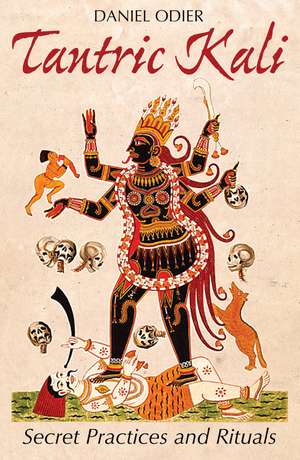
Tantric Kali: Secret Practices and Rituals
Autor Daniel Odieren Limba Engleză Paperback – dec 2016
În literatura academică și spirituală dedicată tantrismului, există adesea o lacună între analiza istorică a textelor și aplicabilitatea lor practică, multe volume rămânând blocate în interpretări pur simbolice care evită aspectele radicale ale tradiției. Subliniem faptul că Tantric Kali de Daniel Odier vine să completeze acest gol, oferind o perspectivă nefiltrată asupra tradiției Kaula din Șivaismul Kașmirian, unde corpul este privit ca templul zeiței, iar normele sociale sunt inversate pentru a atinge eliberarea. Recomandăm acest volum ca o alternativă la Kali Kaula de Jan Fries pentru cursurile de studii religioase sau antropologia religiilor orientale, cu avantajul că Odier se concentrează strict pe descendența inițiatică a tradiției Kaula, oferind instrucțiuni clare despre Vamachara (Calea Mâinii Stângi). Cartea este organizată progresiv: începe cu originile mitologice ale zeiței, continuă cu fundamentele tradiției Kaula și culminează cu ritualurile de uniune sacră și meditația pe cele opt chakre. Notăm cu interes includerea scripturii Nirrutara Tantra, un text esențial pentru înțelegerea modului în care emoțiile „interzise” sunt transformate în instrumente ale conștiinței. În contextul operei sale, Tantric Kali rafinează temele explorate anterior în Desire și Tantric Quest, trecând de la relatarea experiențelor personale la o structură riguroasă de manual practic, păstrând însă accentul pe ideea că nimic nu este impur în fața realității absolute.
Preț: 66.37 lei
Preț vechi: 89.93 lei
-26%
Carte disponibilă
Livrare economică 06-18 noiembrie
Livrare express 22-28 octombrie pentru 39.83 lei
Specificații
ISBN-10: 162055559X
Pagini: 128
Ilustrații: 7 b&w illustrations
Dimensiuni: 137 x 210 x 10 mm
Greutate: 0.14 kg
Editura: Inner Traditions/Bear & Company
Colecția Inner Traditions
V-ar putea interesa
-
 The JobDaniel OdierPreț: 133.01 lei
 -
 Preț: 68.52 lei
 -
 Desire: The Tantric Path to AwakeningDaniel Odier-44%Preț: 65.20 lei115.72 lei
 -
 The Templars and the Assassins: The Militia of HeavenJames WassermanPreț: 116.81 lei
 -
 The Gospel of Mary MagdaleneJean-Yves Leloup-24%Preț: 75.99 lei100.17 lei
 -
 Democracy and Constitutional Politics in IranFarshad Malek-AhmadiPreț: 437.32 lei
 -
 Aprirsi alla GioiaDaniel OdierPreț: 89.20 lei
 -
 Grace That Taught My Heart to FearBrendan BealePreț: 44.62 lei
 -
 The World, the Flesh, and the DevilBrendan BealePreț: 51.34 lei
 -
 We Bow Down in Prayer: 30 Days of Prayer and MeditationSavanda GasquePreț: 60.73 lei
 -
 -25%Preț: 85.66 lei114.42 lei
 -
 -24%Preț: 87.22 lei115.33 lei
 -
 Preț: 95.68 lei
 -
 -25%Preț: 98.51 lei130.52 lei
 -
 -39%Preț: 149.39 lei246.21 lei
 -
 Preț: 26.42 lei
 -
 The Woman with the Alabaster Jar: Mary Magdalen and the Holy GrailMargaret Starbird-23%Preț: 90.43 lei117.25 lei
 -
 Tantra - Eintauchen in die absolute LiebeDaniel OdierPreț: 115.63 lei
 -
 Die Ekstase des HerzensDaniel OdierPreț: 83.19 lei
 -
 Das tantrische ErwachenDaniel OdierPreț: 110.89 lei
 -
 FreudeDaniel OdierPreț: 84.94 lei
De ce să citești această carte
Recomandăm această lucrare celor interesați de formele autentice, non-duale ale tantrismului. Cititorul va câștiga o înțelegere profundă a figurii lui Kali, nu doar ca zeitate distructivă, ci ca forță eliberatoare care anulează dualitatea pur-impur. Este un ghid esențial pentru cei care doresc să exploreze legătura dintre spiritualitate și corporalitate, oferind acces la ritualuri și imnuri care au fost, timp de secole, transmise doar în cerc restrâns.
Despre autor
Daniel Odier este un autor și maestru spiritual recunoscut, a cărui formare a început în 1968 sub îndrumarea lui Kalu Rinpoche. Expertiza sa este vastă, fiind hirotonit în școlile Lin t'si și Caodong din China și având permisiunea de a preda linia Zhao Zhou Ch'an în Occident. Specialist în Șivaismul Kașmirian, Odier a dedicat numeroase lucrări explorării dorinței și trezirii spirituale, precum Desire: The Tantric Path to Awakening și Yoga Spandakarika. În prezent, acesta susține ateliere internaționale, fiind o voce autoritară în traducerea practicilor ezoterice estice pentru publicul european.
Descriere scurtă
• Reveals the practices of Vamachara, known as the Left-hand Path but more accurately translated as the Path of Shakti
• Includes a Kali ritual from the Nirrutara Tantra, translated here for the first time
• Presents devotional chants, meditations, and mudras specific to Tantric worship of Kali
According to traditions going back to pre-Vedic times, Kali sprang from the third eye of the Goddess Durga as a destructive and terrifying manifestation of feminine power sent to lay waste to the forces of evil. Throughout India to this day, Kali is worshipped as the destroyer of bondage, capable of liberating her devotee from all rules and subjugation.
In Tantric Kali, Daniel Odier presents the mythology, practices, and rituals of Kali worship in the Tantric Kaula tradition within Kashmiri Shaivism. He reveals the practices of Vamachara, commonly known as the Left-hand Path but more accurately translated as the Path of Shakti. In this tradition the body itself is Kali’s temple, and it is therefore unnecessary to reject or deny the body to know union with the divine. Instead, nothing is regarded as pure or impure and there is complete freedom from rules. Focused on working directly with forbidden emotions and behaviors, this path allows the seeker to transcend obstacles to liberation through sexual union. According to the Kaula Upanishad, “In your behavior do the opposite to what the norms dictate but remain in consciousness.” This is the essence of Tantra. Kali is absolute reality: manifested as woman intoxicated by desire, she frees the tantric practitioner from all desire except union with the divine.
The author includes an evocative ritual from the Nirrutara Tantra--never before translated into any Western language--containing devotions to the 64 yoginis according to Matsyendranath, founder of the Kaula path. Offering devotional chants, meditations, and mudras specific to Tantric worship of Kali, this empowering book provides practices and teachings for those on the Tantric path to liberation.
Notă biografică
Daniel Odier is a teacher of Tantra who received a mystical initiation from the tantric yogini, Lalita Devi. He was also a student of Kalu Rinpoche and received dharma transmission from a Chinese Chan Master. He founded the Tantra/Chan center in Paris and has taught courses on Eastern spiritual traditions at the University of California and on screen writing at the University of Tulsa. He is the author of Tantric Quest: An Encounter with Absolute Love and many other books, including Diva (under the nom de plume Delacorta), which was made into a popular movie of the same name. He lives in Switzerland.
Extras
Advancing on the Kaula Path
The Eight Chakras, Devouring of Inner Demons, and the Yoginis’ Ultimate Practice of the Heart
Kali speaks to us of the darker aspects of nature and our own human nature, yet she also speaks to us of love, for she became the consort of Shiva, adopted by tantric practitioners of the Kaula path. Kaula is the vamachara path, often called “the left-hand path,” but since vama also means “woman,” it would be more accurate and in harmony with the Kaula path to translate vamachara as “the Shakti path.”
THE YOGINIS’ PRACTICE OF THE HEART
As numerous tantras make known, the heart is the main energy center in the Kaula path. The Yoginis’ Practice of the Heart is considered to be the ultimate practice of sadhana because it continually connects the sadhana to the energy of the heart. This practice leads to the constant integration of the Real into the center of the Heart. Abhinavagupta points out that the pleasures of the senses linked to the ego deplete the reservoir of the heart, while the Practice of the Red Goddesses fills it ceaselessly. There are however three obstacles to overcome:
• The obstacle of egoistic individuality
• The obstacle of not recognizing one’s plenitude and one’s identity with the divine.
• The obstacle that renders pleasures of the senses a distraction and a loss of absolute essence.
Attachment is an identification with the physical body, freedom is an identification with the cosmic body.
Abhinavagupta says that he who at every moment dissolves the universe in his own consciousness and then manifests it once again by projecting it toward the world becomes Bhairava/Bhairavi.
It is through this practice received from Sambunatha, master of the Kaula tradition, that the awakening of Abhinavagupta took place. This practice leads to the ultimate.
• Become aware that reality is identical to your own heart--the place where the red yoginis reside.
• Levels of reality are layered around absolute consciousness.
• The fire of the knower-subject, the experience under the aspect of the sun and the moon of the knownobject, form a spiral that pours into the heart and emerges from it endlessly.
• Reality dissolves in the fire of the heart; reality springs forth from the heart.
• This ceaseless vortex reveals the true nature of the Self.
• The shaktichakra of the Heart delights in all sensorial, emotional, and mental forms, and the Goddesses ceaselessly harvest Reality in order to dissolve it in the Heart.
• External objects are recognized as identical to absolute consciousness in the fire of non-duality.
• The footprints and residues of perceptions dissolve.
• This is the union of Bhairava/Bhairavi in the Heart.
• Through this practice you attain supernatural powers which match the Real perfectly.
Kali Practice: The Devouring of Inner Demons
By “demons” you must understand that they are not external menacing entities; “all demons are manifestations of the ego.”
1. In a relaxed and comfortable posture consider the twelve categories of demons, and choose which one you want to work on:
1. Lack
2. Fear
3. Abandonment
4. Neurotic love
5. Addiction
6. Pride, positive or negative judgment of oneself or others
7. Family, father, mother
8. Anger, violence
9. Shame, guilt, unworthiness
10. Vanity
11. Cruelty
12. Sadness, depression
2. Travel through your body looking to meet the chosen demon. What is its usual abode? Is this an itinerant demon, or does it always hide in the same spot?
3. Once you have found the demon’s room (organ), enter that room with all your senses on the alert. At first, the room will be fairly dark. Sit down and scrutinize the dark. What do you feel, what do you see? Does the demon have objects around it? Protective animals perhaps? Does it appear itself? What shape does it adopt?
4. How many arms, legs, eyes? What does it smell like? What color is it?
5. Feel the demon’s frustration in not being able to be in full possession of you. Feel that your resistance gives it strength and ensures that you must struggle. This is the first time you have faced the demon, the first time you have seen it. To appease it you are going to offer it your body, your essence. It can devour you, drink you, absorb you.
6. When the demon is satisfied, the tension disappears. Face it without fear for the first time. Your resistance gave the demon its charge, its strength. Imagine a little golden sphere in the center of your heart. Perhaps your confrontation surprised the demon, drove it crazy, made it violent; maybe it is brandishing weapons, belching terrible sounds. But stay in the presence of the golden sphere, in the calm of peaceful breathing.
7. As you stay in the room, visualize that your body is floating in midnight blue space and that in this space, all around you, dozens of Kalis appear forming an unassailable sphere. Armed with their head slicer blades and their tridents, they excitedly await the battle.
8. Look the demon in the eyes, even if they are bloody, black, or terrifying. After breathing in deeply, feel that in the sudden powerful breathing out the golden sphere expands, explodes, moves out of your body and hurls the demon out of its room, through your body, and then into space where the famished Kalis are waiting for it. They descend on it, cut it to pieces, and devour it.
9. As soon as the demon has disappeared, the golden sphere returns to the room and surrounds it like a halo with gold that is half liquid, half vapor. You float in the golden light and thank the Goddess.
This practice is intense and tiring. Only deal with one demon at a time. No more than one each day. After the practice, take a shower or dive into a river, a lake, or the sea.
Cuprins
Preface
Introduction
Kali and the Tantric Path
1 Kali's Origins and Symbolism
2 The Kaula Tradition
3 Preliminary Practices of the Kaula Tradition
4 The Nirrutara Tantra
Scripture That Is Superior to All Others
5 The Rituals of Kali and the Sacred Union
6 Advancing on the Kaula Path
Meditation on the Eight Chakras, the Yoginis’ Ultimate Practice of the Heart, and the Devouring of Inner Demons
7 Hymns and Songs in Praise of Kali
Notes
Bibliography
Index
About the Author