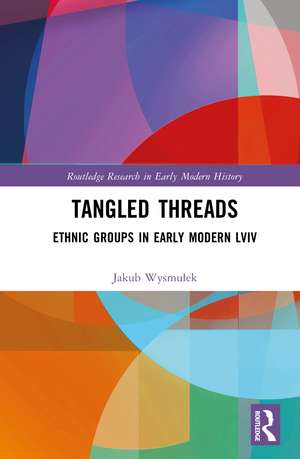
Tangled Threads: Ethnic Groups in Early Modern Lviv: Routledge Research in Early Modern History
Autor Jakub Wysmułeken Limba Engleză Hardback – 10 dec 2026
Combining archival research, urban history, and social theory, this book asks how ethnic groups were created in a premodern city. It shows that Lviv’s communities were not primordial entities or simple products of religious difference. They became durable collective actors through courts, councils of elders, confraternities, parishes, synagogues, schools, hospitals, and systems of representation. Their boundaries were narrated through origin stories, enforced through law and custom, materialised in houses and quarters, and continually tested by migration, external threats, economic rivalry, limited urban space, and everyday proximity.
Like the carpets once brought to Lviv by Armenian merchants, the city’s social fabric was woven from threads of different colour and thickness. The main strands remained visible, but they crossed, knotted, and changed their pattern over time. By untangling this weave, the book challenges both the myth of premodern multicultural harmony and the opposite image of ceaseless ethnic conflict. It offers instead a dynamic history of how ethnic groups are made, governed, contested, and reproduced.
Din seria Routledge Research in Early Modern History
- 9%
 Preț: 1333.71 lei
 - 8%
 Preț: 441.91 lei
 -
 Preț: 415.63 lei
 -
 Preț: 444.01 lei
 -
 Preț: 475.47 lei
 -
 Preț: 433.22 lei
 - 18%
 Preț: 1113.27 lei
 - 18%
 Preț: 1110.62 lei
 - 18%
 Preț: 1248.98 lei
 - 18%
 Preț: 1112.48 lei
 - 18%
 Preț: 1112.48 lei
 - 18%
 Preț: 1110.91 lei
 - 18%
 Preț: 1114.85 lei
 -
 Preț: 439.64 lei
 -
 Preț: 470.80 lei
 - 18%
 Preț: 1113.27 lei
 - 18%
 Preț: 954.07 lei
 -
 Preț: 440.91 lei
 -
 Preț: 413.54 lei
 - 18%
 Preț: 1068.96 lei
 - 18%
 Preț: 1114.54 lei
 -
 Preț: 437.63 lei
 - 18%
 Preț: 1112.48 lei
 - 18%
 Preț: 1299.20 lei
 - 18%
 Preț: 1112.48 lei
 - 18%
 Preț: 1131.01 lei
 - 18%
 Preț: 1108.55 lei
 -
 Preț: 450.95 lei
 -
 Preț: 447.84 lei
 - 18%
 Preț: 1004.91 lei
 - 18%
 Preț: 1121.30 lei
 - 18%
 Preț: 1112.48 lei
 -
 Preț: 449.96 lei
 - 18%
 Preț: 1125.37 lei
 - 18%
 Preț: 1003.26 lei
 -
 Preț: 433.39 lei
 - 18%
 Preț: 1249.23 lei
 - 18%
 Preț: 1113.50 lei
 -
 Preț: 447.84 lei
Preț: 1131.43 lei
Preț vechi: 1487.87 lei
-24% Precomandă
Puncte Express: 1697
Carte nepublicată încă
Livrare prin curier în România Precomanda se expediază când titlul devine disponibil.
Transport gratuit pentru acest produs Plată online sau ramburs, în funcție de opțiunile comenzii.
Retur gratuit în 14 zile Comandă securizată și suport în română.
Doresc să fiu notificat când acest titlu va fi disponibil:
Se trimite...
Specificații
ISBN-13: 9781041106852
ISBN-10: 1041106858
Pagini: 360
Ilustrații: 26
Dimensiuni: 156 x 234 mm
Ediția:1
Editura: Taylor & Francis
Colecția Routledge
Seria Routledge Research in Early Modern History
Locul publicării:Oxford, United Kingdom
ISBN-10: 1041106858
Pagini: 360
Ilustrații: 26
Dimensiuni: 156 x 234 mm
Ediția:1
Editura: Taylor & Francis
Colecția Routledge
Seria Routledge Research in Early Modern History
Locul publicării:Oxford, United Kingdom
Public țintă
Academic and PostgraduateCuprins
List of Tables, Maps and Figures
List of Abbreviations
Acknowledgements
Introduction
I Frameworks and Contexts
a. Boundaries at the Table?
b. Ethnic Groups and Their Boundaries
c. Origins of Ethnic Inequalities in European Peripheries
d. Lviv on the Eve of Turmoil: Prosperity, Anxiety, and Transformation
II Narrating the City
a. Social Imaginaries and Legitimation
b. Narrators
c. Stories of Conquest
d. The New Order
e. The Golden Age
f. Ordering Diversity
III Ethnic Groups
a. Political Bodies
b. Between Autonomy and Equality
c. Ecclesiastical Authority
d. Ethnic Groups in the Suburbs
e. Territorial Authority
IV The Segregation of Space
a. Origins and Logics of Segregation
b. The Center of a Polycentric Town
c. Ethnic Quarters
Conclusion: How to Untangle Lviv’s Ethnic Groups
Bibliography
Appendix
List of Abbreviations
Acknowledgements
Introduction
I Frameworks and Contexts
a. Boundaries at the Table?
b. Ethnic Groups and Their Boundaries
c. Origins of Ethnic Inequalities in European Peripheries
d. Lviv on the Eve of Turmoil: Prosperity, Anxiety, and Transformation
II Narrating the City
a. Social Imaginaries and Legitimation
b. Narrators
c. Stories of Conquest
d. The New Order
e. The Golden Age
f. Ordering Diversity
III Ethnic Groups
a. Political Bodies
b. Between Autonomy and Equality
c. Ecclesiastical Authority
d. Ethnic Groups in the Suburbs
e. Territorial Authority
IV The Segregation of Space
a. Origins and Logics of Segregation
b. The Center of a Polycentric Town
c. Ethnic Quarters
Conclusion: How to Untangle Lviv’s Ethnic Groups
Bibliography
Appendix
Notă biografică
Jakub Wysmułek is a historian and sociologist interested in how communities are made, remembered, and contested. Working across historical and social-scientific traditions, he studies premodern cities, ethnicity, historical memory, and social structures. He is based in an interdisciplinary research team at the Institute of Political Studies, Polish Academy of Sciences, Poland. His current research focuses on early modern Lviv, exploring how its multiethnic and multireligious urban order was shaped by law, space, institutions, and everyday coexistence.
Descriere
Early modern Lviv was a city of many names, languages, rites, and laws. Catholics, Armenians, Ruthenians, and Jews lived in close quarters with one another in this mutliethnic system. Combining archival research, urban history, and social theory, this book asks how ethnic groups were created in a premodern city.