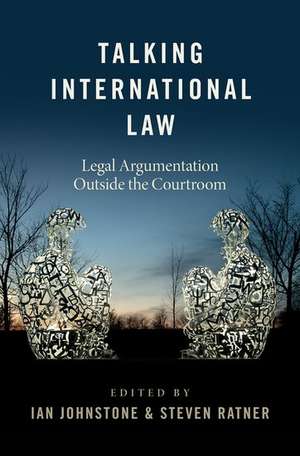
Talking International Law: Legal Argumentation Outside the Courtroom
Editat de Ian Johnstone, Steven Ratneren Limba Engleză Hardback – 3 iul 2026
Preț: 794.26 lei
Preț vechi: 1144.63 lei
-31%
Puncte Express: 1191
Carte tipărită la comandă
Livrare economică 26 noiembrie-01 decembrie
Livrare prin curier în România Termenul estimat este afișat lângă disponibilitate.
Transport gratuit pentru acest produs Plată online sau ramburs, în funcție de opțiunile comenzii.
Retur gratuit în 14 zile Comandă securizată și suport în română.
Specificații
ISBN-13: 9780197588437
ISBN-10: 0197588433
Pagini: 376
Dimensiuni: 165 x 239 x 31 mm
Greutate: 0.68 kg
Editura: Oxford University Press
Colecția OUP USA
Locul publicării:New York, United States
ISBN-10: 0197588433
Pagini: 376
Dimensiuni: 165 x 239 x 31 mm
Greutate: 0.68 kg
Editura: Oxford University Press
Colecția OUP USA
Locul publicării:New York, United States
Recenzii
This pioneering book explores why, how, and by whom legal arguments are given outside the courtroom. Bringing together law and political sciences, the editors proceed both bottom up and top down: Building on a gamut of approaches in both disciplines and on case studies by the contributing scholars and practitioners, the book charts new territory. The outcome is a novel theory for understanding the motives, modes, and effects of legal argumentation in global affairs." -Professor Anne Peters, Director, The Max Planck Institute for Comparative Public Law and International Law Heidelberg, Germany
This fascinating multi-disciplinary volume is a model of combining theory building with case studies. The book examines the role of legal argumentation outside of courts, expertly assessing the microprocesses of communication in framing understandings, elaborating law, shaping identities and communities of practice, and affecting outcomes." -Gregory Shaffer, Chancellor's Professor, University of California, Irvine School of Law, USA
Talking International Law brilliantly addresses the puzzle why and to what effect legal arguments are used outside the courtroom in international law. The book describes how references to international law are all-pervasive in world politics, from inter-state negotiations to proceedings of international organizations including the various UN bodies. "Legal arguments even show up in the discourses of non-state actors, from human rights organizations to rebel groups. But the book does not just describe these discourses, it also explores the "who," "how," and "to what effect." It integrates a whole set of theoretical approaches, from legal theory to political theory to international relations. A "Must Read!" for anybody concerned with international law, international norms, theories of deliberation, and with world politics in general." -Thomas Risse, Professor of International Politics, Freie Universität Berlin, Germany
This fascinating multi-disciplinary volume is a model of combining theory building with case studies. The book examines the role of legal argumentation outside of courts, expertly assessing the microprocesses of communication in framing understandings, elaborating law, shaping identities and communities of practice, and affecting outcomes." -Gregory Shaffer, Chancellor's Professor, University of California, Irvine School of Law, USA
Talking International Law brilliantly addresses the puzzle why and to what effect legal arguments are used outside the courtroom in international law. The book describes how references to international law are all-pervasive in world politics, from inter-state negotiations to proceedings of international organizations including the various UN bodies. "Legal arguments even show up in the discourses of non-state actors, from human rights organizations to rebel groups. But the book does not just describe these discourses, it also explores the "who," "how," and "to what effect." It integrates a whole set of theoretical approaches, from legal theory to political theory to international relations. A "Must Read!" for anybody concerned with international law, international norms, theories of deliberation, and with world politics in general." -Thomas Risse, Professor of International Politics, Freie Universität Berlin, Germany
Notă biografică
Ian Johnstone is Professor of International Law at The Fletcher School of Law and Diplomacy at Tufts University. He has served as Dean ad interim and as Academic Dean of the School. Prior to joining Fletcher in 2000, Johnstone served in the United Nations' Office of the Secretary-General. He has held Visiting Professor positions at the University of Toronto Faculty of Law and Munk School of Global Affairs and Public Policy, and at New York University School of Law. He has served on the editorial boards of Global Governance and International Organizations Law Review. Steven R. Ratner is the Bruno Simma Collegiate Professor of Law at the University of Michigan Law School and the Director of the University of Michigan Donia Human Rights Center. His research addresses a range of issues in international law, including linkages with political philosophy and international relations theory. He has served in U.S. State Department's Office of the Legal Adviser, on expert panels of the UNSecretary-General addressing atrocities in Sri Lanka and Cambodia, in the legal division of the International Committee of the Red Cross, and on the State Department's Advisory Committee on International Law.