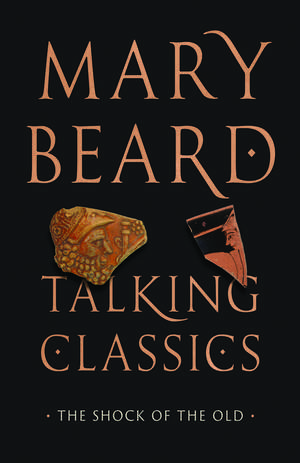
Talking Classics: The Shock of the Old
Autor Mary Bearden Limba Engleză Hardback – 21 mai 2026
Why the ongoing fascination with the ancient world? This witty, approachable book asks why—for better or (sometimes) worse—antiquity continues to exert such a powerful hold on the contemporary imagination. Recalling a formative childhood encounter with a four-thousand-year-old piece of bread in a museum, Beard introduces the idea of thauma, or wonder, that kick-started a lifetime engaging with classics. It was not the canonical “greats” of ancient literature and art that initially drew her in, she confesses, but rather the more intimate, messy, and humdrum evidence of daily life in the remote past.
Confronting the uses and abuses of symbols of the ancient world, Beard reminds us that the traditions and “masterpieces” of Greece and Rome have certainly been politicized, but they belong to neither the left nor the right. Happily, no one owns the past. She warns us not to let a sense of reverence or overfamiliarity dampen the “shock of the old,” arguing that one of the most important things that classics teach us is how to grapple with complicated and controversial things. “The Greeks and Romans are long dead, they cannot answer back, and you can say what you like about them,” she reminds readers. “The simple fact that classics belong to none of us can offer a safe space to argue about the most difficult debates we face now.”
Beard welcomes everyone into classics. “It is not compulsory to be excited by the ancient world,” she writes. “But it can be a shame not to be.” This charming, sharp, and readable book from one of the world’s most entertaining classicists offers something for both new and established fans of classics, bringing new wonder and curiosity to even the most ancient of ideas.
Preț: 127.28 lei
Puncte Express: 191
Carte disponibilă
Livrare economică 29 octombrie-12 noiembrie
Livrare express 15-21 octombrie pentru 76.11 lei
Livrare prin curier în România Termenul estimat este afișat lângă disponibilitate.
Transport gratuit de la 400.00 lei Plată online sau ramburs, în funcție de opțiunile comenzii.
Retur gratuit în 14 zile Comandă securizată și suport în română.
Specificații
ISBN-13: 9780226834245
ISBN-10: 0226834247
Pagini: 208
Ilustrații: 30 halftones
Dimensiuni: 140 x 216 x 20 mm
Greutate: 0.36 kg
Ediția:First Edition
Editura: University of Chicago Press
Colecția University of Chicago Press
ISBN-10: 0226834247
Pagini: 208
Ilustrații: 30 halftones
Dimensiuni: 140 x 216 x 20 mm
Greutate: 0.36 kg
Ediția:First Edition
Editura: University of Chicago Press
Colecția University of Chicago Press
Notă biografică
Mary Beard is a distinguished classicist, international bestselling author, and popular television personality. She is professor emerita of classics at the University of Cambridge, a fellow of Newnham College, and professor of Ancient Literature at the Royal Academy, as well as being the classics editor of the Times Literary Supplement, a fellow of the British Academy, and an international member of the American Academy of Arts and Sciences. Her books include SPQR: A History of Ancient Rome, Women and Power: A Manifesto, Twelve Caesars: Images of Power from the Ancient World to the Modern, and Emperor of Rome: Ruling the Ancient Roman World.
Cuprins
Introduction
1. A Sense of Wonder
2. How to be Modern?
3. Rights and Wrongs
4. The Case for Classics
Epilogue: The Boy who Breathed on the Glass in the British Museum
Further Reading
Acknowledgements
List of Illustrations
Index
1. A Sense of Wonder
2. How to be Modern?
3. Rights and Wrongs
4. The Case for Classics
Epilogue: The Boy who Breathed on the Glass in the British Museum
Further Reading
Acknowledgements
List of Illustrations
Index
Recenzii
“If classics has a grande dame, it is the actual Dame Mary Beard. . . [W]ide-ranging and entertaining . . . . Talking Classics is full of Beard’s old joy at the unexpectedness of ancient realities.”
“Few scholars make ancient Greece and Rome come alive as vividly—or seem as relatable—as Beard, the popular British classicist. Her latest book is a kaleidoscopic survey of some of the ancient people and objects, both awe-inducing and ordinary, that have delighted and intrigued her over her life and career—starting with a formative encounter at age 5 with a 4,000-year-old bread roll at the British Museum.”
“Like that ancient hunk of Egyptian bread that fascinated Mary Beard as a child, Talking Classics offers readers plenty to chew on.”
“The master of the epic blockbuster takes on the granddaddy of all epics with this summer’s The Odyssey. . . . Why should we care about (literally) ancient history? The benefits of a classical education are enumerated with style and passion in the latest book by Beard, the recently retired Cambridge professor best known for her riveting books on Ancient Rome. Beard’s case for antiquity is articulate and rich in her trademark historical insight—but also animated by a contagious joy and curiosity. Her bone-deep love for digging into these long-ago civilizations was sparked, she writes, by a piece of fossilized bread. Yours just might come from the movies.”
“This companionable book, by a Cambridge classicist, marvels at the ancient world. Beard’s subjects range from artistic achievements to signs of ordinary life: scrawled Roman graffiti, a piece of ancient bread. Simultaneously rendering the past less remote while relishing its radical foreignness, Beard presses readers to grapple with alien ideas, reckon with gaps in their knowledge, and confront complexity. She also critiques the Classics’ history of exclusionary requirements, such as mastering accent marks the ancient Greeks never used, and challenges modern leaders who signal legitimacy through simplistic references to Greece and Rome. Throughout, she shows how the classical world can sneak ‘up from behind, as it were, to surprise us, and make us think again.’”
“Britain's most beloved intellectual.”
"The rock star scholar of Ancient Rome.”
“A passionate defense particularly notable for its bracing lack of old fogeyism.”
“The book feels as if Beard, with her excitement and good humor, is regaling an audience. . . . [S]tudents (current, former, and future) of classical education will savor Beard’s rooted rumination on classics as both a discipline and a means of finding thauma.”
"Britain’s most famous classicist is at the peak of her powers.'
“Her irreverence has turned her into a national treasure. . . [She] illuminates the present through the past.”
“The reigning Queen of Classics."
“Beard's enthusiastic sense of wonder remains undimmed.”
: “Beard informs and entertains."
“Mary Beard may be the most popular classicist in the world."
“Brisk and lively.”
“Britain’s best-known classicist offers a spirited defence of her discipline. Like an archaeologist, she excavates classics from the layers of discourse that surround it.”
“Few scholars make ancient Greece and Rome come alive as vividly—or seem as relatable—as Beard, the popular British classicist. Her latest book is a kaleidoscopic survey of some of the ancient people and objects, both awe-inducing and ordinary, that have delighted and intrigued her over her life and career—starting with a formative encounter at age 5 with a 4,000-year-old bread roll at the British Museum.”
“Like that ancient hunk of Egyptian bread that fascinated Mary Beard as a child, Talking Classics offers readers plenty to chew on.”
“The master of the epic blockbuster takes on the granddaddy of all epics with this summer’s The Odyssey. . . . Why should we care about (literally) ancient history? The benefits of a classical education are enumerated with style and passion in the latest book by Beard, the recently retired Cambridge professor best known for her riveting books on Ancient Rome. Beard’s case for antiquity is articulate and rich in her trademark historical insight—but also animated by a contagious joy and curiosity. Her bone-deep love for digging into these long-ago civilizations was sparked, she writes, by a piece of fossilized bread. Yours just might come from the movies.”
“This companionable book, by a Cambridge classicist, marvels at the ancient world. Beard’s subjects range from artistic achievements to signs of ordinary life: scrawled Roman graffiti, a piece of ancient bread. Simultaneously rendering the past less remote while relishing its radical foreignness, Beard presses readers to grapple with alien ideas, reckon with gaps in their knowledge, and confront complexity. She also critiques the Classics’ history of exclusionary requirements, such as mastering accent marks the ancient Greeks never used, and challenges modern leaders who signal legitimacy through simplistic references to Greece and Rome. Throughout, she shows how the classical world can sneak ‘up from behind, as it were, to surprise us, and make us think again.’”
“Britain's most beloved intellectual.”
"The rock star scholar of Ancient Rome.”
“A passionate defense particularly notable for its bracing lack of old fogeyism.”
“The book feels as if Beard, with her excitement and good humor, is regaling an audience. . . . [S]tudents (current, former, and future) of classical education will savor Beard’s rooted rumination on classics as both a discipline and a means of finding thauma.”
"Britain’s most famous classicist is at the peak of her powers.'
“Her irreverence has turned her into a national treasure. . . [She] illuminates the present through the past.”
“The reigning Queen of Classics."
“Beard's enthusiastic sense of wonder remains undimmed.”
: “Beard informs and entertains."
“Mary Beard may be the most popular classicist in the world."
“Brisk and lively.”
“Britain’s best-known classicist offers a spirited defence of her discipline. Like an archaeologist, she excavates classics from the layers of discourse that surround it.”