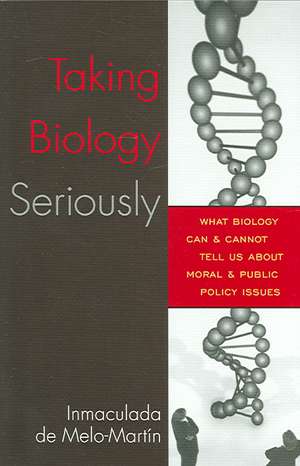
Taking Biology Seriously: What Biology Can and Cannot Tell Us About Moral and Public Policy Issues
Autor Inmaculada De Melo-Martínen Limba Engleză Paperback – 6 oct 2005
Preț: 241.80 lei
Preț vechi: 333.60 lei
-28%
Puncte Express: 363
Carte tipărită la comandă
Livrare economică 17 noiembrie-01 decembrie
Livrare prin curier în România Termenul estimat este afișat lângă disponibilitate.
Transport gratuit de la 400.00 lei Plată online sau ramburs, în funcție de opțiunile comenzii.
Retur gratuit în 14 zile Comandă securizată și suport în română.
Specificații
ISBN-13: 9780742549210
ISBN-10: 0742549216
Pagini: 161
Dimensiuni: 148 x 228 x 12 mm
Greutate: 0.25 kg
Editura: Bloomsbury Publishing
Colecția Rowman & Littlefield
Locul publicării:New York, United States
ISBN-10: 0742549216
Pagini: 161
Dimensiuni: 148 x 228 x 12 mm
Greutate: 0.25 kg
Editura: Bloomsbury Publishing
Colecția Rowman & Littlefield
Locul publicării:New York, United States
V-ar putea interesa
-
 Clinical Judgement: Evidence in PracticeRobin Downie-25%Preț: 663.46 lei881.93 lei
 -
 -28%Preț: 481.12 lei670.15 lei
 -
 Choosing Children: Genes, Disability, and DesignJonathan Glover-19%Preț: 255.52 lei315.28 lei
 -
 Questions Of Ethics In Counselling And TherapyCaroline Jones-29%Preț: 174.46 lei247.15 lei
 -
 Twice DeadMargaret M. LockPreț: 278.82 lei
 -
 A Question of TrustOnora O'Neill-5%Preț: 190.55 lei200.58 lei
 -
 From Chance to ChoiceDan W. BrockPreț: 376.07 lei
 -
 Informed Consent and Clinician AccountabilitySteve Clarke-5%Preț: 466.51 lei491.06 lei
 -
 -23%Preț: 278.53 lei362.28 lei
 -
 BioethicsStephen Holland-5%Preț: 216.57 lei227.97 lei
 -
 Health Care Professionalism at a GlanceJill Thistlethwaite-5%Preț: 251.43 lei264.66 lei
 -
 -5%Preț: 440.91 lei464.12 lei
 -
 Values, Ethics and Health CarePeter Duncan-5%Preț: 385.14 lei405.41 lei
 -
 -23%Preț: 1042.79 lei1362.00 lei
 -
 The Body in BioethicsAlastair V. Campbell-15%Preț: 428.70 lei504.36 lei
Cuprins
Chapter 1 Misunderstanding Biology: Epistemological, Scientific, and Moral Problems
Chapter 2 Biological Explanations and Social Responsibility
Chapter 3 An Introduction to the Science of Cloning
Chapter 4 Cloning-or not-Human Beings
Chapter 5 Putting Human Cloning Where It belongs
Chapter 6 Obtaining Genetic Information
Chapter 7 Genetic Information and Moral Obligation
Chapter 8 Moral Obligations, Genetic Information, and Social Context
Chapter 9 On the Need to Take Biology Seriously
Part 22 Genetic Information and Moral Obligations
Chapter 2 Biological Explanations and Social Responsibility
Chapter 3 An Introduction to the Science of Cloning
Chapter 4 Cloning-or not-Human Beings
Chapter 5 Putting Human Cloning Where It belongs
Chapter 6 Obtaining Genetic Information
Chapter 7 Genetic Information and Moral Obligation
Chapter 8 Moral Obligations, Genetic Information, and Social Context
Chapter 9 On the Need to Take Biology Seriously
Part 22 Genetic Information and Moral Obligations
Recenzii
In an age of genetic information and promised enhancements, we wonder what biology can tell us - and what it can't - about how we should live. This superbly clear and sensible book, written by a philosopher trained in biology, is a perfect introduction to this important question. Professor DeMelo-Martin takes us briskly through central social controversies concerning intelligence, aggression, gender, cloning, and genetics, on a guided tour of blind alleys, inaccurate assumptions, and logical mistakes. DeMelo-Martin shows exceptional skill in guiding the reader through complex terrain with balance and objectivity. This book holds rewards for scientists, philosophers, students, and citizens. It provides ideal stepping-off points for classroom discussions and public debates.
Full of common sense, De Melo-Martin's book shows why biological determinism need not undercut moral responsibility. With a rich background in both biology and philosophy, she does a good job of uncovering scientific and ethical flaws in some arguments about cloning and genetic technologies.
In a culture in tension between biotechnological enthusiasms for a post-human future and fearful anti-evolutionist ideologies, de Melo-Martin carefully defends the importance of social and political policies to guide the bio-ethical co-construction of a better life for all. As she argues with edifying balance, only by taking biology seriously can we become serious in appreciating its true benefits and counter the illusory hopes and fears that are often projected upon it.
Professor de Melo-Martin shows herself to be as knowledgeable as she says philosophers and others making ethical and political claims should be. Though many will disagree with her views, it is welcome to have a clearly stated and well argued position with which others can choose to disagree or not.
This book is an empirically rich, theoretically cogent, and sorely needed account of the interdependence of biology and ethics in matters that affect us all.
Dr. de Melo-Martin offers an insightful and sensible account of the mistakes that philosophers, scientists, and policy makers commit when drawing conclusions about genetics.
Full of common sense, De Melo-Martin's book shows why biological determinism need not undercut moral responsibility. With a rich background in both biology and philosophy, she does a good job of uncovering scientific and ethical flaws in some arguments about cloning and genetic technologies.
In a culture in tension between biotechnological enthusiasms for a post-human future and fearful anti-evolutionist ideologies, de Melo-Martin carefully defends the importance of social and political policies to guide the bio-ethical co-construction of a better life for all. As she argues with edifying balance, only by taking biology seriously can we become serious in appreciating its true benefits and counter the illusory hopes and fears that are often projected upon it.
Professor de Melo-Martin shows herself to be as knowledgeable as she says philosophers and others making ethical and political claims should be. Though many will disagree with her views, it is welcome to have a clearly stated and well argued position with which others can choose to disagree or not.
This book is an empirically rich, theoretically cogent, and sorely needed account of the interdependence of biology and ethics in matters that affect us all.
Dr. de Melo-Martin offers an insightful and sensible account of the mistakes that philosophers, scientists, and policy makers commit when drawing conclusions about genetics.