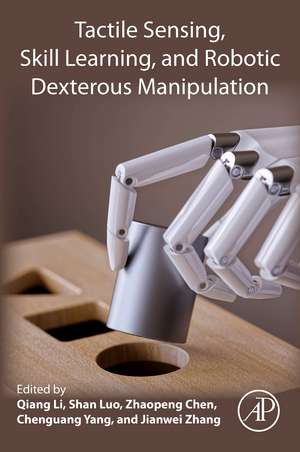
Tactile Sensing, Skill Learning, and Robotic Dexterous Manipulation
Editat de Qiang Li, Shan Luo, Zhaopeng Chen, Chenguang Yang, Jianwei Zhangen Limba Engleză Paperback – 7 apr 2022
Observăm că volumul Tactile Sensing, Skill Learning, and Robotic Dexterous Manipulation propune o abordare integrată a roboticii avansate, oferind cititorului instrumentele necesare pentru a implementa sisteme capabile să recunoască proprietățile obiectelor necunoscute și să execute sarcini complexe de manipulare. Rezultatul concret vizat este dezvoltarea unei dexterități robotice care să oglindească sinergiile umane între forță și cinematică, trecând de la simplele acționări mecanice la interacțiunea inteligentă cu mediul.
Textul este organizat riguros în trei secțiuni fundamentale. Prima parte se concentrează pe hardware-ul percepției, analizând senzorii tactili și multimodali. A doua parte explorează învățarea abilităților, unde sunt discutate tehnici precum controlul admitanței și învățarea prin imitație. În final, a treia parte detaliază controlul adaptiv, oferind o perspectivă aplicată prin studii de caz precum proteza Hannes. Merită menționat că echipa de editori, condusă de Qiang Li, integrează aproximativ 100 de ilustrații color care clarifică arhitecturile sistemelor descrise.
Pe linia practică a lucrării Introduction to Tactile Intelligence de Shan Luo, acest volum merge mai departe, punând un focus deosebit pe controlul adaptiv și pe utilizarea algoritmilor de tip Guided-DDPG pentru asamblarea industrială. În contextul operei autorilor, lucrarea extinde conceptele din Tactile Robotics, rafinând procesarea datelor tactile nu doar pentru identificarea proprietăților obiectelor, ci și pentru calculul direct al controlerelor de mișcare. Față de titluri precum In-Hand Object Localization and Control, care prioritizează localizarea, volumul de față oferă o acoperire mai largă a procesului de învățare a abilităților prin colaborare om-robot.
Preț: 676.57 lei
Preț vechi: 1114.73 lei
-39%
Carte tipărită la comandă
Livrare economică 17 noiembrie-01 decembrie
Specificații
ISBN-10: 0323904459
Pagini: 372
Ilustrații: Approx. 100 illustrations (100 in full color)
Dimensiuni: 152 x 229 mm
Greutate: 0.5 kg
Editura: ELSEVIER SCIENCE
V-ar putea interesa
-
 Joysticks to HapticsLost in CultPreț: 266.56 lei
 -
 Learning for Adaptive and Reactive Robot ControlAude Billard-14%Preț: 560.09 lei651.27 lei
 -
 HapticsLynette JonesPreț: 96.64 lei
 -
 Atlas of Orthoses and Assistive DevicesDouglas P. Murphy-28%Preț: 1141.83 lei1590.55 leiRecomandat
 -
 Introduction to Robotics, Global EditionJohn Craig-9%Preț: 596.70 lei655.72 lei
 -
 MechatronicsW. Bolton-11%Preț: 666.56 lei748.94 lei
 -
 Motor Control and LearningCarolee Winstein-9%Preț: 741.27 lei814.58 lei
 -
 -24%Preț: 737.04 lei969.80 lei
 -
 The Biomechanics of the Tactile Perception of FrictionLaurence Willemet-20%Preț: 1031.70 lei1289.63 lei
 -
 Advances in Service and Industrial RoboticsDoina Pisla-24%Preț: 1713.83 lei2255.03 lei
 -
 -15%Preț: 651.36 lei766.30 lei
 -
 Springer Handbook of RoboticsBruno Siciliano-18%Preț: 2602.52 lei3173.80 lei
 -
 Haptic Devices for Studies on Human Grasp and RehabilitationAlessandro Altobelli-20%Preț: 620.33 lei775.41 lei
 -
 Robotics Goes MOOCBruno SicilianoPreț: 404.01 lei
 -
 -20%Preț: 327.36 lei409.20 lei
 -
 The Science of Soft RobotsKoichi Suzumori-20%Preț: 569.10 lei711.38 lei
 -
 Human Motion Awareness and Robot TeleoperationHonghao Lyu-18%Preț: 1111.98 lei1356.06 lei
De ce să citești această carte
Recomandăm această resursă profesioniștilor din industria roboticii și hapticii care doresc să implementeze sisteme de manipulare dexteră. Cititorul câștigă o înțelegere profundă a modului în care învățarea automată și senzorii tactili pot fi fuzionați pentru a permite roboților să manipuleze obiecte fragile sau complexe. Este un ghid tehnic esențial pentru trecerea de la prototipuri rigide la sisteme robotice adaptive și versatile.
Descriere scurtă
The book summarizes the different approaches and discusses the pros and cons of each. Chapters not only describe the research but also include basic knowledge that can help readers understand the proposed work, making it an excellent resource for researchers and professionals who work in the robotics industry, haptics and in machine learning.
- Provides a review of tactile perception and the latest advances in the use of robotic dexterous manipulation
- Presents the most detailed work on synthesizing intelligent tactile perception, skill learning and adaptive control
- Introduces recent work on human’s dexterous skill representation and learning and the adaptive control schema and its learning by imitation and exploration
- Reveals and illustrates how robots can improve dexterity by modern tactile sensing, interactive perception, learning and adaptive control approaches
Cuprins
1. Tactile sensors for dexterous manipulation
2. Robotic perception of object properties using tactile sensing
3. Multimodal perception for dexterous manipulation
4. Using Machine Learning for Material Detection with Capacitive Proximity Sensors
Part II: Skill representation and learning
5. Admittance control: learning from human and collaboration with human
6. Sensorimotor Control for Dexterous Grasping--Inspiration from human hand
7. Efficient Haptic Learning and Interaction
8. From human to robot grasping: kinematics and forces synergies
9. Learning a form-closure grasping with attractive region in environment
10. Learning hierarchical control for robust in-hand manipulation
11. Learning Industrial Assembly by Guided-DDPG
Part III: Robotic hand adaptive control
12. The novel poly-articulated prosthetic hand Hannes: A survey study, and clinical evaluation
13. Enhancing vision control by tactile sensing for robotic manipulation
14. Neural Network enhanced Optimal Control of Manipulator
15. Towards Dexterous In-Hand Manipulation of Unknown Objects: A Feedback Based Control Approach
16. Learning Industrial Assembly by Guided-DDPG