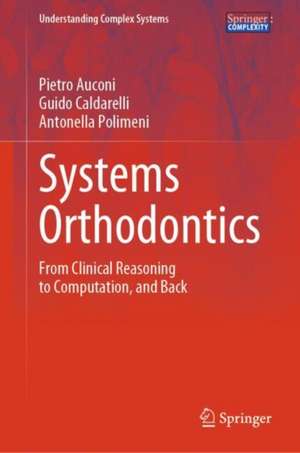
Systems Orthodontics: Understanding Complex Systems
Autor Pietro Auconi, Guido Caldarelli, Antonella Polimenien Limba Engleză Hardback – 17 sep 2024
In recent times, systems thinking and complexity theory have yielded substantial conceptual advancements across various research domains. In the context of orthodontics, these approaches offer a more comprehensive understanding in contrast to the traditional mechanistic approach, which primarily focuses on the analysis of applied forces. Systems thinking directs attention to the interaction among dentoskeletal components, where the behavior of one element can influence others. The amalgamation of multiple elements leads to entities with properties distinct from those of individual components. The increasing complexity of orthodontic reality beyond clinical or radiological observations necessitates the development of new theories.
Complexity theory has demonstrated that emergent properties in biological systems can be discerned through appropriate computational models, as opposed to the analytical study of individual components. The central metaphor for the interactive craniofacial system during growth is portrayed by the facial topology revealed through network analysis, facilitating a systemic reevaluation of traditional orthodontic theories. This book delineates the novel insights derived from the clinical-computational approach, applicable for a prognostic and early interception perspective in managing dentofacial dysmorphoses. Its objective is to captivate practitioners and persuade them of the practical utility of these innovative approaches.
Din seria Understanding Complex Systems
- 18%
 Preț: 1080.00 lei
 -
 Preț: 439.80 lei
 - 18%
 Preț: 988.65 lei
 - 15%
 Preț: 661.12 lei
 - 18%
 Preț: 1170.06 lei
 - 18%
 Preț: 911.29 lei
 - 15%
 Preț: 622.09 lei
 - 15%
 Preț: 653.43 lei
 - 15%
 Preț: 675.52 lei
 - 18%
 Preț: 955.93 lei
 - 18%
 Preț: 990.14 lei
 - 15%
 Preț: 666.14 lei
 - 15%
 Preț: 663.50 lei
 -
 Preț: 442.26 lei
 - 15%
 Preț: 661.83 lei
 - 15%
 Preț: 631.43 lei
 - 15%
 Preț: 666.40 lei
 - 20%
 Preț: 674.28 lei
 - 20%
 Preț: 677.98 lei
 - 18%
 Preț: 982.53 lei
 - 18%
 Preț: 1150.57 lei
 - 18%
 Preț: 1280.17 lei
 - 15%
 Preț: 668.60 lei
 - 18%
 Preț: 983.43 lei
 - 15%
 Preț: 669.20 lei
 - 18%
 Preț: 1440.00 lei
 - 18%
 Preț: 990.35 lei
 -
 Preț: 414.85 lei
 - 18%
 Preț: 980.03 lei
 - 18%
 Preț: 1297.31 lei
 - 15%
 Preț: 621.89 lei
 - 5%
 Preț: 1465.64 lei
 - 18%
 Preț: 984.66 lei
 - 18%
 Preț: 982.96 lei
 -
 Preț: 402.76 lei
 - 20%
 Preț: 680.46 lei
 - 18%
 Preț: 1047.87 lei
Preț: 963.59 lei
Preț vechi: 1175.11 lei
-18%
Puncte Express: 1445
Carte tipărită la comandă
Livrare economică 23 noiembrie-07 decembrie
Livrare prin curier în România Termenul estimat este afișat lângă disponibilitate.
Transport gratuit pentru acest produs Plată online sau ramburs, în funcție de opțiunile comenzii.
Retur gratuit în 14 zile Comandă securizată și suport în română.
Specificații
ISBN-13: 9783031649318
ISBN-10: 3031649311
Pagini: 172
Ilustrații: X, 340 p.
Dimensiuni: 160 x 241 x 16 mm
Greutate: 0.43 kg
Ediția:2024
Editura: Springer
Colecția Understanding Complex Systems
Seria Understanding Complex Systems
Locul publicării:Cham, Switzerland
ISBN-10: 3031649311
Pagini: 172
Ilustrații: X, 340 p.
Dimensiuni: 160 x 241 x 16 mm
Greutate: 0.43 kg
Ediția:2024
Editura: Springer
Colecția Understanding Complex Systems
Seria Understanding Complex Systems
Locul publicării:Cham, Switzerland
Cuprins
Introduction.- Seeing the Invisible.- Biological Constraints.- Physical Constraints.- Personalised Orthodontics.- Perspectives.
Notă biografică
Pietro Auconi MD is Pediatrist and Practitioner active in the study of orthodontics complexity, a topic on which he published several paper in the recent years. His main activity is the study of the co-evolution of cephalometric quantities in patient developments with the aid of complex networks and artificial intelligence.
Guido Caldarelli is Full Professor of Theoretical Physics at Ca' Foscari University of Venice and presently Director of the Institute of Complex Systems of the National Research Council of Italy (ISC-CNR). His main scientific activity is the study of networks. Author of more than 250 publications on the subject and various books, he has been President of the Complex Systems Society from 2018 to 2021. He received his Ph.D. from SISSA Trieste, after which he was a postdoc in the University of Manchester, UK, and in the Theory of Condensed Matter Group, University of Cambridge, UK.
Antonella Polimeni is Full Professor of Oral Diseases and Specialised in Orthodontics. She is Author of over 470 publications in national and international journals, of 6 manuals, one of which in English, and of 2 monographs. She edited the clinical dentistry manual by David and Laura Mitchel, two other manuals, the Italian edition of the atlas, and the guidelines of the Ministry of Health. On 13 November 2020, she was Elected Rector of the “Sapienza” University of Rome, one of the largest in the world.
Guido Caldarelli is Full Professor of Theoretical Physics at Ca' Foscari University of Venice and presently Director of the Institute of Complex Systems of the National Research Council of Italy (ISC-CNR). His main scientific activity is the study of networks. Author of more than 250 publications on the subject and various books, he has been President of the Complex Systems Society from 2018 to 2021. He received his Ph.D. from SISSA Trieste, after which he was a postdoc in the University of Manchester, UK, and in the Theory of Condensed Matter Group, University of Cambridge, UK.
Antonella Polimeni is Full Professor of Oral Diseases and Specialised in Orthodontics. She is Author of over 470 publications in national and international journals, of 6 manuals, one of which in English, and of 2 monographs. She edited the clinical dentistry manual by David and Laura Mitchel, two other manuals, the Italian edition of the atlas, and the guidelines of the Ministry of Health. On 13 November 2020, she was Elected Rector of the “Sapienza” University of Rome, one of the largest in the world.
Textul de pe ultima copertă
This book marks one of the first applications of the Medicine Network discipline to an everyday scenario. It explores situations where patients, often in adolescence, grapple with the decision of whether to commence a treatment, seeking insights into the more plausible future scenarios. Additionally, the specific feedback from biological systems in the human body serves as a potent metaphor for addressing various challenges in the field of Complex Systems.
In recent times, systems thinking and complexity theory have yielded substantial conceptual advancements across various research domains. In the context of orthodontics, these approaches offer a more comprehensive understanding in contrast to the traditional mechanistic approach, which primarily focuses on the analysis of applied forces. Systems thinking directs attention to the interaction among dentoskeletal components, where the behavior of one element can influence others. The amalgamation of multiple elements leads to entities with properties distinct from those of individual components. The increasing complexity of orthodontic reality beyond clinical or radiological observations necessitates the development of new theories.
Complexity theory has demonstrated that emergent properties in biological systems can be discerned through appropriate computational models, as opposed to the analytical study of individual components. The central metaphor for the interactive craniofacial system during growth is portrayed by the facial topology revealed through network analysis, facilitating a systemic reevaluation of traditional orthodontic theories. This book delineates the novel insights derived from the clinical-computational approach, applicable for a prognostic and early interception perspective in managing dentofacial dysmorphoses. Its objective is to captivate practitioners and persuade them of the practical utility of these innovative approaches.
In recent times, systems thinking and complexity theory have yielded substantial conceptual advancements across various research domains. In the context of orthodontics, these approaches offer a more comprehensive understanding in contrast to the traditional mechanistic approach, which primarily focuses on the analysis of applied forces. Systems thinking directs attention to the interaction among dentoskeletal components, where the behavior of one element can influence others. The amalgamation of multiple elements leads to entities with properties distinct from those of individual components. The increasing complexity of orthodontic reality beyond clinical or radiological observations necessitates the development of new theories.
Complexity theory has demonstrated that emergent properties in biological systems can be discerned through appropriate computational models, as opposed to the analytical study of individual components. The central metaphor for the interactive craniofacial system during growth is portrayed by the facial topology revealed through network analysis, facilitating a systemic reevaluation of traditional orthodontic theories. This book delineates the novel insights derived from the clinical-computational approach, applicable for a prognostic and early interception perspective in managing dentofacial dysmorphoses. Its objective is to captivate practitioners and persuade them of the practical utility of these innovative approaches.
Caracteristici
Applies network analysis principles to complex biological systems Provides the current state of the field, including the latest research and developments in network medicine Explains applying network medicine in research and healthcare to predict and personalize disease intervention