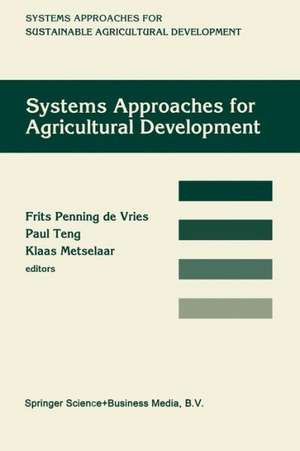
Systems approaches for agricultural development: Proceedings of the International Symposium on Systems Approaches for Agricultural Development, 2–6 December 1991, Bangkok, Thailand
Autor Frits Penning de Vries, Paul Teng, Klaas Metselaaren Limba Engleză Paperback – 12 dec 1992
Preț: 627.93 lei
Preț vechi: 738.74 lei
-15%
Puncte Express: 942
Carte tipărită la comandă
Livrare economică 30 noiembrie-14 decembrie
Livrare prin curier în România Termenul estimat este afișat lângă disponibilitate.
Transport gratuit pentru acest produs Plată online sau ramburs, în funcție de opțiunile comenzii.
Retur gratuit în 14 zile Comandă securizată și suport în română.
Specificații
ISBN-13: 9780792318811
ISBN-10: 0792318811
Pagini: 542
Ilustrații: XII, 542 p.
Dimensiuni: 155 x 235 x 29 mm
Greutate: 0.77 kg
Ediția:1993
Editura: SPRINGER NETHERLANDS
Colecția Springer
Locul publicării:Dordrecht, Netherlands
ISBN-10: 0792318811
Pagini: 542
Ilustrații: XII, 542 p.
Dimensiuni: 155 x 235 x 29 mm
Greutate: 0.77 kg
Ediția:1993
Editura: SPRINGER NETHERLANDS
Colecția Springer
Locul publicării:Dordrecht, Netherlands
V-ar putea interesa
-
 Botany IllustratedJanice Glimn-LacyPreț: 518.65 lei
 -
 The Remarkable BaobabThomas PakenhamPreț: 124.76 lei
 -
 Plastid BiologyKevin PykePreț: 409.72 lei
 -
 -25%Preț: 89.58 lei119.80 lei
 -
 Plant BiologyAlison M. Smith-9%Preț: 714.55 lei785.23 lei
 -
 Principles of Plant NutritionKonrad Mengel-18%Preț: 2783.54 lei3394.56 lei
 -
 Nectaries and NectarSusan W. Nicolson-18%Preț: 1276.02 lei1556.13 lei
 -
 Rainfed Farming SystemsPhilip Tow-18%Preț: 1290.25 lei1573.48 lei
 -
 Preț: 145.40 lei
 -
 -18%Preț: 983.19 lei1199.01 lei
 -
 Physiological Plant EcologyWalter Larcher-18%Preț: 771.23 lei940.53 lei
 -
 Forest Tree Breeding in EuropeLuc E. Pâques-18%Preț: 1283.48 lei1565.22 lei
Public țintă
ResearchCuprins
Session 1. Crop Production: Genotypic Constraints.- Designing improved plant types: a breeder’s viewpoint.- Improvement of rice plant type concepts: systems research enables interaction of physiology and breeding.- Designing improved plant types for the semiarid tropics: agronomists’ viewpoints.- Simulation in pre-testing of rice genotypes in Tamil Nadu.- Genetic specific data for crop modeling.- Session 2. Crop Production: Weather Constraints.- Agro-ecological zoning using crop growth simulation models: characterization of wheat environments of India.- An agroclimatic approach to agricultural development in India.- Optimising harvest operations against weather risk.- The impacts of climate change on rice yield: evaluation of the efficacity of different modeling approaches.- Rice production and climate change.- Session 3. Crop Production: Soil Constraints.- A systems approach to the assessment and improvement of water use efficiency in the North China Plain.- Soil data for crop-soil models.- Root ventilation, rhizosphere modification, and nutrient uptake by rice.- Adjustment of nitrogen inputs in response to a seasonal forecast in a region of high climatic risk.- Maize modeling in Malawi: a tool for soil fertility research and development.- Session 4. Crop Production: Biological Constraints.- Pest damage relations at the field level.- Quantification of components contributing to rate-reducing resistance in a plant virus pathosystem.- The rice leaf blast simulation model ‘Epiblast’.- Session 5. Farming Systems.- Potential for systems simulation in farming systems research?.- Making farming systems a more objective and quantitative research tool.- Options for agricultural development: a new quantitative approach.- Options for agricultural development: a case studyfor Mali’s fifth Region.- Multicriteria optimization for a sustainable agriculture.- Simulation of multiple cropping systems with CropSys.- Optimization of cropping patterns in tank irrigation systems in Tamil Nadu, India.- Agricultural development in Thailand.- A methodological framework to explore long-term options for land use.- Session 6. Education, Training and Technology Transfer.- Decision support systems for agricultural development.- Constraints in technology transfer: a user’s perspective with a focus on IPM, Philippines.- Postgraduate education in agricultural systems: the AIT experience.- The IBSNAT project.- Building capacity for systems research at national agricultural research centres: SARP’s experience.