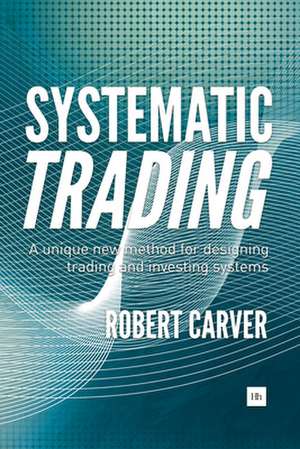
Systematic Trading
Autor Robert Carveren Limba Engleză Hardback – 14 sep 2015
Majoritatea investitorilor consideră că succesul în piețele financiare depinde de intuiție sau de găsirea unei formule magice de prognoză; în realitate, cel mai mare obstacol în calea profitabilității este însăși biologia umană. Merită menționat că Systematic Trading nu este o simplă colecție de algoritmi, ci o metodologie riguroasă de disciplinare a procesului decizional. Reținem perspectiva autorului Robert Carver, care, după o carieră la vârful industriei de hedge funds, demonstrează că eliminarea erorilor sistematice și a intervențiilor emoționale este mult mai valoroasă decât încercarea de a prezice viitorul. Subliniem modul în care această lucrare se poziționează în cadrul operei autorului: dacă Smart Portfolios se concentra pe alocarea activelor, iar Advanced Futures Trading Strategies pe tactici specifice, Systematic Trading reprezintă fundamentul filosofic și tehnic al întregului său sistem. Cartea este structurată progresiv, pornind de la eșecurile psihologice documentate în criza din 2008 și evoluând spre construcția unui „black box” care, surprinzător, este mult mai simplu decât s-ar aștepta un novice. Cititorul care a aplicat ideile din A Guide to Creating A Successful Algorithmic Trading Strategy de Perry J. Kaufman va găsi aici elementul care lipsește adesea din ghidurile pur tehnice: un cadru robust de management al pozițiilor adaptabil în funcție de capital și costurile de tranzacționare. Spre deosebire de abordările care promit randamente triple, Robert Carver oferă o arhitectură open-source pentru investiții, punând accent pe supraviețuirea pe termen lung și pe controlul riscului, indiferent dacă tranzacționați acțiuni, obligațiuni sau instrumente derivate.
Preț: 308.28 lei
Preț vechi: 348.23 lei
-11%
Carte disponibilă
Livrare economică 12-26 noiembrie
Livrare express 29 octombrie-04 noiembrie pentru 89.94 lei
Specificații
ISBN-10: 0857194453
Pagini: 328
Dimensiuni: 175 x 250 x 22 mm
Greutate: 0.68 kg
Editura: HARRIMAN HOUSE
V-ar putea interesa
-
 Paradise With SerpentsRobert CarverPreț: 118.39 lei
 -
 Candlestick Charting ExplainedGreg Morris-20%Preț: 403.02 lei506.32 lei
 -
 All About Index FundsRichard FerriPreț: 165.47 lei
 -
 -12%Preț: 140.91 lei160.99 lei
 -
 Preț: 127.67 lei
 -
 -23%Preț: 547.92 lei711.58 lei
 -
 The Essential P/EKeith Anderson-28%Preț: 106.07 lei147.93 lei
 -
 Share AttackMalcolm Stacey-29%Preț: 92.23 lei129.69 lei
 -
 Smart PortfoliosRobert Carver-27%Preț: 310.27 lei426.38 lei
 -
 Leveraged TradingRobert Carver-13%Preț: 201.14 lei232.02 lei
 -
 Advanced Futures Trading StrategiesRobert Carver-14%Preț: 399.66 lei467.04 lei
 -
 Sector TradingJonathan BernsteinPreț: 131.52 lei
 -
 Preparing Data for Analysis with JMPRobert CarverPreț: 242.10 lei
 -
 Practical Data Analysis with JMP, Third EditionRobert Carver-20%Preț: 519.98 lei649.97 lei
 -
 Euro BondsMarida Bertocchi-15%Preț: 613.24 lei721.47 lei
 -
![CONTINGENT CONVERTIBLES [COCOS]](https://i4.books-express.ro/bt/9789814619899/contingent-convertibles-cocos.jpg) CONTINGENT CONVERTIBLES [COCOS]Furstenberg George M von-15%Preț: 634.95 lei747.01 lei
CONTINGENT CONVERTIBLES [COCOS]Furstenberg George M von-15%Preț: 634.95 lei747.01 lei
De ce să citești această carte
Această carte este esențială pentru traderii care doresc să treacă de la decizii bazate pe impuls la un proces bazat pe date și reguli clare. Veți învăța să construiți un sistem de tranzacționare personalizat care elimină subiectivitatea, optimizează dimensiunea pozițiilor și minimizează costurile inutile. Este instrumentul ideal pentru a transforma tranzacționarea dintr-o activitate stresantă într-o operațiune sistematică, profesională și controlată.
Despre autor
Robert Carver are o experiență de peste un deceniu în City-ul londonez, activând inițial ca trader de produse derivate exotice pentru Barclays. Ulterior, a fost manager de portofoliu la AHL, unul dintre cele mai mari fonduri de tip systematic hedge fund din lume, unde a gestionat strategii macro globale și portofolii de venit fix de ordinul miliardelor de dolari în timpul crizei financiare din 2008. Cu studii avansate în economie, Carver s-a retras din industria instituțională în 2013 pentru a-și gestiona propriile investiții folosind aceleași principii sistematice pe care le descrie în lucrările sale.
Descriere scurtă
Notă biografică
Robert Carver is Professor of Business Administration at Stonehill College in Easton, Massachusetts, and Adjunct Professor at the International Business School at Brandeis University in Waltham, Massachusetts. At both institutions, he teaches courses on business analytics in addition to general management courses, and he has won teaching awards at both schools. His primary research interest is statistics education. A JMP user since 2006, Carver holds an A.B. in political science from Amherst College in Amherst, Massachusetts, and an M.P.P.and Ph.D. in public policy from the University of Michigan at Ann Arbor.
Cuprins
Preface
- Systematic trading and investing
- Who should read this book
- Overview - what is coming
Introduction
- September 2008: The Billion Dollar Day
- January 2009: Why (most) humans make poor traders
- The black box is simpler than you think
- An open source revolution
- An open source systematic framework
PART ONE: THEORY
The good, the bad and the ugly of systematic trading
- Humans should be great traders - in theory
-- The death of rational economic man
-- Why we run losses and stop out profits
- Introducing a systematic rule for trading
-- Stick to the rules and don't meddle
-- Overcoming instinct - why 'contra' instinctive behaviour works
-- Why subjective 'systems' don't work
- Commitment mechanisms - how do we stop ourselves 'meddling'?
-- Automation - the use of dogs in finance and engineering
- Systematic trading in financial institutions
The commitment problem does not go away...
-- . but there are benefits
- The ideal systematic trading shop
- Two more tricks to reduce meddling
-- Abstraction
-- Ignorance
- Designing systems to discourage meddling - the three virtues
-- Trust your system
-- Understand the limits of your ignorance
-- Sleep at night: Position size is as important than position sign
- When is meddling acceptable?
-- Unacceptable meddling
-- Acceptable meddling
- Irrationality in trading system development - the three sins
-- Overfitting
-- Overtrading
-- Overbetting
Systematic strategies
- Why do strategies 'work'?
-- Risk premia
-- Frictions and barriers to entry
-- Information less trading
-- Returns to effort and cost
-- Behavioural effects
-- Pure alpha:skill
- What makes a good strategy?
-- Intuitive
-- Well motivated
-- As simple as possible
-- Can be systematised
- Categorising the strategy universe
-- Static versus Dynamic
-- Buying and selling insurance
-- Technical vs fundamental
-- Fast vs Slow
-- Directional vs cross sectional
-- Low versus high leverage
-- Many positions vs few positions
-- Crowd following vs contrarian
PART TWO: THE TOOLBOX
- Model selection, calibration and fitting
-- The perils of overfitting
-- Distinguishing dud models from good models
-- Fitting and overfitting
- Four rules for effective fitting
-- Start with a small number of ideas, not with data
-- Save real data for a rainy day; use artificial data
-- Don't fit unless there is a gun to your head
-- If you must fit to real data, be very, very careful
- Portfolio allocation
-- Anecdote: When smart people make stupid decisions
-- The bad news: Portfolio optimisation is hard
-- A simple fix: bootstrapping
-- 'Handcrafting' the weights: The heuristic method
-- Some problems
-- The good news
PART THREE: THE FRAMEWORK
An 'open source' framework for systematic trading and investing
- Why an open source framework?
-- Parallels with open source software
-- Flexibility
-- Individual seperable components with well defined interface
-- Underlying logic exposed â+' easily modified
- The elements of the framework
-- Instruments to trade
-- One or more signals
-- Forecasts - combinations of signals
-- Scaled positions
-- Portfolios of positions
-- Total capital scaling - money management
-- Risk measurement and control
- Modifying and extending the 'open source' framework
Instruments - the building blocks
- Asset classes: Stocks, bonds, ETF's, futures, CFD's ...
- The character of different instruments
- Portfolios as instruments
- Spreads - a special kind of portfolio instrument
- Summary - key points
Signals - looking under the hood
- What is a signal?
- What properties should signals have?
-- A signal is a scaled quantity
-- But what scale
-- Why it makes sense to have a unit variance signal
-- Are jumpy signals okay?
-- Should we allow signals to be as large as possible?
-- Three signals in detail
-- Summary
From signals to forecast
- Combination
-- Linear versus non linear
-- Choosing the weights - we need portfolio optimisation
-- The diversification multiplier
- Mapping function
-- Binary
-- Linear
-- Linear with cutoffs (recommended)
-- Linear with flat spot
- Summary - the default system does...
Position scaling
- The magic number
- Position is signal over standard deviation
- Expected volatility
-- How do we measure expected volatility?
-- Dangers of low volatility
-- A rule for low volatility
- Summary - the default system position scaling is...
Instrument weights - more portfolio allocation
- Linear weighting for portfolios
- Portfolio optimisation amongst instruments
-- Which grouping for the heuristic?
-- Multiple dimensions
-- Portfolios of spreads
- The diversification multiplier, part two
- Summary
Total capital scaling: Risk appetite and money management
- How much can you lose?
- A brief primer on the Kelly Criteria
- From Sharpe to Kelly
- The total capital scaling rule
-- Low risk target, high worst loss; or high risk target, low worst loss?
-- Upside ratcheting and downside adjustment
- Special cases: Interest paying, living off the proceeds and principal protection
- Summary
Risk measurement and risk control
- Some risk management issues
-- What is risk and how do we measure it?
-- Risk that's hard to measure
-- Two key flavours of system for risk management
- Built in risk management
-- Risk managing at a signal level
-- Risk managing at an instrument level
- System level risk management
-- Maximum estimated risk
-- Correlation risk - the perfect storm
-- Jump risk redux - low volatility
-- Combining them - the worst case scenario multiplier
-- The clipping problem
- Outside the system - the risk envelope
-- The risk envelope exists to avoid meddling
-- Measuring the envelope
-- Applying the envelope
- Buying an insurance against poor performance
- Summary
Tailoring
- Speed of trading
-- Calculating the damage from trading too quickly
-- Decomposing and calculating the cost of trading
-- Applying the brakes - how to slow down
-- Costs and calibration
-- Some subtleties
- Trading with more or less capital
-- Trading with more capital
-- Trading with less capital
PART FOUR: PRACTICE
Example one: Systematic trading for discretionary traders
- Why use a systematic framework with discretionary decisions?
-- Instruments
-- Signals
-- Forecasts
-- Position scaling
-- A 'portfolio' of trades
- Total capital scaling
- Risk control
- Worked portfolio example
- Extensions
Example two: Systematic asset allocation; a long only risk parity portfolio
- A risk parity system
- Instruments to trade
- World's dullest signal and forecast
- Position scaling
- Portfolio construction - the difficult part
-- Bootstrap method
-- Heuristic method
- Total capital scaling
- Risk control
- Worked portfolio example
- Extensions
Example three: Fully systematic futures trading system
- A futures system
- Instruments
- Signals
-- Momentum
-- Carry
- Combining signals to get forecasts
-- Cost estimation
-- Heuristic
-- Bootstrapping
- Position scaling
- A portfolio of instruments
-- Heuristic
-- Bootstrap
- Total capital scaling - the dangers of easy leverage
- Risk measurement and control
- Worked portfolio example
- Extensions
Appendices
Appendix A: Resources
Further reading
Data sources
Brokers and platforms
Coding
Appendix B: Formulas
Backtesting
- Accounting
- Costs
- Judging the results
-- Sharpe ratio
-- T- test
-- Skew
Fitting
Iterative binary grid search
Portfolio construction
- Markowitz portfolio optimisation
- Bootstrapped portfolio optimisation
- By hand portfolio optimisation
-- Means
-- Costs - specific case of means
- Linear portfolio weighting and calculating the diversification effect
- Nearest portfolio
Signals
- Random entry stop loss
- Flip flop stop loss
- Basic moving average crossover
- Exponetial moving average crossover
- Raw carry signal for generic asset
- Raw carry signal futures contracts
- Smoothed carry signal
From signal to forecast
- Individual signal scaling
- Linear signal combination and calculating the diversification effect
- Forecast mapping functions
- Linear with cap
-- Binary
-- Cutoff
- Position scaling
-- Volatility estimation
- Minimum volatility rule
- Final position calculation
- Portfolios of instruments
- Total capital scaling
-- Establishing the initial scalar
-- The auto ratchet down
-- The manual ratchet up
- Risk measurement and control
-- Natural risk scalar
-- Vol shock risk scalar
- Correlation shock scalar
- Total risk scalar
- System performance envelope