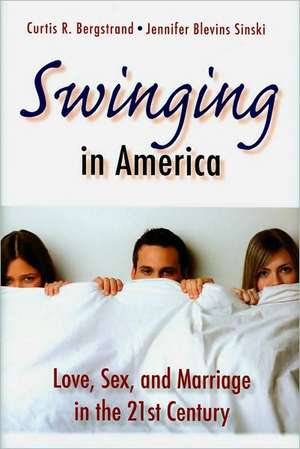
Swinging in America: Love, Sex, and Marriage in the 21st Century
Autor Curtis R. Bergstrand, Jennifer Blevins Sinskien Limba Engleză Hardback – 25 noi 2009
Based on an exhaustive survey into the lives of real people, Swinging in America: Love, Sex, and Marriage in the 21st Century concludes that nonmonogamous relationships such as swinging and polyamory offer a new blueprint for combining sex and love-one that may prove more in line with the way people actually live their lives in our society.
Swinging in America begins with what we know about swingers and the swinging lifestyle, based on personal narratives and over 40 years of sociological research comparing swinging and non-swinging couples on factors such as personal happiness, marital satisfaction, psychological stability, and personal values. The second half of the book explores the historical rise and contemporary decline of monocentrism-the sexually monogamous marriage as the organizing principle underlying our culture-and the implications of this decline for new nonmonogamous relationships and marriages.
Preț: 295.58 lei
Preț vechi: 378.05 lei
-22%
Puncte Express: 443
Carte tipărită la comandă
Livrare economică 08-22 iunie
Specificații
ISBN-13: 9780313379666
ISBN-10: 0313379661
Pagini: 216
Dimensiuni: 156 x 235 x 25 mm
Greutate: 0.48 kg
Ediția:New.
Editura: Bloomsbury Publishing
Colecția Praeger
Locul publicării:New York, United States
ISBN-10: 0313379661
Pagini: 216
Dimensiuni: 156 x 235 x 25 mm
Greutate: 0.48 kg
Ediția:New.
Editura: Bloomsbury Publishing
Colecția Praeger
Locul publicării:New York, United States
V-ar putea interesa
-
 The World of SexHenry MillerPreț: 40.45 lei
 -
 50 Great Myths of Human SexualityPepper SchwartzPreț: 172.29 lei
 -
 Sexuality: All That MattersLouise FoxcroftPreț: 130.87 lei
 -
 Little Emperors and Material Girls: Sex and Youth in Modern ChinaJemimah Steinfeld-21%Preț: 149.73 lei190.35 lei
 -
 Preț: 90.17 lei
 -
 Straight SexLynne SegalPreț: 140.78 lei
 -
 -27%Preț: 45.40 lei62.10 lei
Cuprins
Introduction
Part I: Swinging in America: The New Monogamy?
1. What Is Swinging?
2. Who Are Swingers?
3. Entering the Lifestyle
4. Personal Effects of Swinging
5. Effects on Marriage
Part II: The Rise and Decline of Monocentrism
6. The Social Construction of Monogamy: The Religious and Economic Narrative
7. The Legal Narrative: Monogamy and the Moral Architecture of the Law
8. Psychological Science and the Therapeutic Narrative
9. Sexuality and Monocentrism: The Heretical Narratives
10. The Social Consequences of Monocentrism
11. Toward a Nonmonocentric Narrative of Love, Sex, and Marriage
Conclusion: Is Nonmonogamy for You?
Notes
Index
Part I: Swinging in America: The New Monogamy?
1. What Is Swinging?
2. Who Are Swingers?
3. Entering the Lifestyle
4. Personal Effects of Swinging
5. Effects on Marriage
Part II: The Rise and Decline of Monocentrism
6. The Social Construction of Monogamy: The Religious and Economic Narrative
7. The Legal Narrative: Monogamy and the Moral Architecture of the Law
8. Psychological Science and the Therapeutic Narrative
9. Sexuality and Monocentrism: The Heretical Narratives
10. The Social Consequences of Monocentrism
11. Toward a Nonmonocentric Narrative of Love, Sex, and Marriage
Conclusion: Is Nonmonogamy for You?
Notes
Index
Recenzii
Specialists in swinging, Bergstrand (sociology, criminal justice, and anthropology; Bellarmine U., Kentucky) and special education teacher Sinski explore the phenomenon of established couples having consensual sex with each other's partners, and ponder its implications for society and monogamy. Their topics include who are swingers (no phone numbers!), entering the lifestyle, effects on marriage, monogamy and the moral architecture of the law, psychological science and the therapeutic narrative, and the heretical narratives regarding sexuality and monocentrism.
Swinging in America is an excellent read for those interested in alternative relationships and the social institutions that work against their success. . I wanted to read the first half for the same reason I shamefully buy People magazine before a plane flight. But it was the second half of the book that really made me think, and which I strongly recommend to marriage and couple therapists.
Swinging in America is an excellent read for those interested in alternative relationships and the social institutions that work against their success. . I wanted to read the first half for the same reason I shamefully buy People magazine before a plane flight. But it was the second half of the book that really made me think, and which I strongly recommend to marriage and couple therapists.