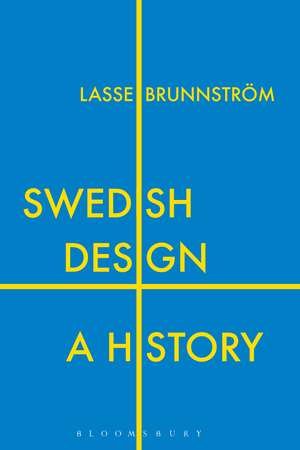
Swedish Design: A History
Autor Lasse Brunnströmen Limba Engleză Paperback – 18 oct 2018
Leading design historian Lasse Brunnström traces the move from artisanal crafts production to the mass production and consumption of designed objects, a process by which the role and profile of the designer became increasingly important. His survey, richly illustrated with images of the designed objects discussed, takes in forms of design traditionally associated with Sweden, such as household objects and textiles, while also considering some less-written about genres such as industrial and graphic design. Brunnström questions many established ideas about design in Sweden, notably its aesthetics and its relationship to Sweden's national and political culture. He argues that the history of design in Sweden has been far more complex and less straightforwardly 'blond' than hitherto understood.
Preț: 194.64 lei
Preț vechi: 254.93 lei
-24%
Puncte Express: 292
Carte tipărită la comandă
Livrare economică 30 noiembrie-14 decembrie
Livrare prin curier în România Termenul estimat este afișat lângă disponibilitate.
Transport gratuit de la 400.00 lei Plată online sau ramburs, în funcție de opțiunile comenzii.
Retur gratuit în 14 zile Comandă securizată și suport în română.
Specificații
ISBN-13: 9781350000155
ISBN-10: 1350000159
Pagini: 280
Ilustrații: 60 BW and two 8pp colour plate sections
Dimensiuni: 152 x 232 x 18 mm
Greutate: 0.52 kg
Editura: Bloomsbury Publishing
Colecția Bloomsbury Visual Arts
Locul publicării:London, United Kingdom
ISBN-10: 1350000159
Pagini: 280
Ilustrații: 60 BW and two 8pp colour plate sections
Dimensiuni: 152 x 232 x 18 mm
Greutate: 0.52 kg
Editura: Bloomsbury Publishing
Colecția Bloomsbury Visual Arts
Locul publicării:London, United Kingdom
V-ar putea interesa
-
 -13%Preț: 134.60 lei154.31 lei
 -
 -15%Preț: 139.28 lei163.96 lei
 -
 -12%Preț: 219.67 lei249.49 leiRecomandat
 -
 Interior Design Since 1900Anne Massey-16%Preț: 93.68 lei111.39 lei
 -
 Design: The Whole StoryElizabeth Wilhide-18%Preț: 188.13 lei230.28 lei
 -
 Transnational Discourses in Nordic DesignAstrid Skjerven-32%Preț: 569.86 lei833.95 lei
 -
 -21%Preț: 306.34 lei388.73 lei
 -
 50 Design Ideas You Really Need to KnowJohn Jervis-28%Preț: 50.78 lei70.05 lei
 -
 -30%Preț: 133.32 lei190.75 lei
 -
 Preț: 193.36 lei
 -
 Modern Scandinavian DesignCharlotte Fiell-23%Preț: 491.91 lei635.62 lei
 -
 100 Ideas that Changed DesignCharlotte Fiell-25%Preț: 109.08 lei145.91 lei
 -
 Preț: 274.34 lei
 -
 Svenskt TennNina Strizler-Levine-8%Preț: 520.82 lei566.11 lei
 -
 History of Modern Design Second EditionDavid Raizman-23%Preț: 276.32 lei358.01 lei
 -
 100 Years of Swiss Graphic DesignChristian Brändle-8%Preț: 400.20 lei435.00 lei
 -
 Graphic Design. 1890-TodayJens MüllerPreț: 115.56 lei
 -
 The Designs of Arne JacobsenThomas Dickson-8%Preț: 401.35 lei436.25 lei
 -
 Industrial Design A-ZCharlotte FiellPreț: 168.91 lei
 -
 Scandinavian DesignCharlotte FiellPreț: 206.62 lei
Cuprins
Introduction
1. Art to Industry: 1840s to 1910s
The nations' struggle for product dominance
Education for increased industrial competitiveness
On a mission to improve taste and morality
The promised land of Windsor chairs and iron stoves
The product range grows and is differentiated
Inventions pave the way for the manufacturing industry
The new industrial products are aestheticized but criticised
Attempts at artistic renewal
2. On the industry's terms: 1910s to 1940s
Serial production enables the breakthrough of consumer goods
Swedish luxury production excels
The Stockholm exhibition paves the way for the factory good
Functionalist ideas pervade society
Furniture design is renewed and professionalised
Prominent defenders of "good taste"
The vision of the Swedish welfare state materialises
3. The promotion of soft values: 1940s to 1950s
Women's understanding of home economics is utilised
The industrial designer demonstrates his talents
Integrated design thinking
Colourful plastic replaces the black era
Mobility increases and the leisure sector expands
The foundation is laid for the Swedish safety philosophy
Human dimensions and requirements govern design
The Swedish Society of Crafts and Design attain their goal of more beautiful everyday goods
Everyday items with classic status
4. Broadened design commissions: 1950s to 1980s
The industrial design profession finds its form
Advertising becomes ever more important within design
Breakthrough for female designers
Factory packaging drives out bulk
Rationality shapes everyday life
Design protests against a grey and unjust world
Design with a user focus becomes a speciality
5. Limitless design: 1980s to 2000s
Visual values are upgraded
Design is recognised as an economic success factor
A personal signature becomes increasingly important
The budget giants step into the sphere of design
The need for strategic brand design increases
Standards of taste and the gender power order are challenged
Sustainability permeates design
Collections, meeting places, archives, awards
Bibliography
Index
1. Art to Industry: 1840s to 1910s
The nations' struggle for product dominance
Education for increased industrial competitiveness
On a mission to improve taste and morality
The promised land of Windsor chairs and iron stoves
The product range grows and is differentiated
Inventions pave the way for the manufacturing industry
The new industrial products are aestheticized but criticised
Attempts at artistic renewal
2. On the industry's terms: 1910s to 1940s
Serial production enables the breakthrough of consumer goods
Swedish luxury production excels
The Stockholm exhibition paves the way for the factory good
Functionalist ideas pervade society
Furniture design is renewed and professionalised
Prominent defenders of "good taste"
The vision of the Swedish welfare state materialises
3. The promotion of soft values: 1940s to 1950s
Women's understanding of home economics is utilised
The industrial designer demonstrates his talents
Integrated design thinking
Colourful plastic replaces the black era
Mobility increases and the leisure sector expands
The foundation is laid for the Swedish safety philosophy
Human dimensions and requirements govern design
The Swedish Society of Crafts and Design attain their goal of more beautiful everyday goods
Everyday items with classic status
4. Broadened design commissions: 1950s to 1980s
The industrial design profession finds its form
Advertising becomes ever more important within design
Breakthrough for female designers
Factory packaging drives out bulk
Rationality shapes everyday life
Design protests against a grey and unjust world
Design with a user focus becomes a speciality
5. Limitless design: 1980s to 2000s
Visual values are upgraded
Design is recognised as an economic success factor
A personal signature becomes increasingly important
The budget giants step into the sphere of design
The need for strategic brand design increases
Standards of taste and the gender power order are challenged
Sustainability permeates design
Collections, meeting places, archives, awards
Bibliography
Index
Recenzii
[There] is no other English-language book like this in the marketplace. Academic readers should be delighted as yet another barrier to Nordic design history has been stripped away by Brunnström's book.
An impressive account of Sweden's design history from its origin in craft traditions to its role in the creation of a modern industrial state. The book's broad approach shows the relation of political, social, and economic factors that contribute to design's development.
This important study significantly extends the information available in English on the subject of Swedish design. More than that, it presents an expanded take on the topic, in which the heroes of Swedish design are placed in the wider context of both Swedish and global industrial and design developments. In expanding beyond the classic fields of furniture, glass, ceramics and textiles (though these are included) and in ranging from the late nineteenth century up to the 2000s, the book challenges the traditionally narrow definitions of what 'Swedish design' can mean. This is an important contribution to our understanding of design in Sweden and how design histories can be written.
Finally, a nuanced and critical survey of Swedish design. Brunnström demonstrates that the history of Swedish design is far more variegated than is usually portrayed.
In rich, informative discussions of both historical and contemporary Swedish design, Lasse Brunnström broadens the conventional perspective on design developments beyond the familiar names of luxury products. In this copiously illustrated study, Brunnström also pushes against such standard distinctions as "industry" and "craft." Focusing on such diverse topics as manufacturing, functionalism, advertising and gender, Swedish Design: A History provides a welcome addition to the expansion of Sweden's design history beyond "Swedish Grace."
Swedish Design: A History is quite possibly the best account of popular design in Scandinavia, and an exciting addition to design history. Complicating the familiar narrative of Swedish design as blonde and handmade, Lasse Brunnström places 19th and 20th century type, textile, product, packaging, car design, and more squarely in the middle of a broader material culture. This is not just a robust history of modern Swedish design and its evolving ideals and ambitions. It is also a rich history of the everyday told through the objects that filled it and the institutions that shaped it.
An impressive account of Sweden's design history from its origin in craft traditions to its role in the creation of a modern industrial state. The book's broad approach shows the relation of political, social, and economic factors that contribute to design's development.
This important study significantly extends the information available in English on the subject of Swedish design. More than that, it presents an expanded take on the topic, in which the heroes of Swedish design are placed in the wider context of both Swedish and global industrial and design developments. In expanding beyond the classic fields of furniture, glass, ceramics and textiles (though these are included) and in ranging from the late nineteenth century up to the 2000s, the book challenges the traditionally narrow definitions of what 'Swedish design' can mean. This is an important contribution to our understanding of design in Sweden and how design histories can be written.
Finally, a nuanced and critical survey of Swedish design. Brunnström demonstrates that the history of Swedish design is far more variegated than is usually portrayed.
In rich, informative discussions of both historical and contemporary Swedish design, Lasse Brunnström broadens the conventional perspective on design developments beyond the familiar names of luxury products. In this copiously illustrated study, Brunnström also pushes against such standard distinctions as "industry" and "craft." Focusing on such diverse topics as manufacturing, functionalism, advertising and gender, Swedish Design: A History provides a welcome addition to the expansion of Sweden's design history beyond "Swedish Grace."
Swedish Design: A History is quite possibly the best account of popular design in Scandinavia, and an exciting addition to design history. Complicating the familiar narrative of Swedish design as blonde and handmade, Lasse Brunnström places 19th and 20th century type, textile, product, packaging, car design, and more squarely in the middle of a broader material culture. This is not just a robust history of modern Swedish design and its evolving ideals and ambitions. It is also a rich history of the everyday told through the objects that filled it and the institutions that shaped it.