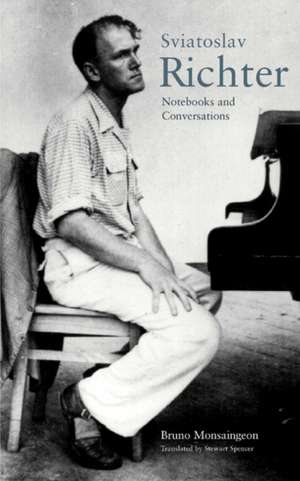
Sviatoslav Richter
Autor Bruno Monsaingeon Traducere de Stewart Spenceren Limba Engleză Paperback – 15 sep 2002
Când deschidem paginile volumului Sviatoslav Richter, suntem întâmpinați de un vocabular al introspecției și al rigoarei artistice, acoperind termeni esențiali despre interpretare, tehnică pianistică și compoziție, totul filtrat prin experiența directă a unuia dintre cei mai mari pianiști ai secolului XX. Putem afirma că această lucrare nu este o biografie convențională, ci un dialog intim între autorul Bruno Monsaingeon și un artist care și-a păzit cu ferocitate viața privată timp de decenii. Structura cărții urmărește o progresie cronologică și tematică fascinantă. Începând cu primii ani în Odessa și perioada formativă la Conservatorul din Moscova sub îndrumarea lui Heinrich Neuhaus, textul evoluează spre episoade istorice de o intensitate rară, cum este relatarea laconica a momentului în care Richter a cântat la funeraliile lui Stalin. Ca și Memoirs and Reflections de Evgeny Kissin, acest volum oferă o perspectivă rară asupra școlii ruse de pian, dar se diferențiază printr-o metodologie mult mai documentară: Monsaingeon integrează jurnalele de audiție ale lui Richter, oferindu-ne acces la gândirea critică a pianistului despre colegii săi de scenă, precum Gilels sau Rostropovich. Suntem de părere că secțiunea „Notebooks” reprezintă inima cărții, transformând lectura într-o experiență de mentorat. Richter analizează cu un umor sec și o onestitate brutală propriile înregistrări, dar și lucrările lui Prokofiev sau Shostakovich, oferind cititorului instrumentele necesare pentru a înțelege rolul interpretului ca servitor al compozitorului. Este o lucrare masivă, de peste 400 de pagini, publicată de Princeton University Press, care reușește să deconstruiască mitul „artistului enigmatic” în favoarea unui intelectual profund.
Preț: 370.73 lei
Carte tipărită la comandă
Livrare economică 26 noiembrie-10 decembrie
Specificații
ISBN-10: 0691095493
Pagini: 464
Ilustrații: 20 halftones
Dimensiuni: 156 x 234 x 28 mm
Greutate: 0.79 kg
Editura: Princeton University Press
Locul publicării:Princeton, United States
V-ar putea interesa
-
 The Musical as DramaH. Scott McMillinPreț: 233.13 lei
 -
 Mozart's GraceScott BurnhamPreț: 233.06 lei
 -
 Opera in the Development of German Critical ThoughtGloria FlahertyPreț: 509.07 lei
 -
 Tchaikovsky and His WorldLeslie KearneyPreț: 501.26 lei
 -
 The Music Theory of Godfrey WinhamLeslie David BlasiusPreț: 286.42 lei
 -
 The Science and Art of Renaissance MusicJames Haar-19%Preț: 435.71 lei537.91 lei
 -
 The Structure of Recognizable Diatonic TuningsEasley BlackwoodPreț: 434.64 lei
 -
 Music in the French Royal Academy of SciencesAlbert CohenPreț: 286.08 lei
 -
 The Traditional Tunes of the Child Ballads, Volume 4Bertrand Harris Bronson-19%Preț: 601.85 lei743.02 lei
 -
 Analyse der Motette Nr. 4 von Guillaume MachautPhilip Henri UnterreinerPreț: 80.28 lei
 -
 Preț: 88.79 lei
 -
 Die Bettler-OperElise PolkoPreț: 213.99 lei
 -
 Die OrgelOtto WangemannPreț: 230.66 lei
 -
 LustgartenHans Leo HasslerPreț: 118.69 lei
 -
 Preț: 187.05 lei
 -
 Life of our Saviour Jesus ChristJames TissotPreț: 149.66 lei
 -
 Geschichte der MusikAugust Wilhelm AmbrosPreț: 313.82 lei
 -
 PRONOUNCING and DEFINING DICTIONARY of MUSICW. S. B. MathewsPreț: 184.62 lei
 -
 Preț: 238.77 lei
 -
 Die Kunst des reinen Satzes in der MusikJohann Philipp KirnbergerPreț: 158.99 lei
 -
 Fachkatalog der musikhistorischen AbteilungGuido AdlerPreț: 387.03 lei
 -
 Arban's complete celebrated method for the cornetJean-Baptiste ArbanPreț: 258.72 lei
 -
 Preț: 176.90 lei
De ce să citești această carte
Recomandăm această carte oricărui meloman care dorește să înțeleagă rigoarea din spatele geniului interpretativ. Cititorul câștigă o perspectivă unică asupra culturii muzicale ruse și un ghid de audiție critică prin jurnalele lui Richter. Este o lectură esențială pentru studenții la conservator și pentru cei care apreciază memoriile scrise cu onestitate intelectuală, oferind un context istoric și artistic pe care nicio analiză exterioară nu îl poate replica.
Despre autor
Bruno Monsaingeon este un scriitor și realizator de filme documentare stabilit la Paris, recunoscut pe plan internațional pentru portretele sale cinematografice dedicate unor mari muzicieni precum Glenn Gould, Yehudi Menuhin sau David Oistrakh. Filmul său despre Richter a fost primit cu un succes răsunător în Franța și Statele Unite, servind drept bază pentru acest volum. Monsaingeon este, de asemenea, autorul cărții „Mademoiselle”, o serie de conversații cu legendara Nadia Boulanger, consolidându-și reputația de biograf care reușește să extragă mărturii profunde de la artiști extrem de rezervați.
Descriere scurtă
Cuprins
Ritcher in his own words
Prolegomenon 3
1. Childhood 7
2. Odessa in the Thirties 16
3. Heinrich Neuhaus 25
4. The War Years 41
5. On Prokofiev 67
6. A Dark Chapter 90
7. Foreign Tours 95
8. Silhouettes 115
9. The Mirror 138
Notebooks: On Music 167
Appendices
A Don Juan of Music, or Richter in Figures 379
Highlights of Richter's Career 407
Index 414
Textul de pe ultima copertă
Recenzii
Richter himself spends 200 of these pages putting us straight as regards his recordings . . . The table of his repetoire in these Notebooks and Conversations shows he was always a subtle, inquisitive artist, who played for his own developing pleasure, not to feed the public with exactly what it gaped for . . .
This is as close, in a human and enlightening way, as the likes of thee and me are likely to get to truly towering creative (and interpretive) genius.
In allowing Richter's own words to take precedence over anecdotes or analysis, a clear view of Richter's musical life emerges . . . Richter develops from a mischievous-looking young man to the chiseled, inscrutable icon of his later years.
Music lovers should be grateful, for along with [Richter's] comments on music and musicians, it displays the foibles, opinions, skills, joys, and sorrows of the publicly reticent keyboard titan. Lavishly illustrated with photographs, it should enlighten and delight lovers of the piano and the pianist.
This book is almost impossible to put down . . . Its target is anyone who wishes to sit at the foot of the Richter legend. . . .
Here is one of the great pianists of the 20th century, who was justly welcomed with adulation any time he appeared, who never once, in dozens of recordings, seemed to doubt what he was doing or what the music was saying.
Few in the 20th century loomed so tall artistically but lived more eccentrically than the late Russian pianist Sviatoslav Richter. . . . Was there ever a more singular musician?. . . In what initially appears to be a mere appendix of the book, there is the most insightful, engaging part of all: excerpts from Richter's personal notebooks. . . . This is the heart of music-making and an artistic life. To understand [Richter] is to better understand all of those individualists of the keyboard.
[In this well-made book] . . . Richter appears part monk, part showman, part unworldly, part shrewd. . . . Richter's notebooks, reproduced in the second half of the book, slag off, with gusto, other musicians, recordings, conductors, and, to be fair, himself.
Enlivened throughout by Richter's intelligence and his eccentric humor, particularly in the last section, a diary where he has made notes on the music he is listening to. . . . Characteristically, his sternest criticisms are reserved for his own recordings.
Quintessential Richter . . . highly cultivated, perceptive but caustic, particularly about what he perceived as superficiality and egotism. . . . Determination, sincerity, strength in abundance. Everything about Richter seemed outsized.
This book is almost impossible to put down. . . . The strength of Richter's personality, his obstinacy, and his candour, leap from every page.
The book will . . . be of interest to anyone interested in Richter's ideas and personality.
The reader is presented with an intimate portrait. . . . Monsaingeon has put together a volume that gives the reader a close-up look at an internationally known musician recognized as one of the most important pianists in the last half of the 20th century.
"This is a fascinating glimpse of the musical world through the eyes of one of its major practitioners."--Library Journal "Richter himself spends 200 of these pages putting us straight as regards his recordings ... The table of his repetoire in these Notebooks and Conversations shows he was always a subtle, inquisitive artist, who played for his own developing pleasure, not to feed the public with exactly what it gaped for ..."--Eric Griffiths, The Evening Standard "This is as close, in a human and enlightening way, as the likes of thee and me are likely to get to truly towering creative (and interpretive) genius."--Michael Wolff, New York Observer "In allowing Richter's own words to take precedence over anecdotes or analysis, a clear view of Richter's musical life emerges ... Richter develops from a mischievous-looking young man to the chiseled, inscrutable icon of his later years."--The Economist "Music lovers should be grateful, for along with [Richter's] comments on music and musicians, it displays the foibles, opinions, skills, joys, and sorrows of the publicly reticent keyboard titan. Lavishly illustrated with photographs, it should enlighten and delight lovers of the piano and the pianist."--Booklist "This book is almost impossible to put down ... Its target is anyone who wishes to sit at the foot of the Richter legend..."--Andrew Clark, Financial Times "Here is one of the great pianists of the 20th century, who was justly welcomed with adulation any time he appeared, who never once, in dozens of recordings, seemed to doubt what he was doing or what the music was saying."--Edward Rothstein, New York Times Book Review "Few in the 20th century loomed so tall artistically but lived more eccentrically than the late Russian pianist Sviatoslav Richter... Was there ever a more singular musician?... In what initially appears to be a mere appendix of the book, there is the most insightful, engaging part of all: excerpts from Richter's personal notebooks... This is the heart of music-making and an artistic life. To understand [Richter] is to better understand all of those individualists of the keyboard."--David Patrick Stearns, The Philadelphia Inquirer "[In this well-made book] ... Richter appears part monk, part showman, part unworldly, part shrewd... Richter?s notebooks, reproduced in the second half of the book, slag off, with gusto, other musicians, recordings, conductors, and, to be fair, himself."--Richard Coles, Times Literary Supplement "Enlivened throughout by Richter's intelligence and his eccentric humor, particularly in the last section, a diary where he has made notes on the music he is listening to... Characteristically, his sternest criticisms are reserved for his own recordings."--The New Yorker "Quintessential Richter ... highly cultivated, perceptive but caustic, particularly about what he perceived as superficiality and egotism... Determination, sincerity, strength in abundance. Everything about Richter seemed outsized."--Michael Kimmelman, The New York Review of Books "This book is almost impossible to put down... The strength of Richter?s personality, his obstinacy, and his candour, leap from every page."--Andrew Clark, Financial Times The book will ... be of interest to anyone interested in Richter's ideas and personality."--Paul Orgel, Notes "The reader is presented with an intimate portrait... Monsaingeon has put together a volume that gives the reader a close-up look at an internationally known musician recognized as one of the most important pianists in the last half of the 20th century."--Choice