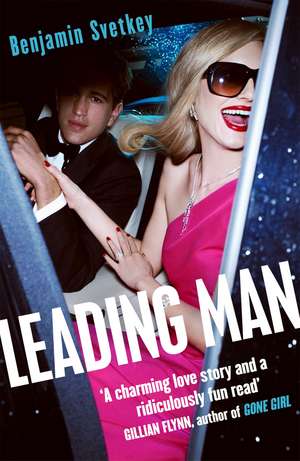
Leading Man
Autor Benjamin Svetkeyen Limba Engleză Paperback – 16 ian 2014
Max Lerner has it all figured out. He's got the girl - his childhood sweetheart Samantha. He's got the job - reporter for a national magazine. Life is sweet. Until his aspiring actress girlfriend leaves him for his childhood hero, Johnny Mars. Can Max win her back by throwing himself into the world of celebrities, hangers on and wannabes? Or will he get more of an education than he bargained for?
Uproariously funny and exquisitely poignant, Leading Man will take you back to your first love, your first heartbreak and the first time your heroes let you down.
| Toate formatele și edițiile | Preț | Express |
|---|---|---|
| Paperback (2) | 40.47 lei 3-5 săpt. | |
| Orion Publishing Group – 16 ian 2014 | 40.47 lei 3-5 săpt. | |
| VINTAGE BOOKS – 2 sep 2013 | 97.80 lei 3-5 săpt. |
Preț: 40.47 lei
Preț vechi: 55.34 lei
-27%
Puncte Express: 61
Preț estimativ în valută:
7.16€ • 8.35$ • 6.21£
7.16€ • 8.35$ • 6.21£
Carte disponibilă
Livrare economică 06-20 februarie
Preluare comenzi: 021 569.72.76
Specificații
ISBN-13: 9781780225135
ISBN-10: 178022513X
Pagini: 272
Dimensiuni: 128 x 197 x 19 mm
Greutate: 0.21 kg
Editura: Orion Publishing Group
Colecția W&N
Locul publicării:London, United Kingdom
ISBN-10: 178022513X
Pagini: 272
Dimensiuni: 128 x 197 x 19 mm
Greutate: 0.21 kg
Editura: Orion Publishing Group
Colecția W&N
Locul publicării:London, United Kingdom
V-ar putea interesa
-
 Fifty Shades of GreyE. L. JamesPreț: 98.86 lei
 -
 Fifty Shades DarkerE. L. JamesPreț: 98.86 lei
 -
 Fifty Shades FreedE. L. JamesPreț: 99.80 lei
 -
 The ShadowSylvain ReynardPreț: 75.99 lei
 -
 The Winter SeaDi Morrissey-24%Preț: 86.00 lei112.72 lei
 -
 It's Love, Only Love: Green Mountain Book 5Marie ForcePreț: 184.33 lei
Recenzii
I wrote about pop culture for 10 years and the guy I wanted to write like was Benjamin Svetkey. If you want an insider's look at Hollywood told with an outsider's sense of humor, you need look no further. LEADING MAN is about the adored and the adoring, the famous and their flocks, the people up on pedestals and those who put them there - it's a funny, sharp deconstruction of our fame-obsessed, media-savvy culture, a charming love story, and a ridiculously fun read
Notă biografică
Author Bio: Benjamin Svetkey has been interviewing celebrities and writing about pop culture forEntertainment Weekly since 1991. He served as the magazine's LA Bureau Chief from 2004 to 2007, and is currently an Editor at Large. He holds the distinction of being the only writer in EW history ever to appear on its cover (as a Star Trek alien). Svetkey has also published stories in The New York TimesMagazine, Rolling Stone, Time International, and Spy magazine, the famous satirical monthly of the late 1980s, where he started his career working as a fact checker. Over the past two decades, Svetkey has interviewed hundreds of the biggest stars in the world, traveled around the globe visiting moviesets, and observed how Hollywood works from inside the studio lots. Svetkey attended the University of Vermont and received his masters degree from Columbia University's School of Journalism. He currently lives in California with his wife, Lenka, and their two-year-old daughter, Chloe. Residence: Santa Monica, CA Hometown: Scarsdale, NY
Extras
Excerpted from Chapter One
[2005]
The knocking began at two in the morning. Three sharp raps, a few seconds of silence, then three more. I crawled out of bed, grabbed a fluffy robe from the bathroom— “Grand Hotel d’Angkor” it said in gold lettering on the breast pocket—and opened the door.
Nobody was there.
I didn’t know a soul in Cambodia, certainly not anyone who’d pay a visit at this late hour, so I figured some other hotel guest must have mixed up a room number. I slid back into the comfy king-size bed with the eight-hundred-thread-count sheets, slipped on the eye mask from the minibar, switched off the light, and drifted back to sleep. A few minutes later, though, the knocking started again. Three raps, silence, three more. I headed to the door again. The hallway was still empty.
I don’t believe in ghosts, but if any place seemed likely to be haunted, it was this hotel in Siem Reap. The village itself was straight out of a Children’s Fund late-night TV spot. It was made up mostly of crumbling clay shacks and muddy streets, and the surrounding jungle was littered with unexploded land mines left over from Cambodia’s on-again-off-again civil war. Beggars were everywhere, many of them small children. Buddhist monks in flowing orange robes flocked to the area too, drawn by the Zen magnetism of the nearby Temple of Angkor Wat, the super-sacred eight-hundred-year-old Buddhist shrine located a few miles down a dirt road. But smack in the middle of this twelfth-century landscape, sticking out like Lady Gaga at an ashram, was the five-star Grand Hotel d’Angkor, a colonial palace that had been catering to rich European tourists since Cambodia had been a French outpost back in the 1930s. This was about as far from Western civilization as you could get—in Siem Reap, elephants were still considered a form of mass transit—yet the doormen at the Grand Hotel all wore dainty white gloves.
I had ventured into Cambodia feeling like Captain Willard on the Nung River, in search of DeeDee Devry, the blond movie starlet famous for her in-your-face acting style, stunning violet eyes, and tumultuous private life. DeeDee—or Double-D, as she was nicknamed by the Hollywood press—was in Siem Reap shooting a high-concept action picture called Time Tank. She was starring as a U.S. Army tank commander in Afghanistan who takes a wrong turn into a temporal vortex that sends her and her vehicle hopscotching through portals in time and space. Think Band of Brothers meets Bill & Ted’s Excellent Adventure. At one point in the script, there’s a stop in medieval Indochina, where DeeDee’s character is worshipped by the Khmer natives, the old blond-goddess-in-the-jungle routine.
Technically, I was a member of the Hollywood press, although I didn’t spend a lot of time in Hollywood. My job was to fly around the world, interview movie stars and other celebrities, and write about them in the pages of KNOW magazine, the much-venerated, widely read news weekly headquartered in New York. It was a preposterously glamorous gig, the sort of jet-setting occupation a shallow Matthew McConaughey character might have in a cheesy romantic comedy—until McConaughey’s character falls in love in the second act and learns the greater bliss of settling down with a regular girl like Kate Hudson. Only I was stuck in my second act. I was in my thirties and was unable to fall in love. The way things were going, I’d end up as Matthew McConaughey for the rest of my life, and nobody wants that.
It didn’t matter what sort of girl I dated when I was back home in the United States—the punky music publicist with prematurely blue hair, the sexy sculptress who made spooky artwork out of glass eyeballs, the struggling actress who was so superstitious she dealt herself tarot cards before every audition—I always ended up running away. My intentions were honorable. I would go into each new romance with an open mind, hoping this would be the one that would stick, but it never did. Sooner or later, I would find deal-breaking flaws. A cackling laugh. Thick ankles. Loud chewing. And that was it, I would bolt. I knew, of course, I had plenty of flaws of my own, much worse than unshapely ankles. But I couldn’t help myself.
Lucky for me, though, there was one type of relationship I was really good at—the kind I had with megafamous strangers. Who cared that I couldn’t fall in love? Jack Nicholson knew my name! At least he did for the ninety minutes I spent with him in one of his mansions on Mulholland Drive. Who needed real intimacy with real people when fake intimacy with celebrities I would never see again was so much easier, so much fun? Unlike relationships with the unfamous—which often involved inconvenient emotions like longing or remorse—my relationships with stars were totally feeling-free. The rules of engagement were simple: I’d sit down with someone I’d never met and politely ask him or her invasive questions that would never come up in casual conversation—“What’s it like getting busted with a hooker in your car?” “Why do people think your husband is gay?”—while the stars tried to charm and disarm me, revealing as little about themselves as possible. It was both an intensely personal and completely counterfeit form of communication. It’s not how human beings are wired to interact. I loved it. To me, it was an entire romance, from seduction to betrayal, compressed into a single deadline.
And now I was in a hotel room in Southeast Asia, trying to get some sleep before meeting with yet another international superstar. Only some joker kept rapping on my door, then vanishing into thin air. I sat in bed and thumbed through some magazines. When I got bored with that, I grabbed the remote and turned on the TV. There were only two channels to watch in Cambodia, even at the Grand Hotel. One was broadcasting the Asia Business Report from Hong Kong. The other was airing a rerun of Ally McBeal. I killed a half hour watching Calista Flockhart dubbed in Taiwanese. When it was clear the knocker was not going to return, I switched off the light and curled back into a sleeping position.
A few minutes later, the knocking started again.
[2005]
The knocking began at two in the morning. Three sharp raps, a few seconds of silence, then three more. I crawled out of bed, grabbed a fluffy robe from the bathroom— “Grand Hotel d’Angkor” it said in gold lettering on the breast pocket—and opened the door.
Nobody was there.
I didn’t know a soul in Cambodia, certainly not anyone who’d pay a visit at this late hour, so I figured some other hotel guest must have mixed up a room number. I slid back into the comfy king-size bed with the eight-hundred-thread-count sheets, slipped on the eye mask from the minibar, switched off the light, and drifted back to sleep. A few minutes later, though, the knocking started again. Three raps, silence, three more. I headed to the door again. The hallway was still empty.
I don’t believe in ghosts, but if any place seemed likely to be haunted, it was this hotel in Siem Reap. The village itself was straight out of a Children’s Fund late-night TV spot. It was made up mostly of crumbling clay shacks and muddy streets, and the surrounding jungle was littered with unexploded land mines left over from Cambodia’s on-again-off-again civil war. Beggars were everywhere, many of them small children. Buddhist monks in flowing orange robes flocked to the area too, drawn by the Zen magnetism of the nearby Temple of Angkor Wat, the super-sacred eight-hundred-year-old Buddhist shrine located a few miles down a dirt road. But smack in the middle of this twelfth-century landscape, sticking out like Lady Gaga at an ashram, was the five-star Grand Hotel d’Angkor, a colonial palace that had been catering to rich European tourists since Cambodia had been a French outpost back in the 1930s. This was about as far from Western civilization as you could get—in Siem Reap, elephants were still considered a form of mass transit—yet the doormen at the Grand Hotel all wore dainty white gloves.
I had ventured into Cambodia feeling like Captain Willard on the Nung River, in search of DeeDee Devry, the blond movie starlet famous for her in-your-face acting style, stunning violet eyes, and tumultuous private life. DeeDee—or Double-D, as she was nicknamed by the Hollywood press—was in Siem Reap shooting a high-concept action picture called Time Tank. She was starring as a U.S. Army tank commander in Afghanistan who takes a wrong turn into a temporal vortex that sends her and her vehicle hopscotching through portals in time and space. Think Band of Brothers meets Bill & Ted’s Excellent Adventure. At one point in the script, there’s a stop in medieval Indochina, where DeeDee’s character is worshipped by the Khmer natives, the old blond-goddess-in-the-jungle routine.
Technically, I was a member of the Hollywood press, although I didn’t spend a lot of time in Hollywood. My job was to fly around the world, interview movie stars and other celebrities, and write about them in the pages of KNOW magazine, the much-venerated, widely read news weekly headquartered in New York. It was a preposterously glamorous gig, the sort of jet-setting occupation a shallow Matthew McConaughey character might have in a cheesy romantic comedy—until McConaughey’s character falls in love in the second act and learns the greater bliss of settling down with a regular girl like Kate Hudson. Only I was stuck in my second act. I was in my thirties and was unable to fall in love. The way things were going, I’d end up as Matthew McConaughey for the rest of my life, and nobody wants that.
It didn’t matter what sort of girl I dated when I was back home in the United States—the punky music publicist with prematurely blue hair, the sexy sculptress who made spooky artwork out of glass eyeballs, the struggling actress who was so superstitious she dealt herself tarot cards before every audition—I always ended up running away. My intentions were honorable. I would go into each new romance with an open mind, hoping this would be the one that would stick, but it never did. Sooner or later, I would find deal-breaking flaws. A cackling laugh. Thick ankles. Loud chewing. And that was it, I would bolt. I knew, of course, I had plenty of flaws of my own, much worse than unshapely ankles. But I couldn’t help myself.
Lucky for me, though, there was one type of relationship I was really good at—the kind I had with megafamous strangers. Who cared that I couldn’t fall in love? Jack Nicholson knew my name! At least he did for the ninety minutes I spent with him in one of his mansions on Mulholland Drive. Who needed real intimacy with real people when fake intimacy with celebrities I would never see again was so much easier, so much fun? Unlike relationships with the unfamous—which often involved inconvenient emotions like longing or remorse—my relationships with stars were totally feeling-free. The rules of engagement were simple: I’d sit down with someone I’d never met and politely ask him or her invasive questions that would never come up in casual conversation—“What’s it like getting busted with a hooker in your car?” “Why do people think your husband is gay?”—while the stars tried to charm and disarm me, revealing as little about themselves as possible. It was both an intensely personal and completely counterfeit form of communication. It’s not how human beings are wired to interact. I loved it. To me, it was an entire romance, from seduction to betrayal, compressed into a single deadline.
And now I was in a hotel room in Southeast Asia, trying to get some sleep before meeting with yet another international superstar. Only some joker kept rapping on my door, then vanishing into thin air. I sat in bed and thumbed through some magazines. When I got bored with that, I grabbed the remote and turned on the TV. There were only two channels to watch in Cambodia, even at the Grand Hotel. One was broadcasting the Asia Business Report from Hong Kong. The other was airing a rerun of Ally McBeal. I killed a half hour watching Calista Flockhart dubbed in Taiwanese. When it was clear the knocker was not going to return, I switched off the light and curled back into a sleeping position.
A few minutes later, the knocking started again.