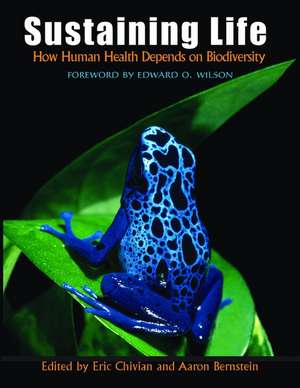
Sustaining Life: How Human Health Depends on Biodiversity
Editat de Eric Chivian, Aaron Bernsteinen Limba Engleză Hardback – 15 mai 2008
Preț: 405.99 lei
Preț vechi: 475.00 lei
-15%
Puncte Express: 609
Carte tipărită la comandă
Livrare economică 19-25 noiembrie
Livrare prin curier în România Termenul estimat este afișat lângă disponibilitate.
Transport gratuit pentru acest produs Plată online sau ramburs, în funcție de opțiunile comenzii.
Retur gratuit în 14 zile Comandă securizată și suport în română.
Specificații
ISBN-13: 9780195175097
ISBN-10: 0195175093
Pagini: 568
Ilustrații: numerous colour illustrations
Dimensiuni: 220 x 284 x 36 mm
Greutate: 2.13 kg
Editura: Oxford University Press
Colecția OUP USA
Locul publicării:New York, United States
ISBN-10: 0195175093
Pagini: 568
Ilustrații: numerous colour illustrations
Dimensiuni: 220 x 284 x 36 mm
Greutate: 2.13 kg
Editura: Oxford University Press
Colecția OUP USA
Locul publicării:New York, United States
V-ar putea interesa
-
 Biodiversity Conservation: A Very Short IntroductionDavid W. Macdonald-19%Preț: 57.41 lei71.11 lei
 -
 Dark MatterJames Kinross-34%Preț: 61.83 lei93.58 lei
 -
 Exploring Linkages Between Soil Health and Human HealthNational Academies of Sciences Engineering and Medicine-5%Preț: 362.49 lei381.57 lei
 -
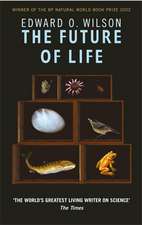 The Future Of LifeProfessor Edward O. Wilson-28%Preț: 66.87 lei92.41 lei
 -
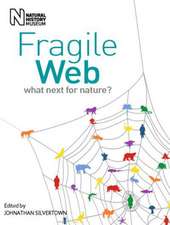 Fragile WebJonathan Silvertown-17%Preț: 88.29 lei106.74 lei
 -
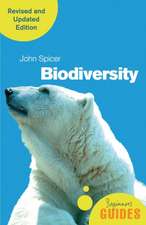 BiodiversityJohn SpicerPreț: 59.04 lei
 -
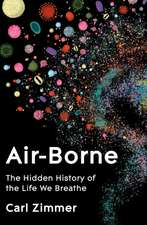 Air-BorneCarl Zimmer-36%Preț: 79.45 lei123.72 lei
 -
 The Decline and Fall of the Human EmpireHenry Gee-34%Preț: 80.86 lei122.38 lei
 -
 Before They VanishPaul R. EhrlichPreț: 173.69 lei
 -
 Our World in Crisis: Health and DiseaseIzzi Howell-36%Preț: 73.04 lei114.22 lei
 -
 -27%Preț: 57.01 lei78.33 lei
 -
 The Hidden UniverseAlexandre Antonelli-24%Preț: 96.91 lei126.87 lei
 -
 Many: The Diversity of Life on EarthNicola DaviesPreț: 55.11 lei
 -
 -19%Preț: 117.40 lei144.47 leiRecomandat
 -
 KingdomWill MillardPreț: 220.02 lei
 -
 FermentTim Spector-5%Preț: 116.95 lei123.10 lei
 -
 The Kew Gardens Salad BookJenny LinfordPreț: 161.70 lei
 -
 The Gut: A Pocket PrimerAmy Fleming-19%Preț: 51.68 lei64.15 lei
 -
 Life on a Little-Known PlanetElizabeth KolbertPreț: 188.00 lei
Recenzii
Sustaining Life: How Human Health Depends on Biodiversity is a landmark book that lays out the case for the conservation of biodiversity and the multiple benefits it provides. The book is well organized, with beautiful supporting imagery. It is a much needed resource and a call to appreciate and take action to conserve our biological diversity at this critical time.
...fabulous book...lavishly illustrated...both fascinating and frightening
This book...reminds us of just how much we have to lose.
This book represents a landmark addition to our understanding of our ecological heritage, and the importance of preserving it.
A Powerhouse of information on a topic that concerns us all. Highly recommended.
It is a new and comprehensive review of the latest tally of planetary profit and loss...
Sustaining Life is the most complete and powerful argument I have seen for the importance of preserving biodiversity.
It was an exhilarating moment when scientists broke the genome code and showed us the basic building blocks of the human being. Now scientists are showing us how biodiversity works and why it is crucial to saving our planet for our children's children and beyond. This important and compelling book is a blueprint for acting wisely and urgently.
"There is probably no better way to convince anyone still uncertain about the urgent need to preserve biodiversity, which is rapidly diminishing as a result of human activities, than to document its importance to human health and medicine. The authors have done this with great thoroughness and from every possible angle, producing a volume that pairs authority with anecdote and scholarship with passion."--Harold Varmus, President, Memorial Sloan-Kettering Cancer Center, 1989 Nobel Prize Laureate, former Director of the National Institutes of Health
"As a public health physician, I have been deeply involved for decades in helping political leaders, policy-makers, and the general public understand the relationship between human beings and the environment. Sustaining Life is the best and most comprehensive resource available demonstrating how human health depends on the health of the natural world."--Gro Brundtland, former Director-General of the World Health Organization, former Prime Minister of Norway
"One of the main reasons the world faces a global environmental crisis is the belief that we human beings are somehow separate from the natural world in which we live, and that we can therefore alter its physical, chemical, and biological systems without these alterations having any effect on humanity. Sustaining Life challenges this widely held misconception by demonstrating definitively, with the best and most current scientific information available, that human health depends, to a larger extent than we might imagine, on the health of other species and on the healthy functioning of natural ecosystems."--Kofi Annan, former Secretary-General of the United Nations, 2001 Nobel Peace Prize Laureate, from the Prologue
This most readable and beautifully illustrated book, with contributions from more than 100 leading scientists from around the world, underlines that the health implications of the loss of biodiversity are every bit as great as those caused by global warming ... The book makes compelling reading for anyone interested in the natural world.
"A powerhouse of information on a topic that concerns of us all. Highly recommended."--Irwin Weintraub, Library Journal Reviews
...fabulous book...lavishly illustrated...both fascinating and frightening
This book...reminds us of just how much we have to lose.
This book represents a landmark addition to our understanding of our ecological heritage, and the importance of preserving it.
A Powerhouse of information on a topic that concerns us all. Highly recommended.
It is a new and comprehensive review of the latest tally of planetary profit and loss...
Sustaining Life is the most complete and powerful argument I have seen for the importance of preserving biodiversity.
It was an exhilarating moment when scientists broke the genome code and showed us the basic building blocks of the human being. Now scientists are showing us how biodiversity works and why it is crucial to saving our planet for our children's children and beyond. This important and compelling book is a blueprint for acting wisely and urgently.
"There is probably no better way to convince anyone still uncertain about the urgent need to preserve biodiversity, which is rapidly diminishing as a result of human activities, than to document its importance to human health and medicine. The authors have done this with great thoroughness and from every possible angle, producing a volume that pairs authority with anecdote and scholarship with passion."--Harold Varmus, President, Memorial Sloan-Kettering Cancer Center, 1989 Nobel Prize Laureate, former Director of the National Institutes of Health
"As a public health physician, I have been deeply involved for decades in helping political leaders, policy-makers, and the general public understand the relationship between human beings and the environment. Sustaining Life is the best and most comprehensive resource available demonstrating how human health depends on the health of the natural world."--Gro Brundtland, former Director-General of the World Health Organization, former Prime Minister of Norway
"One of the main reasons the world faces a global environmental crisis is the belief that we human beings are somehow separate from the natural world in which we live, and that we can therefore alter its physical, chemical, and biological systems without these alterations having any effect on humanity. Sustaining Life challenges this widely held misconception by demonstrating definitively, with the best and most current scientific information available, that human health depends, to a larger extent than we might imagine, on the health of other species and on the healthy functioning of natural ecosystems."--Kofi Annan, former Secretary-General of the United Nations, 2001 Nobel Peace Prize Laureate, from the Prologue
This most readable and beautifully illustrated book, with contributions from more than 100 leading scientists from around the world, underlines that the health implications of the loss of biodiversity are every bit as great as those caused by global warming ... The book makes compelling reading for anyone interested in the natural world.
"A powerhouse of information on a topic that concerns of us all. Highly recommended."--Irwin Weintraub, Library Journal Reviews
Notă biografică
Eric Chivian, M.D., is the Director of the Center for Health and the Global Environment at Harvard Medical School. He shared the 1985 Nobel Peace Prize. He is the lead editor and author of Last Aid: The Medical Dimensions of Nuclear War and Critical Condition: Human Health and the Environment. Aaron Bernstein, M.D., is a Research Associate at the Center for Health and the Global Environment at Harvard Medical School, and Resident, Boston Combined Residency in Pediatrics, Harvard Medical School/Boston University School of Medicine.