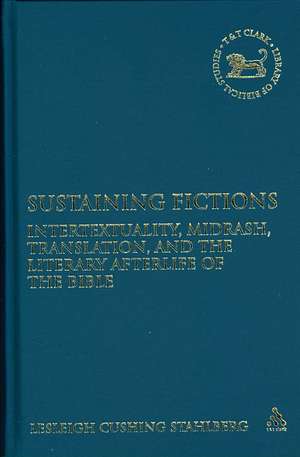
Sustaining Fictions: Intertextuality, Midrash, Translation, and the Literary Afterlife of the Bible: The Library of Hebrew Bible/Old Testament Studies
Autor Lesleigh Cushing Stahlbergen Limba Engleză Hardback – 2009
Literary critics, bible scholars and book reviewers alike seek recourse in words like adaptation, allusion, echo, imitation and influence to describe what the author, for lack of better terms, has come to call retellings or recastings. Although none of these designations rings false, none approaches precision. They do not tell us what the author of a novel or poem has done with a biblical figure, do not signal how this newly recast figure is different from other recastings of it, and do not offer any indication of why these transformations have occurred. Sustaining Fictions sets out to redress this problem, considering the viability of the vocabularies of literary, midrashic, and translation theory for speaking about retelling.
Din seria The Library of Hebrew Bible/Old Testament Studies
- 28%
 Preț: 523.27 lei
 - 34%
 Preț: 524.05 lei
 - nou
 Preț: 563.78 lei
 - 31%
 Preț: 572.25 lei
 - 32%
 Preț: 596.25 lei
 - 35%
 Preț: 717.27 lei
 - 36%
 Preț: 584.76 lei
 - 24%
 Preț: 1221.79 lei
 - 24%
 Preț: 1239.43 lei
 - 25%
 Preț: 1150.86 lei
 - 25%
 Preț: 1087.98 lei
 - 25%
 Preț: 1171.84 lei
 - 25%
 Preț: 1103.91 lei
 - 26%
 Preț: 851.19 lei
 - 33%
 Preț: 771.63 lei
 - 36%
 Preț: 775.17 lei
 - 25%
 Preț: 1024.39 lei
 - 25%
 Preț: 1103.05 lei
 - 33%
 Preț: 1152.79 lei
 - 24%
 Preț: 1222.30 lei
 - 26%
 Preț: 1160.43 lei
 - 22%
 Preț: 532.76 lei
 - 24%
 Preț: 1179.15 lei
 - 24%
 Preț: 1219.04 lei
 - 29%
 Preț: 1215.32 lei
 - 21%
 Preț: 505.33 lei
 - 25%
 Preț: 1215.95 lei
 - 25%
 Preț: 1232.49 lei
 - 25%
 Preț: 1215.51 lei
 - 25%
 Preț: 1211.71 lei
 - 25%
 Preț: 1213.13 lei
 - 25%
 Preț: 845.74 lei
 - 25%
 Preț: 1216.13 lei
 - 25%
 Preț: 961.42 lei
 - 20%
 Preț: 414.96 lei
 - 24%
 Preț: 964.78 lei
 - 26%
 Preț: 369.50 lei
 - 25%
 Preț: 1088.14 lei
 - 34%
 Preț: 914.32 lei
 - 24%
 Preț: 838.13 lei
 - 33%
 Preț: 1215.43 lei
 - 25%
 Preț: 255.74 lei
 - 24%
 Preț: 706.80 lei
 - 33%
 Preț: 1154.57 lei
 - 24%
 Preț: 772.59 lei
 - 25%
 Preț: 1215.87 lei
 - 33%
 Preț: 1024.39 lei
 - 25%
 Preț: 1153.87 lei
 - 25%
 Preț: 1217.20 lei
 - 33%
 Preț: 1152.36 lei
Preț: 1026.15 lei
Preț vechi: 1527.47 lei
-33%
Puncte Express: 1539
Carte tipărită la comandă
Livrare economică 01-15 decembrie
Livrare prin curier în România Termenul estimat este afișat lângă disponibilitate.
Transport gratuit pentru acest produs Plată online sau ramburs, în funcție de opțiunile comenzii.
Retur gratuit în 14 zile Comandă securizată și suport în română.
Specificații
ISBN-13: 9780567027092
ISBN-10: 0567027090
Pagini: 256
Ilustrații: 1 illus
Dimensiuni: 165 x 236 x 25 mm
Greutate: 0.57 kg
Ediția:New.
Editura: Bloomsbury Publishing
Colecția T&T Clark
Seria The Library of Hebrew Bible/Old Testament Studies
Locul publicării:New York, United States
ISBN-10: 0567027090
Pagini: 256
Ilustrații: 1 illus
Dimensiuni: 165 x 236 x 25 mm
Greutate: 0.57 kg
Ediția:New.
Editura: Bloomsbury Publishing
Colecția T&T Clark
Seria The Library of Hebrew Bible/Old Testament Studies
Locul publicării:New York, United States
V-ar putea interesa
-
 Great Lives: Jesus: The Greatest Life of AllCharles R. SwindollPreț: 123.85 lei
 -
 Preț: 117.58 lei
 -
 What's the Difference?John PiperPreț: 77.32 lei
 -
 NIV Popular Blue Hardback BibleNew International VersionPreț: 139.54 lei
 -
 The Biblical Doctrine of Sovereign ElectionJohn Henry MillerPreț: 54.31 lei
 -
 Preț: 224.97 lei
Cuprins
Chapter 1: Tellings Beget Retellings
I. The Question(s) of Retelling
II. The Exploding Canon
A. The Example of Timothy Findley and the Wester Classics
B. The First Theoretical Paradigm: Intertextuality
III. Exploding The Canon
A. The Example of Timothy Findley and the Bible
B. The Second Theoretical Paradigm: Midrash
IV. Theorizing Retelling
A. Critical Dimensions: Approach, Stance, and Filter
B. The Third Theoretical Paradigm: Translation Theory
V. The Project: Talking about Retelling
Chapter 2: Speaking of the Silence
I. It Ain't Nothin': What the Critics are Saying
II. The Pervasiveness of Retelling and the Paucity of Terms
III. The Paucity Examined
A. Retelling and the Western Canon
B. Retelling and the Biblical Canon
Compiling Biblical Retellings
Compiling Biblical Influences
Confronting Biblical Influences
The Art of Biblical Retelling
IV. The Shadows of a Language
Chapter 3: Naming the Animals: The Languages of Literary Criticism and Theory
I. Imitation
II. Invention
III. Influence
V. Intentiveness
VI. Intentional Interrelationships
Gerard Genette's Palimpsests
Varieties of Transtextual Relationship
The Place of Genre
A Hypertextual Taxonomy
Thematic Transpositions
Semantic Transpositions
Naming the Animals
"Hypertexts, as it is well known, generate hypertexts"
Chapter 4: Words of Torah Need Each Other
I. Midrash in the Service of Literature
What is Midrash?
The Two Faces of Midrash: Halakhah and Aggadah
The Nature of the Aggadah
The Inner Logic of Aggadic Midrash
II. Post-Modern Midrash: Midrash Meets Theory
Why is Midrash Part of the Language of Literary Theory?
What is the Midrash of the Literary Theorists?
Midrash and Indeterminancy?
Lo B'Shamayim Hi: The Problem with the Midrash of the Literary Theorists
III. The Retelling as Modern Midrash
The Jewish Question
Bringing Tradition and Time: The Problem with Designating Retelling as Midrashic
IV. From Aggadah to Halakhah: Co-opting the Vocabulary of Midrash
Thinknig in Terms of Midrash's Approach and Stance
V. Co-opting Anew the Vocabulary of Midrash
The Middot: Principles of Rabbinic Exegesis
i. Kal vaHomer
ii. Gezerah Shavah
iii. Binyan Av MiKatuv Echad
iv. Binyan Av MiShnei Ktuvim
v. Clal Ufrat
vi. Ke-yotsei Bo BiM'kom Aher
vii. Davar Halamed Mi-Inyano
The Viability of the Co-option
Chapter 5: Radical Translation?
I. The Disease of Translation
The Literary Afterlife: Where Retelling and Translation Intersect
II. Histories (if not Theories) of Translation
The Translator's Approach
The Translator's Stance
Translating the Language of Translation
III. Vocabularies of Translation
Dryden: Metaphrase, Paraphrase and Imitation
Goethe's Epochs of Translation
The Family "Trans"
Jakobson and the Translation of Verbal Signs
IV. Theories of Translation
V. Theoretical Vocabularies
The Science of Translation
Early Translation Studies
Polysystem Theory
Deconstruction (Or, Translation and the Vocabulary of Deformation)
VI. Translation as Cure
Chapter 6: Literary Afterlives, Literary Afterthoughts
Sustaining Fictions
Wither Thou Goest, I will Go
Bibliography
I. The Question(s) of Retelling
II. The Exploding Canon
A. The Example of Timothy Findley and the Wester Classics
B. The First Theoretical Paradigm: Intertextuality
III. Exploding The Canon
A. The Example of Timothy Findley and the Bible
B. The Second Theoretical Paradigm: Midrash
IV. Theorizing Retelling
A. Critical Dimensions: Approach, Stance, and Filter
B. The Third Theoretical Paradigm: Translation Theory
V. The Project: Talking about Retelling
Chapter 2: Speaking of the Silence
I. It Ain't Nothin': What the Critics are Saying
II. The Pervasiveness of Retelling and the Paucity of Terms
III. The Paucity Examined
A. Retelling and the Western Canon
B. Retelling and the Biblical Canon
Compiling Biblical Retellings
Compiling Biblical Influences
Confronting Biblical Influences
The Art of Biblical Retelling
IV. The Shadows of a Language
Chapter 3: Naming the Animals: The Languages of Literary Criticism and Theory
I. Imitation
II. Invention
III. Influence
V. Intentiveness
VI. Intentional Interrelationships
Gerard Genette's Palimpsests
Varieties of Transtextual Relationship
The Place of Genre
A Hypertextual Taxonomy
Thematic Transpositions
Semantic Transpositions
Naming the Animals
"Hypertexts, as it is well known, generate hypertexts"
Chapter 4: Words of Torah Need Each Other
I. Midrash in the Service of Literature
What is Midrash?
The Two Faces of Midrash: Halakhah and Aggadah
The Nature of the Aggadah
The Inner Logic of Aggadic Midrash
II. Post-Modern Midrash: Midrash Meets Theory
Why is Midrash Part of the Language of Literary Theory?
What is the Midrash of the Literary Theorists?
Midrash and Indeterminancy?
Lo B'Shamayim Hi: The Problem with the Midrash of the Literary Theorists
III. The Retelling as Modern Midrash
The Jewish Question
Bringing Tradition and Time: The Problem with Designating Retelling as Midrashic
IV. From Aggadah to Halakhah: Co-opting the Vocabulary of Midrash
Thinknig in Terms of Midrash's Approach and Stance
V. Co-opting Anew the Vocabulary of Midrash
The Middot: Principles of Rabbinic Exegesis
i. Kal vaHomer
ii. Gezerah Shavah
iii. Binyan Av MiKatuv Echad
iv. Binyan Av MiShnei Ktuvim
v. Clal Ufrat
vi. Ke-yotsei Bo BiM'kom Aher
vii. Davar Halamed Mi-Inyano
The Viability of the Co-option
Chapter 5: Radical Translation?
I. The Disease of Translation
The Literary Afterlife: Where Retelling and Translation Intersect
II. Histories (if not Theories) of Translation
The Translator's Approach
The Translator's Stance
Translating the Language of Translation
III. Vocabularies of Translation
Dryden: Metaphrase, Paraphrase and Imitation
Goethe's Epochs of Translation
The Family "Trans"
Jakobson and the Translation of Verbal Signs
IV. Theories of Translation
V. Theoretical Vocabularies
The Science of Translation
Early Translation Studies
Polysystem Theory
Deconstruction (Or, Translation and the Vocabulary of Deformation)
VI. Translation as Cure
Chapter 6: Literary Afterlives, Literary Afterthoughts
Sustaining Fictions
Wither Thou Goest, I will Go
Bibliography
Recenzii
Mention -Book News, February 2009
"Stahlberg's monograph is groundbreaking in its search for more precise ways of describing retellings and in its concern for all retellings, textual and otherwise, ancient and modern. Its interaction with the history of interpretation and its interdisciplinary forays are well researched and valuable for further study." --Paul S. Evans, McMaster Divinity College, Hebrew Studies 50 (2009)
"This study comes at an opportune time...This book takes on an issue that desperately needs to be addressed, and Stahlberg is to be credited for pointing the way toward further study. Students of the Bible's reception history, in whatever period they work, will find here much to think about and much to carry forward." -Molly M. Zahn, Journal of Religion, Oct. 2009
"The volume reads very well and is engagingly written. It manages admirably to explain complex issues of both literary theory and halakic thought in an easily accessibly manner. Stahlberg is well read and in command of the areas that she explores. I also believe that this book fills a gap in the current scholarly literature. Whether later reviewers and biblical scholars will actually use this particular terminology remains to be seen, but this book has provided us with at least preliminary tools. I can therefore recommend this book warmly." -- Lena-Sofia Tiemeyer, Review of Biblical Literature
"Stahlberg's monograph is groundbreaking in its search for more precise ways of describing retellings and in its concern for all retellings, textual and otherwise, ancient and modern. Its interaction with the history of interpretation and its interdisciplinary forays are well researched and valuable for further study." --Paul S. Evans, McMaster Divinity College, Hebrew Studies 50 (2009)
"This study comes at an opportune time...This book takes on an issue that desperately needs to be addressed, and Stahlberg is to be credited for pointing the way toward further study. Students of the Bible's reception history, in whatever period they work, will find here much to think about and much to carry forward." -Molly M. Zahn, Journal of Religion, Oct. 2009
"The volume reads very well and is engagingly written. It manages admirably to explain complex issues of both literary theory and halakic thought in an easily accessibly manner. Stahlberg is well read and in command of the areas that she explores. I also believe that this book fills a gap in the current scholarly literature. Whether later reviewers and biblical scholars will actually use this particular terminology remains to be seen, but this book has provided us with at least preliminary tools. I can therefore recommend this book warmly." -- Lena-Sofia Tiemeyer, Review of Biblical Literature