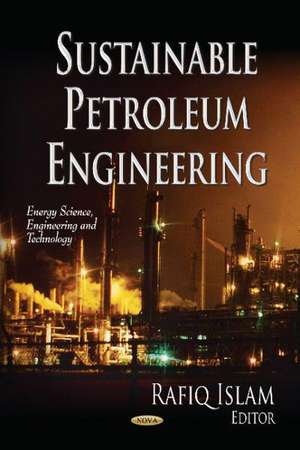
Sustainable Petroleum Engineering
Editat de Rafiq Islamen Limba Engleză Hardback – iul 2013
Preț: 1223.90 lei
Preț vechi: 1663.72 lei
-26%
Puncte Express: 1836
Carte disponibilă
Livrare economică 03-17 noiembrie
Livrare prin curier în România Termenul estimat este afișat lângă disponibilitate.
Transport gratuit pentru acest produs Plată online sau ramburs, în funcție de opțiunile comenzii.
Retur gratuit în 14 zile Comandă securizată și suport în română.
Specificații
ISBN-13: 9781626185982
ISBN-10: 1626185980
Pagini: 223
Dimensiuni: 180 x 260 x 23 mm
Greutate: 0.79 kg
Editura: Nova Science Publishers Inc
Colecția Nova Science Publishers, Inc (US)
Locul publicării:United States
ISBN-10: 1626185980
Pagini: 223
Dimensiuni: 180 x 260 x 23 mm
Greutate: 0.79 kg
Editura: Nova Science Publishers Inc
Colecția Nova Science Publishers, Inc (US)
Locul publicării:United States
V-ar putea interesa
-
 Fusion: The Energy of the UniverseGarry McCracken-19%Preț: 314.47 lei386.29 lei
 -
 Gas and Oil Reliability Engineering: Modeling and AnalysisEduardo Calixto-29%Preț: 451.33 lei638.16 lei
 -
 Limiting ResourcesLadawn HaglundPreț: 274.81 lei
 -
 Before the Lights Go OutMaggie Koerth-BakerPreț: 156.90 lei
 -
 -18%Preț: 1113.27 lei1357.65 lei
 -
 -27%Preț: 1384.75 lei1888.13 lei
 -
 Energy SecuritySascha Muller-KraennerPreț: 396.69 lei
Cuprins
Preface; Modeling of Pressure & Temperature Distributions for a Two-Phase Flow in Producing Oil Wells; Substitution of Numerical Simulation by Artificial Neural Networks in Counter-Current Spontaneous Imbibition; Advances in Coring & Core Analysis for Reservoir Formation Evaluation; Development of a New Approach for Lithologic Boundary Detection using Artificial Neural Networks; Hydrodynamic Modeling of Wellbore Hydraulics with Drill Pipe Rotation in Air Drilling; Ozone Reactions with Diene Rubbers; Developing Simple Correlations for Estimation of Mud Invasion in Underbalanced Drilling Using Artificial Neural Networks; Perfect Decoupled Control System for a Distillation Column; The Effect of Nonionic Surfactants on the Interfacial Tension between Crude Oil & water; Hydrodynamic Modeling of Pressure Drop for Two-Phase Flow in Vertical Wellbores; The Effect of Nanoclay on the Viscosity of Crude Oil; Analysis Methods for Filled Nanocomposites; Temperature Variation in Catalytic Beds of Claus Process: Rapid Estimation; Calculation of Specific Retention Volumes of Organic Compounds with their Physical-Chemical Properties Using Multiparametric Equations; The Effect of EO/PO Block Copolymer on the Interfacial Tension between Crude Oil & Water; The Interfacial Layer in Elastomeric Nanocomposites: New Experimental & Theoretical Approaches; Investigation of Membrane Technology in Gas Separation Process; Fiber Reinforced Antibacterial Laminated Nanostructured Material for Filtration of Toxic Particles; The Effect of EO/PO Block Copolymer on the Viscosity of Crude Oil; Microbiological Corrosion & Protection of Metals; Determination of Crude Oil Viscosity Using Artificial Neural Networks; Biodamaging & Protection of Paint Materials; Modeling & Simulation of Scale Deposition during Water Flooding in Porous Media; Biodegradation & Protection of Synthetic Polymer Materials; Index.