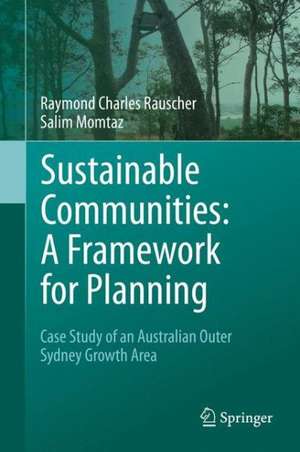
Sustainable Communities: A Framework for Planning
Autor Raymond Charles Rauscher, Salim Momtazen Limba Engleză Hardback – 23 oct 2013
Preț: 661.49 lei
Preț vechi: 778.23 lei
-15%
Puncte Express: 992
Carte tipărită la comandă
Livrare economică 03-17 decembrie
Livrare prin curier în România Termenul estimat este afișat lângă disponibilitate.
Transport gratuit pentru acest produs Plată online sau ramburs, în funcție de opțiunile comenzii.
Retur gratuit în 14 zile Comandă securizată și suport în română.
Specificații
ISBN-13: 9789400775084
ISBN-10: 9400775083
Pagini: 148
Ilustrații: XX, 128 p. 39 illus., 33 illus. in color.
Dimensiuni: 160 x 241 x 13 mm
Greutate: 0.34 kg
Ediția:2014
Editura: Springer
Locul publicării:Dordrecht, Netherlands
ISBN-10: 9400775083
Pagini: 148
Ilustrații: XX, 128 p. 39 illus., 33 illus. in color.
Dimensiuni: 160 x 241 x 13 mm
Greutate: 0.34 kg
Ediția:2014
Editura: Springer
Locul publicării:Dordrecht, Netherlands
V-ar putea interesa
-
 -25%Preț: 444.27 lei592.10 lei
 -
 -25%Preț: 551.68 lei737.75 lei
 -
 Brooklyn's Bushwick - Urban Renewal in New York, USARaymond Charles Rauscher-15%Preț: 663.25 lei780.30 lei
 -
 Sustainable Neighbourhoods in AustraliaRaymond Charles Rauscher-15%Preț: 667.19 lei784.93 lei
 -
 Cities in Global TransitionRaymond Charles Rauscher-20%Preț: 662.38 lei827.97 lei
 -
 New York Neighborhoods - Addressing Sustainable City PrinciplesRaymond Charles Rauscher-15%Preț: 668.72 lei786.73 lei
 -
 -18%Preț: 809.27 lei986.91 lei
 -
 Sustainable Risk ManagementPeter A. Wilderer-18%Preț: 1155.14 lei1408.71 lei
 -
 -18%Preț: 697.07 lei850.08 lei
 -
 Risks, Violence, Security and Peace in Latin AmericaÚrsula Oswald SpringPreț: 431.51 lei
 -
 Preț: 405.18 lei
 -
 -18%Preț: 834.95 lei1018.24 lei
 -
 Urban Planning and Water-related Disaster ManagementGuangwei Huang-18%Preț: 810.92 lei988.93 lei
 -
 Preț: 116.99 lei
 -
 Resilient AsiaKazuhiko Takeuchi-24%Preț: 837.30 lei1101.71 lei
 -
 New Vision 2050Hiroshi KomiyamaPreț: 417.44 lei
 -
 Metaphorical ManagementKlaus EllePreț: 543.35 lei
 -
 The Economy of Green CitiesRichard Simpson-15%Preț: 680.13 lei800.15 lei
 -
 Treatise on Sustainability Science and EngineeringI. S. Jawahir-15%Preț: 672.68 lei791.40 lei
 -
 -18%Preț: 993.96 lei1212.14 lei
 -
 Global Change, Energy Issues and Regulation PoliciesJean Bernard Saulnier-15%Preț: 670.93 lei789.33 lei
 -
 -15%Preț: 674.21 lei793.19 lei
 -
 An Ecosystem Approach to Sustainable AgricultureCarl F. Jordan-15%Preț: 667.86 lei785.72 lei
 -
 The Design CharretteRob Roggema-15%Preț: 675.79 lei795.05 lei
 -
 -15%Preț: 665.01 lei782.36 lei
 -
 Globalized WaterGraciela Schneier-Madanes-18%Preț: 986.35 lei1202.86 lei
 -
 Aid Effectiveness for Environmental SustainabilityYongfu Huang-18%Preț: 1046.55 lei1276.29 lei
 -
 -15%Preț: 669.81 lei788.01 lei
 -
 Governance for the Sustainable Development GoalsJoachim Monkelbaan-23%Preț: 895.70 lei1163.26 lei
Public țintă
GraduateCuprins
Chapter 1: Introduction to sustainability.- 1.1 Abstract.- 1.2 Introducing Sustainability Terms.- Chapter 2: Sustainability and Urban Planning.- 2.1: Abstract.- 2.2: Sustainability and ESD.- 2.3: ESD Related Documents.- 2.3.1 International.- 2.3.2 International Non-government Organisations (NGOs).- 2.3.3 Commonwealth.- 2.3.4 New South Wales.- 2.4: ESD Based Urban Planning Frameworks.- 2.4.1 Land Use Planning.- 2.4.2 Natural Resource Planning.- 2.4.3 Sustainable Urban Planning.- Chapter 3: sustainable communities framework (SCF).- 3.1: Abstract.- 3.2: SCF Structure.- Chapter 4: Data sources and indicators of sustainability.- 4.1: Abstract.- 4.2: Searching data sources.- 4.3: Indicators of Sustainability.- Chapter 5: Examining study area.- 5.1: Abstract.- 5.2: Background to Study Area.- 5.3: Study Area and Planning.- Chapter 6: Applying the framework to the natural environment.- 6.1: Abstract.- 6.2: Step 1 – Review ESD Related Documents.- 6.3: Step 2 – Selecting Indicators of Sustainability.- 6.4: Step 3 – Area Survey.- 6.5 Steps 4 and 5 – Complete Sustainability Score Cards and Sustainability Reports.- 6.6 Aggregating Sustainability Score Cards.- Chapter 7: Applying the framework to the built environment.- 7.1: Abstract.- 7.2: Step 1 – Review ESD Related Documents.- 7.3: Step 2 – Selecting Indicators of Sustainability.- 7.4: Step 3 – Survey Area.- 7.5: Step 4 – Completing a Sustainability Score Card.- 7.6: Step 5 – Adopting Sustainability Report.- 7.7 Aggregating Sustainability Score Cards.- Chapter 8: Future applications of sCF.- 8.1: Abstract.- 8.2: Overview of SCF Applications.- 8.3: Research to Expand SCF applications.- Appendices.- Appendix A: ESD principles built into eco-village design.- Appendix B: Sustainable urban planning web sites.- Glossary.- Index.
Textul de pe ultima copertă
This book is in part a response to the attempts of governments to address increasing concerns over such environmental issues as the impact of climate change; carbon emissions; pressures from overpopulation of cities; coal seam gas extraction and depleting natural resources. The authors have developed a Sustainable Communities Framework (SCF) which incorporates social-cultural, environmental and economic sustainability principles in the process of urban planning. The authors propose a five-step SCF built on an application of sustainability tables. The book examines a wide range of urban planning practices utilizing sustainability criteria, outlining both qualitative and quantitative tools. Separate chapters discuss application of the SCF to both the natural environment and the built environment. This framework is applied to a case study of the outer Sydney growth area of Wyong Shire, Central Coast, NSW, Australia. Addressing the question of how best to measure the environment, the authors present a table for selecting indicators of sustainability, and outline sustainability scorecards which use color-coded ratings of green, red and amber to measure indicators of sustainability. The authors show how aggregating these ratings allows the framework to be scaled up for application to larger areas. Finally, the authors show how scorecards can be incorporated in sustainability reports, with actions and monitoring components. The authors also examine urban planning education including land use planning, natural resource planning and sustainable urban planning, focusing on the extent to which schools incorporate principles of sustainability. The authors offer their critique on the movement of planning practices towards a more coordinated and holistic framework, in incorporating sustainability principles. Sustainable Communities: A Framework for Planning concludes by drawing a future scenario on the application of the SCF to incorporate principles of sustainability intourban planning. The authors propose future options for SCF applications, including adopting a systems program; environmental performance monitoring and showing how the framework will accommodate the social-cultural and economic components of sustainability, in addition to the environmental ones as examined in the case study.
Caracteristici
Offers the latest interpretation of sustainable urban planning and ecologically sustainable development (ESD) Provides planning tools for measuring the sustainability of urban and regional areas Demonstrates a hands-on approach for achieving sustainable communities
Notă biografică
Raymond Charles Rauscher I have always been interested in town planning, being born in Brooklyn, New York City (1943) and graduating from the City College of New York (Bachelor of Engineering, Civil 1966). I later completed a first part of a masters degree at the Univ of Michigan (research submission on Detroit entitled A Solution to the Urban Crisis: Proposal for the Creation of Region Serving New Cities (unpublished 1969). The Masters of Town and Country Planning was completed at Sydney University (1971) with a thesis Community Response to a Redevelopment Proposal (University of Sydney Library Microfilm Dept). The thesis covered planning conflicts in Erskineville and measures to resolving these. Chapter 7 of this book refers back to the planning of Erskineville in 1971, and lessons learned. Delving into the subject of sustainable urban planning, I completed a PhD (2009) at the University of Newcastle, including the thesis Sustainable Area Planning Framework for Ecologically Sustainable Development: Case Study Wyong Shire, NSW, Australia. Wanting to research further the subject of sustainable urban planning, I published (with co-author Salim Momtaz) Sustainable Communities: A Framework for Planning - Case Study of an Australian Outer Sydney Growth Area (Springer 2014). Over the years I continued to study urban change in my birth place Brooklyn (New York). My interest was drawn to Bushwick (my old neighborhood), an area of Brooklyn that met its low point of urban slide in the 1977 arson fires. I did field work over several years, from 1979 onwards, to better understand reasons for USA style urban decline and renewal. This culminated in the book (with co-author Salim Momtaz) Brooklyn's Bushwick - Urban Renewal in New York, USA (Springer 2014). Still wanting to understand the urban changes in inner city neighbourhoods (beyond Erskineville of 1971), I continued (over a number of years) to monitor planning and development of the City of Sydney inner city areas. This monitoring focused on the question of how sustainable were the urban changes taking place in these Sydney neighbourhoods (given the rapid growth of Sydney into a global city). To prepare this book I spent five years (2009-2014) on the ground in the inner city of Sydney doing qualitative research field work, including photographing changes in City of Sydney neighbourhoods. During this research I recalled my involvement with community groups at the time of my earlier research in Erskineville noted above. At the time (1971-1973), neighbourhood associations were successful in calling on the New South Wales (NSW) Builders Labourers' Federation (BLF) to impose 'green bans' to stop NSW State or developer proposed developments which residents felt were inappropriate. This led to a number of 'green bans' imposed in inner city communities covered in this book, including Woolloomooloo (Chapter 3), Victoria St, Kings Cross (Chapter 4), Waterloo (Chapter 6), and Glebe (Chapter 10). Since 1973 I have been a member of the Australian based Social Developers Network (SDN) The Network commenced at the time of PM Gough Whitlam (1972-1975) (currently 98 years old, living in Sydney). As prime minister Whitlam (and Minister for Planning and Regional Development, Tom Uren) promoted and instituted programs in urban planning, regional development and community development. A number of those initiatives are included in the book (Woolloomooloo in Chapter 3, Kings Cross in Chapter 4, and Glebe in Chapter 9). I am currently a Conjoint Lecturer at the University of Newcastle, Australia. I am also a director of Habitat Association for Arts and Environment Inc. Under this body I continue to work on 'Visions Inner Sydney' (VIS). This is a program recording the changes in the inner city local government areas of the City of Sydney, and Municipalities of Leichhardt, Marrickville and Ashfield. Salim Momtaz Dr Salim Momtaz is a senior lecturer at the University of Newcastle, Australia. He teaches in t