Cantitate/Preț
Produs

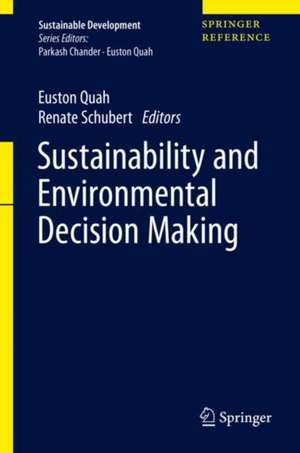
Sustainability and Environmental Decision Making: Sustainability and Environmental Decision Making

Editat de Euston Quah, Renate Schubert
en Limba Engleză Hardback – 8 iun 2021

După parcurgerea acestui volum de referință, cititorul va dobândi capacitatea de a cuantifica beneficiile și costurile de mediu și de a proiecta politici publice care să echilibreze eficient resursele naturale limitate. Sustainability and Environmental Decision Making nu este doar un tratat teoretic, ci un ghid pragmatic care transformă concepte economice complexe în instrumente de lucru pentru factorii de decizie. Descoperim aici o abordare structurată, care începe cu bazele evaluării beneficiilor de mediu și progresează spre aplicații sectoriale vitale: managementul conflictelor legate de apă, eficiența transportului și strategii pentru managementul deșeurilor. Ne-a atras atenția în mod deosebit integrarea economiei comportamentale în luarea deciziilor. Reținem capitolele dedicate 'arhitecturii alegerii' și modului în care setările implicite pot influența consumul de electricitate fără a impune restricții rigide. Pe linia practică a lucrării Environmental Decision-Making in Context, dar cu un focus mult mai accentuat pe economia resurselor și reglementarea durabilelor, acest volum editat de Euston Quah și Renate Schubert oferă o perspectivă globală, susținută de observații empirice din diverse regiuni. Poziționată în contextul operei editorului, cartea reprezintă o evoluție firească de la lucrarea sa anterioară, Cost-Benefit Analysis. Dacă acolo Euston Quah stabilea cadrul analitic general, în acest volum din seria Sustainable Development el aplică aceleași rigori metodologice provocărilor climatice actuale. Structura logică a cuprinsului — de la măsurare la limitări și, în final, la soluții inovatoare pentru stocarea energiei — indică o acoperire exhaustivă, esențială pentru oricine dorește să fundamenteze decizii de mediu pe date economice solide.

Citește tot Restrânge

Preț: 277063 lei

Preț vechi: 337881 lei
-18%

Puncte Express: 4156

Carte disponibilă

Livrare economică 30 septembrie-14 octombrie

Livrare prin curier în România Termenul estimat este afișat lângă disponibilitate.
Transport gratuit pentru acest produs Plată online sau ramburs, în funcție de opțiunile comenzii.
Retur gratuit în 14 zile Comandă securizată și suport în română.

Specificații

ISBN-13: 9789811592867
ISBN-10: 9811592861
Pagini: 516
Ilustrații: XLIV, 472 p. 74 illus., 52 illus. in color.
Dimensiuni: 160 x 241 x 32 mm
Greutate: 1.03 kg
Ediția:1st ed. 2021
Editura: Springer
Colecția Sustainability and Environmental Decision Making
Seriile Sustainability and Environmental Decision Making, Sustainable Development

Locul publicării:Singapore, Singapore

De ce să citești această carte

Această carte este indispensabilă managerilor de resurse și decidenților guvernamentali care au nevoie de o metodologie clară pentru evaluarea impactului de mediu. Veți câștiga o înțelegere profundă a modului în care reglementările și informația pot influența comportamentul durabil, primind recomandări concrete pentru politici de mediu aplicabile imediat în sectorul public sau privat.


Despre autor

Euston Quah este un expert recunoscut în economia mediului, ocupând funcții academice de prestigiu în Singapore. Este cunoscut pentru contribuția sa majoră în domeniul analizei cost-beneficiu, fiind autorul lucrării fundamentale Cost-Benefit Analysis. Expertiza sa este completată de studii asupra dezvoltării industriale a Singaporelui, precum în lucrarea Albert Winsemius and Singapore: Here It Is Going to Happen. Renate Schubert este specialistă în economie, cu un focus pe procesele decizionale și sustenabilitate. Împreună, cei doi editori reunesc în acest volum perspective economice și comportamentale pentru a aborda criza climatică globală.


Descriere scurtă

The primary aim of this reference volume is to provide an accessible and comprehensive review of current methods used to address resource evaluation and environmental as well as climate issues, and in a manner easily understood by decision-makers and the non-economists interested in environmental policy matters. Theoretical insight and empirical observations from various countries will be presented and recommendations on sustainable environmental decision-making will be given. Natural resource managers, environmental and climate decision-makers, government policy makers, and economics scholars will all find this volume to be an essential reference. 


Cuprins

Measurement and valuation of environmental benefits and costs.- Management of natural resources and conflicts (water as example).- Sustainable Decision-Making with respect to transport and mobility.- Sustainable Decision-Making related to waste management.- Sustainable Decision-Making with respect to buildings and housing.- Limitations to making sustainable environmental decisions.-  Choice architecture for sustainable energy decisions.- Are Defaults Enhancing Sustainable Decisions Related to Electricity Use?.- Energy-Using Durables: More Sustainability Through Information or Regulation?.- Electricity Storage: How to Incentivize Innovation and Investment.

Notă biografică

Euston Quah is Albert Winsemius chair professor of economics and director of the Economic Growth Centre at Nanyang Technological University, Singapore. He is also editor of the Singapore Economic Review and president of the Economic Society of Singapore. Professor Quah has published widely in the fields of cost-benefit analysis, environmental economics, and law and economics. Contributing to more than a hundred publications, inclusive of academic journals and lead opinion pieces in media, Professor Quah has also served as external reviewer for some economics schools in various universities in Asia. Some of his works have been selected for inclusion by the International Library of Critical Writings in Economics in the UK as well as received favorable
reviews in such leading journals as Economic Journal, Journal of Economic Literature, and the Journal of Labour Economics. His textbook with E.J Mishan, now in its 6th edition (Routledge, UK, 2020), is regarded as a classictext in this subject and used by
many universities and governments. It was listed for reference by the US Office of Management and Budget and also by the US Department of Transportation. Professor Quah was listed in Google Scholar Profiler in 2020 as among the top ten most highly cited university economists in the area of cost-benefit analysis in the world. Formerly vice dean of the Faculty of Arts and Social
Sciences at the National University of Singapore and headed the economics departments at both Nanyang Technological University and the National University of Singapore, Professor Quah has been and continues to be advisor to many government ministries in Singapore. Professor Quah chaired the School of Humanities and Social Sciences at NTU. He is a member of the Social
Sciences Research Council of Singapore, board member of the Competition and Consumer Commission of Singapore, and board member of the Market Surveillance and Compliance Committee of Singapore’s Energy Market Company. Professor Quah is a recipient of the Public Administration Medal (Silver) in 2020.

Professor Renate Schubert is a professor of economics and a dedicated researcher and teacher. Her key focus is on behavioral economics, environmental and energy economics, social and political analyses, as well as digitization topics. Besides research and teaching, Professor, Schubert is an advisor to governmental committees and an experienced expert in assessments of research projects and research institutions. For many years, Professor Schubert has been professor of economics at ETH Zurich (Switzerland). In 2015 she joined the Singapore-ETH Center (SEC) to run projects in the FRS (Future Resilient Systems) program as well as in the Cooling Singapore and Heat Safe Singapore cluster. She has been involved in projects coping with the mitigation of urban heat effects, assessing the costs and benefits as well as thecitizens’ willingness-  associated with different mitigation measures. Measuring, modelling, and enhancing social resilience in case of natural but also pandemic disasters is part of her project portfolio. Furthermore, Professor, Schubert’s research has been focused on adequate measures to induce behavioral changes with respect to the consumption of natural resources. Hereby, the existence of positive and negative spillover effects are of special importance. The work mostly relies on empirical studies including lab experiments, field experiments, and questionnaire-based surveys. Professor, Schubert has been the author of high-rank publications, but also reaches out to decision-makers to foster and support sustainable decisions. Professor, Schubert has been member of various juries, evaluation committees, and research networks worldwide. She chaired the German Advisory Council on Global Change (WBGU) as well as the external advisory board of the Center for Research on Environmental Decisions (CRED) at Columbia University. Professor, Schubert initiated the ClimPol (Climate Policy Making for Enhanced Technological and Institutional Innovation) initiative within the ETH Domain and was a member of the advisory board of the Rachel Carson Center in Munich. For many years, she was the chair of the supervisory board of the Karlsruhe Institute of Technology (KIT). Professor, Schubert has been a member of the OcCC (Organe Consultatif sur les Changements Climatiques) of the Swiss Government as well as of the Advisory Group to the Swiss Government on the Agenda 2030.

Caracteristici

Provides a unique reference for environmental policy matters Covers essential areas relevant to key environmental problems such as housing, transport, or energy-using durables Features concrete recommendations for decision-makers