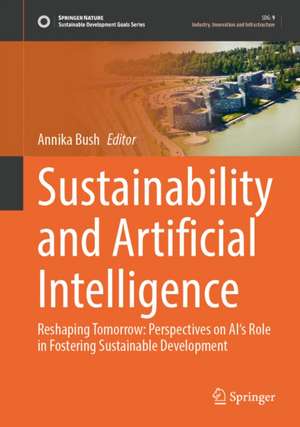
Sustainability and Artificial Intelligence: Sustainable Development Goals Series
Editat de Annika Bushen Limba Engleză Hardback – 28 oct 2026
From geothermal resource identification to food systems and industrial infrastructure, contributors demonstrate AI's transformative potential while examining the sustainability paradox: harnessing computational power for environmental solutions while managing significant energy consumption and resource demands.
The book presents research across three domains: reimagining our relationship with natural systems, transforming human-built infrastructure, and ensuring responsible AI development. Contributors offer frameworks for understanding AI's sustainability role, governance approaches, and pathways toward sustainable artificial intelligence.
Din seria Sustainable Development Goals Series
- 18%
 Preț: 951.99 lei
 - 18%
 Preț: 716.88 lei
 - 20%
 Preț: 981.62 lei
 - 15%
 Preț: 633.37 lei
 - 18%
 Preț: 867.04 lei
 - 5%
 Preț: 1177.84 lei
 - 15%
 Preț: 621.42 lei
 - 15%
 Preț: 624.84 lei
 - 18%
 Preț: 1105.65 lei
 - 18%
 Preț: 759.00 lei
 - 18%
 Preț: 753.65 lei
 - 18%
 Preț: 703.46 lei
 - 18%
 Preț: 2073.51 lei
 - 5%
 Preț: 1020.70 lei
 - 5%
 Preț: 400.80 lei
 - 18%
 Preț: 766.12 lei
 - 15%
 Preț: 617.77 lei
 - 18%
 Preț: 870.88 lei
 - 18%
 Preț: 859.65 lei
 - 15%
 Preț: 571.53 lei
 - 18%
 Preț: 711.94 lei
 - 18%
 Preț: 975.10 lei
 - 5%
 Preț: 391.89 lei
 - 5%
 Preț: 1086.89 lei
 -
 Preț: 192.19 lei
 - 18%
 Preț: 2059.27 lei
 - 15%
 Preț: 498.81 lei
 - 18%
 Preț: 1360.04 lei
 - 18%
 Preț: 1108.93 lei
 - 18%
 Preț: 867.05 lei
 - 15%
 Preț: 621.42 lei
 - 5%
 Preț: 878.66 lei
 - 18%
 Preț: 975.93 lei
 - 18%
 Preț: 762.56 lei
 - 18%
 Preț: 1125.90 lei
 - 15%
 Preț: 625.70 lei
 - 18%
 Preț: 975.93 lei
 -
 Preț: 432.49 lei
 - 18%
 Preț: 761.55 lei
 -
 Preț: 384.83 lei
 - 15%
 Preț: 621.67 lei
 - 18%
 Preț: 940.74 lei
 - 18%
 Preț: 924.23 lei
 - 18%
 Preț: 959.88 lei
 - 5%
 Preț: 919.87 lei
 - 5%
 Preț: 759.77 lei
 - 5%
 Preț: 437.85 lei
 - 5%
 Preț: 1136.78 lei
 -
 Preț: 424.87 lei
 - 18%
 Preț: 920.94 lei
Preț: 980.66 lei
Preț vechi: 1225.83 lei
-20% Precomandă
Puncte Express: 1471
Carte nepublicată încă
Livrare prin curier în România Precomanda se expediază când titlul devine disponibil.
Transport gratuit pentru acest produs Plată online sau ramburs, în funcție de opțiunile comenzii.
Retur gratuit în 14 zile Comandă securizată și suport în română.
Doresc să fiu notificat când acest titlu va fi disponibil:
Se trimite...
Specificații
ISBN-13: 9783032133953
ISBN-10: 3032133955
Pagini: 185
Dimensiuni: 178 x 254 mm
Editura: Springer Nature Switzerland AG
Colecția Sustainable Development Goals Series
Seria Sustainable Development Goals Series
ISBN-10: 3032133955
Pagini: 185
Dimensiuni: 178 x 254 mm
Editura: Springer Nature Switzerland AG
Colecția Sustainable Development Goals Series
Seria Sustainable Development Goals Series
Cuprins
Chapter 1. The Convergence of Two Transformative Forces: The AI-Sustainability Nexus (Annika Bush).- Part I. Reimagining Our Relationship with Natural Systems.- Chapter 2. Artificial Intelligence for Geothermometry: Recent 1 Developments and Opportunities (Mahmoud AlGaiar).- Chapter 3. How the fossil fuel phaseout impacts sustainable development indicators: a computational modelling approach (Nelson Ndugu).- Chapter 4. Contribution of digital technologies to the sustainable development of the food value chain (Fabrice Bruno Siewe).- Chapter 5. Evaluation of the Predicting Ability of Artificial Neural Networks Compared to Supervised Learning Algorithms for Crop Yield Prediction (Olaniyi Ifeoluwa).- Part II. Transforming Human-Built Systems and Infrastructure.- Chapter 6. Sustainalyze: An LLM-driven Approach for Transparent Sustainability Benchmarking (Pionzewski).- Chapter 7. Sandboxing Sustainable Tourism (Pablo Noriega).- Chapter 8. Goal-oriented counterfactuals promoting sustainable and healthy behavior (Hakan Lane).- Part III. Ensuring Human Flourishing in an AI-Enabled Future.- Chapter 9. The Role of Regulation in Reaching Sustainable AI: a Law and Economics Approach (Thomas Le Goff).- Chapter 10. Artificial Intelligence and the Human Needs – What impact will AI-Based Decision-making have on our Sustainable Future? (Christian Holzbaur).- Chapter 11. Can AI Break Language Barriers in Developing Countries? (Murod Ismailov).