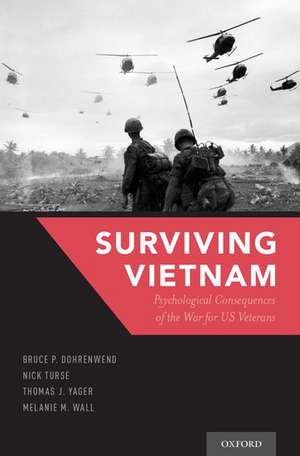
Surviving Vietnam: Psychological Consequences of the War for US Veterans
Autor Bruce P. Dohrenwend, Nick Turse, Thomas J. Yager, Melanie M. Wallen Limba Engleză Hardback – 31 ian 2019
Putem afirma că Surviving Vietnam reprezintă o sinteză clinică și istorică de o rigoare deosebită, fiind un manual de referință comparabil cu Stress Disorders Among Vietnam Veterans: Theory, Research, dar actualizat conform ghidurilor și studiilor longitudinale de la începutul secolului XXI. În timp ce lucrările anterioare, precum cele ale lui Charles R. Figley, puneau bazele înțelegerii stresului posttraumatic imediat după conflict, volumul de față, publicat de Oxford University Press, beneficiază de o perspectivă temporală unică, acoperind aproape patru decenii de evoluție a simptomatologiei. Găsim în această lucrare o metodologie complexă care îmbină datele din National Vietnam Veterans Longitudinal Study cu înregistrări militare oficiale, oferind un răspuns fundamentat științific la controversele privind ratele de prevalență ale PTSD. Notăm cu interes modul în care autorii depășesc simpla descriere a simptomelor, analizând variabile critice precum implicarea în vătămarea civililor sau impactul apartenenței etnice asupra rezilienței. Față de Shook Over Hell – Post Traumatic Stress, Vietnam, & the Civil War (Paper), care plasează trauma într-un context istoric comparativ, Surviving Vietnam se concentrează pe mecanismele interne de vulnerabilitate și pe modul în care atitudinea publică a modelat reajustarea socială a veteranilor. Lucrarea se raportează direct la temele de cercetare anterioare ale lui Bruce P. Dohrenwend din Adversity, Stress and Psychopathology, extinzând conceptul de „adversitate extremă” de la situații catastrofice generale la specificul brutal al războiului de gherilă și al consecințelor sale transgeneraționale asupra familiilor.
Preț: 449.63 lei
Preț vechi: 573.75 lei
-22%
Carte disponibilă
Livrare economică 19-25 noiembrie
Specificații
ISBN-10: 0190904445
Pagini: 352
Dimensiuni: 239 x 160 x 25 mm
Greutate: 0.64 kg
Editura: Oxford University Press
Colecția OUP USA
Locul publicării:New York, United States
V-ar putea interesa
-
 Adversity, Stress and PsychopathologyBruce P. Dohrenwend-24%Preț: 877.01 lei1157.22 lei
 -
 Antipsychotic Trials in SchizophreniaT. Scott Stroup-5%Preț: 868.43 lei914.14 lei
 -
 The ComplexNick TursePreț: 127.06 lei
 -
 Time to ListenRobert R. RynearsonPreț: 93.25 lei
 -
 DelusionsPeter Mckenna-5%Preț: 441.81 lei465.07 lei
 -
 Case Studies in Sports PsychiatryAmit D Mistry-5%Preț: 306.28 lei322.40 lei
 -
 Changing Face of EmpireNick TursePreț: 78.01 lei
 -
 Next Time They'll Come to Count the DeadNick TursePreț: 92.54 lei
 -
 -5%Preț: 216.05 lei227.42 lei
 -
 The Case for Withdrawal from AfghanistanNick TursePreț: 137.54 lei
 -
 Psychiatry and Mental HealthRachel Freeth-5%Preț: 343.20 lei361.26 lei
 -
 Suicide Risk Assessment and PreventionMaurizio Pompili-5%Preț: 5125.50 lei5395.27 lei
 -
 Adolescent Suicide and Self-InjuryLaurel L. Williams-5%Preț: 713.08 lei750.60 lei
 -
 Mein Leitfaden PsychiatrieJan Philipp Klein-5%Preț: 374.30 lei394.01 lei
 -
 Therapeutische BeziehungenFriedrich Riffer-5%Preț: 432.90 lei455.69 lei
 -
 -5%Preț: 565.67 lei595.44 lei
 -
 S2k-Leitlinie NotfallpsychiatrieFrank-Gerald Pajonk-5%Preț: 467.18 lei491.76 lei
De ce să citești această carte
Această carte este esențială pentru psihiatri, psihologi clinici și istorici militari care doresc să înțeleagă fundamentul științific al diagnosticului de PTSD. Cititorul câștigă o perspectivă bazată pe date concrete asupra modului în care traumele de război persistă și evoluează pe parcursul întregii vieți, oferind argumente solide în dezbaterea dintre vulnerabilitatea pre-existentă și severitatea expunerii la evenimente traumatice.
Despre autor
Bruce P. Dohrenwend, Ph.D., este profesor de psihiatrie și sănătate publică la Universitatea Columbia, fiind o autoritate recunoscută în studiul epidemiologic al tulburărilor mintale. Cariera sa s-a concentrat pe intersecția dintre factorii de stres sociali și psihopatologie, explorând modul în care mediile adverse influențează sănătatea mintală la nivel de populație. În Surviving Vietnam, Dohrenwend își aplică expertiza metodologică pentru a clarifica una dintre cele mai disputate probleme din psihiatria modernă, colaborând cu experți în biostatistică și istorie militară precum Thomas J. Yager și Nick Turse.