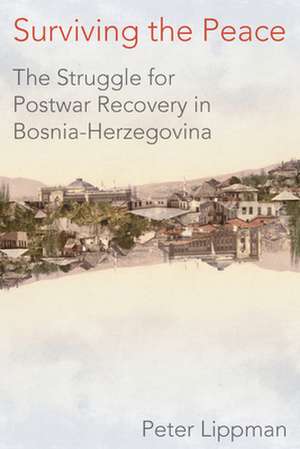
Surviving the Peace: The Struggle for Postwar Recovery in Bosnia-Herzegovina
Autor Peter Lippmanen Limba Engleză Hardback – 15 noi 2019
Essential reading for students of the former Yugoslavia and anyone interested in postwar or post-genocide studies, Surviving the Peace is an instant classic of long-form reporting, an impossible accomplishment without a lifetime of dedication to a place and people.
Peter Lippman's website is http://survivingthepeace.org/.
Preț: 184.38 lei
Puncte Express: 277
Carte disponibilă
Livrare economică 02-16 noiembrie
Livrare prin curier în România Termenul estimat este afișat lângă disponibilitate.
Transport gratuit de la 400.00 lei Plată online sau ramburs, în funcție de opțiunile comenzii.
Retur gratuit în 14 zile Comandă securizată și suport în română.
Specificații
ISBN-13: 9780826522610
ISBN-10: 0826522610
Pagini: 488
Dimensiuni: 152 x 229 x 41 mm
Greutate: 0.93 kg
Editura: Vanderbilt University Press
Colecția Vanderbilt University Press
ISBN-10: 0826522610
Pagini: 488
Dimensiuni: 152 x 229 x 41 mm
Greutate: 0.93 kg
Editura: Vanderbilt University Press
Colecția Vanderbilt University Press
Notă biografică
Peter Lippman, born in Seattle, is a journalist and human rights activist. A fascination with the ethnography of southeast Europe led him to Yugoslavia in the early 1980s. He lived and worked in Bosnia-Herzegovina for two years after the war, and has returned many times since then. Over more than two decades, he has closely followed the efforts of grassroots activists to return to their prewar homes, to fight corruption and discrimination, and to regain their rights.
Recenzii
"Once the shooting stops, most reporters and commentators pack up and go home, as if everything important is over. Yet, as Lippman so eloquently shows, for many, an entirely new life has begun, one they are not prepared for and have few resources to manage. Moreover, there appears to be almost an aversion to reporting on successes, i.e., former enemies reconnecting and working together. It does exist and is the part we should be emphasizing. Lippman reports both the successes and failures, as well as the continued challenges faced by a society torn apart by ethnic hatred. This book is about this little-addressed aspect of war—what happens when the shooting stops—and how ordinary people are critical in reconstituting community."
—Judith Armatta, author of Twilight of Impunity: The War Crimes Trial of Slobodan Milošević
"This is a highly engaging, well-written, and factual account of postwar Bosnia-Herzegovina seen from a grassroots perspective by a researcher and a cultural outsider who demonstrates an enviable understanding of his research field. It is an exemplar of engaged and informed writing: moving and informative, evocative and profound. It is a deeply serious book, but with the light touch of an accomplished writer."
—Hariz Halilovich, RMIT University, Melbourne
"A lot of books are written on postwar reconstruction in Bosnia-Herzegovina but not from this longitudinal, ethnographic, and bottom-up approach portraying ordinary people in the extraordinary struggle to rebuild lives and peaceful living. Most books are overly scientific and academic with little voice given to the grassroots human rights activists. This book is unique."
—Selma Porobić, Palacky University, Czech Republic
—Judith Armatta, author of Twilight of Impunity: The War Crimes Trial of Slobodan Milošević
"This is a highly engaging, well-written, and factual account of postwar Bosnia-Herzegovina seen from a grassroots perspective by a researcher and a cultural outsider who demonstrates an enviable understanding of his research field. It is an exemplar of engaged and informed writing: moving and informative, evocative and profound. It is a deeply serious book, but with the light touch of an accomplished writer."
—Hariz Halilovich, RMIT University, Melbourne
"A lot of books are written on postwar reconstruction in Bosnia-Herzegovina but not from this longitudinal, ethnographic, and bottom-up approach portraying ordinary people in the extraordinary struggle to rebuild lives and peaceful living. Most books are overly scientific and academic with little voice given to the grassroots human rights activists. This book is unique."
—Selma Porobić, Palacky University, Czech Republic
Descriere
Twenty years of on-the-ground reportage in the grassroots struggle for normalcy and postwar return in the former Republic of Yugoslavia