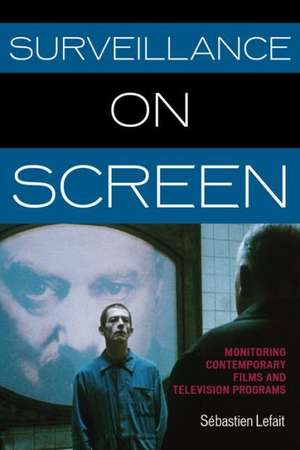
Surveillance on Screen: Monitoring Contemporary Films and Television Programs
Autor Sébastien Lefaiten Limba Engleză Hardback – 18 oct 2012
In Surveillance on Screen: Monitoring Contemporary Films and Television Programs, Sébastien Lefait examines this ever-increasing phenomenon. Drawing on the rapidly developing field of surveillance studies, Lefait offers an in-depth analysis of television shows and films, which complement current theoretical approaches to those subjects. This unique combination of surveillance theories with the latest concepts of film, television, and Internet studies is based on a large and diversified range of popular series and films, including the shows 24, Lost, and Survivor as well as such films as Minority Report, Paranormal Activity, The Truman Show, and the on-screen version of George Orwell's Nineteen Eighty-Four.
Written from a perspective that does not limit itself to a "reflection-of-society" approach, this book explores both how cinema shapes our experience of surveillance and how surveillance influences our viewing of cinema. Lefait follows the various identifiable stages in cinema's experimental use of surveillance, studying the impact of technology on both the watcher and the watched. In addition to film and media studies, this book will be of interest to those engaged in information technology, sociology, and, of course, surveillance studies.
Preț: 519.44 lei
Preț vechi: 782.11 lei
-34%
Puncte Express: 779
Preț estimativ în valută:
91.93€ • 107.44$ • 79.81£
91.93€ • 107.44$ • 79.81£
Carte tipărită la comandă
Livrare economică 20 februarie-06 martie
Preluare comenzi: 021 569.72.76
Specificații
ISBN-13: 9780810885905
ISBN-10: 0810885905
Pagini: 223
Ilustrații: 29 BW Photos
Dimensiuni: 157 x 236 x 23 mm
Greutate: 0.5 kg
Editura: Bloomsbury Publishing
Colecția Scarecrow Press
Locul publicării:New York, United States
ISBN-10: 0810885905
Pagini: 223
Ilustrații: 29 BW Photos
Dimensiuni: 157 x 236 x 23 mm
Greutate: 0.5 kg
Editura: Bloomsbury Publishing
Colecția Scarecrow Press
Locul publicării:New York, United States
Cuprins
Contents
Acknowledgements
Introduction
Chapter 1 Dystopian (Super)Panopticism: from Nineteen Eighty-Four to Orwellian Films
Chapter 2 Closed-Circuit Filmmaking: Cinema in the Age of Panopticism Come True
Chapter 3 Audiovisual Fiction and Synoptic Surveillance: the Televisualisation of Life
Chapter 4 Cinema in the Catoptic Age: Visions of a Sousveillance World
Conclusion: Surveillance Screens-The New Site of Film?
Bibliography
Filmography
About the author
Acknowledgements
Introduction
Chapter 1 Dystopian (Super)Panopticism: from Nineteen Eighty-Four to Orwellian Films
Chapter 2 Closed-Circuit Filmmaking: Cinema in the Age of Panopticism Come True
Chapter 3 Audiovisual Fiction and Synoptic Surveillance: the Televisualisation of Life
Chapter 4 Cinema in the Catoptic Age: Visions of a Sousveillance World
Conclusion: Surveillance Screens-The New Site of Film?
Bibliography
Filmography
About the author
Recenzii
This volume will be of interest to film and media students and can serve to supplement other film reference works in modern cinema. It may also be of interest to those in surveillance studies, sociology, and information technology.
Lefait presents a series of detailed arguments throughout the book about the intertwined relationship between surveillance and cinema/television, and our position, both watching screens and being watched by them. Overall, the book provides a very clear analysis of the various debates about surveillance and popular culture, with some well-chosen and closely-analysed films and television programmes throughout.
The book is solidly written and engaging throughout. . . .After reading Surveillance on Screen:Monitoring Contemporary Films and Television Programs by Sébastien Lefait, [the reader has] agreater understanding and appreciation ofthe purpose of surveillance in cinema andhow the techniques are applied in some ofthe best known surveillance films.
Lefait presents a series of detailed arguments throughout the book about the intertwined relationship between surveillance and cinema/television, and our position, both watching screens and being watched by them. Overall, the book provides a very clear analysis of the various debates about surveillance and popular culture, with some well-chosen and closely-analysed films and television programmes throughout.
The book is solidly written and engaging throughout. . . .After reading Surveillance on Screen:Monitoring Contemporary Films and Television Programs by Sébastien Lefait, [the reader has] agreater understanding and appreciation ofthe purpose of surveillance in cinema andhow the techniques are applied in some ofthe best known surveillance films.