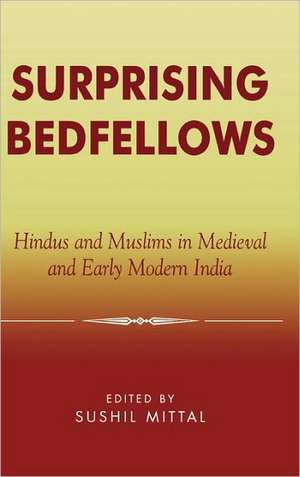
Surprising Bedfellows: Hindus and Muslims in Medieval and Early Modern India
Editat de Sushil Mittal Contribuţii de Catherine B. Asher, Stewart Gordon, Peter Gottschalk, James W. Laine, Tony K. Stewart, Phillip B. Wagoneren Limba Engleză Hardback – 24 iun 2003
Preț: 522.06 lei
Preț vechi: 767.49 lei
-32%
Puncte Express: 783
Carte tipărită la comandă
Livrare economică 25 noiembrie-09 decembrie
Livrare prin curier în România Termenul estimat este afișat lângă disponibilitate.
Transport gratuit pentru acest produs Plată online sau ramburs, în funcție de opțiunile comenzii.
Retur gratuit în 14 zile Comandă securizată și suport în română.
Specificații
ISBN-13: 9780739106730
ISBN-10: 0739106732
Pagini: 136
Dimensiuni: 152 x 230 x 14 mm
Greutate: 0.37 kg
Ediția:New.
Editura: Bloomsbury Publishing
Colecția Lexington Books
Locul publicării:New York, United States
ISBN-10: 0739106732
Pagini: 136
Dimensiuni: 152 x 230 x 14 mm
Greutate: 0.37 kg
Ediția:New.
Editura: Bloomsbury Publishing
Colecția Lexington Books
Locul publicării:New York, United States
V-ar putea interesa
-
 -24%Preț: 557.86 lei730.97 lei
 -
 -28%Preț: 488.24 lei679.74 lei
 -
 -11%Preț: 361.35 lei408.22 lei
 -
 On Religious DiversityRobert McKim-12%Preț: 372.02 lei421.50 lei
 -
 The White Buddhist – The Asian Odyssey of Henry Steel OlcottStephen ProtheroPreț: 193.62 lei
 -
 Christians, Muslims, and JesusMona SiddiquiPreț: 143.36 lei
 -
 Preț: 124.02 lei
 -
 A Little Girl After God's Own HeartElizabeth GeorgePreț: 96.85 lei
 -
 The Faith ClubRanya IdlibyPreț: 109.98 lei
 -
 Of God and ManZygmunt BaumanPreț: 132.62 lei
 -
 Believing GodBeth MoorePreț: 99.42 lei
 -
 Amazing GraceKathleen NorrisPreț: 155.82 lei
 -
 A Heart of Many RoomsDavid HartmanPreț: 146.62 lei
 -
 This Beautiful MessRick MckinleyPreț: 94.41 lei
 -
 The Godseeker's GuideLionel Blue-52%Preț: 58.05 lei120.93 lei
 -
 Christian Criticisms, Islamic ProofsSimon A Wood-5%Preț: 166.47 lei175.31 lei
 -
 Preț: 114.12 lei
Cuprins
Chapter 1 Preface
Chapter 2 Introduction
Chapter 3 Hindus, Muslims, and the Other in Eighteenth Century India
Chapter 4 Fortuitous Convergences and Essential Ambiguities: Transcultural Political Elites in the Medieval Deccan
Chapter 5 Surprising Bedfellows: Vaisnava and Shi'a Alliance in Kavi Ariph's 'Tale of Lalmon'
Chapter 6 The dharma of Islam and the din of Hinduism: Hindus and Muslims in the Age of Sivaji
Chapter 7 Conclusion
Chapter 2 Introduction
Chapter 3 Hindus, Muslims, and the Other in Eighteenth Century India
Chapter 4 Fortuitous Convergences and Essential Ambiguities: Transcultural Political Elites in the Medieval Deccan
Chapter 5 Surprising Bedfellows: Vaisnava and Shi'a Alliance in Kavi Ariph's 'Tale of Lalmon'
Chapter 6 The dharma of Islam and the din of Hinduism: Hindus and Muslims in the Age of Sivaji
Chapter 7 Conclusion
Recenzii
This collection of essays will be extremely useful to scholars seeking specific examples of cases where the Hindu/Muslim binary simply does not work-and given the constant reinforcement for mass media and academic institutions today, such examples are welcome, and worthy of being propagated.