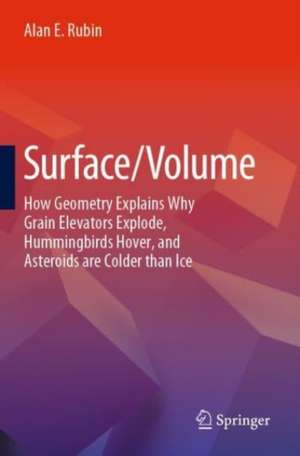
Surface/Volume
Autor Alan E. Rubinen Limba Engleză Paperback – mar 2023
This book explains that diffusion, osmosis, dissolution, evaporation, and heat loss all preferentially affect small bodies due to their high surface/volume ratios. Because surface area increases as the square of length, but volume (and mass) increase as the cube, large objects have low surface/volume ratios and small objects have high surface/volume ratios. This simple physical constraint governs much of the physical world. It accounts for why the Earth has active volcanoes, but the Moon does not, why the human brain has numerous folds, why deciduous trees lose their leaves every Fall, and why nanoparticles of gold melt at surprisingly low temperatures. It is a phenomenon well known to every scientist, but this book is the first comprehensive treatment of this effect.
Preț: 264.60 lei
Puncte Express: 397
Carte tipărită la comandă
Livrare economică 16-23 noiembrie
Livrare prin curier în România Termenul estimat este afișat lângă disponibilitate.
Transport gratuit de la 400.00 lei Plată online sau ramburs, în funcție de opțiunile comenzii.
Retur gratuit în 14 zile Comandă securizată și suport în română.
Specificații
ISBN-13: 9783031237485
ISBN-10: 303123748X
Pagini: 200
Ilustrații: XVII, 182 p. 134 illus., 109 illus. in color.
Dimensiuni: 155 x 235 x 11 mm
Greutate: 0.35 kg
Ediția:1st ed. 2023
Editura: Springer
Locul publicării:Cham, Switzerland
ISBN-10: 303123748X
Pagini: 200
Ilustrații: XVII, 182 p. 134 illus., 109 illus. in color.
Dimensiuni: 155 x 235 x 11 mm
Greutate: 0.35 kg
Ediția:1st ed. 2023
Editura: Springer
Locul publicării:Cham, Switzerland
V-ar putea interesa
-
 StructuresJ. E. GordonPreț: 108.04 lei
 -
 -13%Preț: 66.14 lei76.07 lei
 -
 Seven Brief Lessons on Physics. Anniversary EditionCarlo RovelliPreț: 92.10 lei
 -
 SpeedVaclav SmilPreț: 137.30 lei
 -
 SizeVaclav Smil-19%Preț: 62.80 lei77.72 lei
 -
 -35%Preț: 143.98 lei222.69 lei
 -
 On the Calculation of Volume (Book I)Solvej BallePreț: 85.86 lei
 -
 On the Calculation of Volume (Book II)Solvej BallePreț: 85.58 lei
 -
 Volcanoes: 10 Things You Should KnowDr Rebecca Williams-27%Preț: 66.34 lei91.26 lei
 -
 Desperate MeasuresKjartan PoskittPreț: 37.58 lei
 -
 WaterAnna Skowronska-28%Preț: 73.89 lei102.74 lei
 -
 Frequently Asked Questions About the UniverseDaniel Whiteson-27%Preț: 68.00 lei93.08 lei
 -
 SnoSverker SörlinPreț: 124.56 lei
 -
 The Everything Kids' Astronomy Book: de la 7 aniKathi WagnerPreț: 57.86 lei
 -
 Can Volcanoes Turn the Moon Blue?Olivia WatsonPreț: 72.80 lei
 -
 Thinking Small and LargePeter ForbesPreț: 107.54 lei
 -
 Nature's Tiny ChampionsBen LerwillPreț: 135.78 lei
 -
 Human NatureKate MarvelPreț: 136.91 lei
 -
 Preț: 57.70 lei
 -
 AvalanchesDalton RainsPreț: 200.95 lei
Cuprins
Introduction.- A Truncated History of Geometry.- Middle School Math.- Asteroids, Moons, Planets, and Meteorites.- Geologic Processes.- Geometry of Life.- Biochemistry.- Chemical Reactions.- Ecology.- Manufacturing.
Textul de pe ultima copertă
This book explains that diffusion, osmosis, dissolution, evaporation, and heat loss all preferentially affect small bodies due to their high surface/volume ratios. Because surface area increases as the square of length, but volume (and mass) increase as the cube, large objects have low surface/volume ratios and small objects have high surface/volume ratios. This simple physical constraint governs much of the physical world. It accounts for why the Earth has active volcanoes, but the Moon does not, why the human brain has numerous folds, why deciduous trees lose their leaves every Fall, and why nanoparticles of gold melt at surprisingly low temperatures. It is a phenomenon well known to every scientist, but this book is the first comprehensive treatment of this effect.
Caracteristici
Teaches the geometrical approach to nature Explores the physical processes in a variety of objects using surface/volume ratios Explains why the physical properties preferentially affect smaller bodies