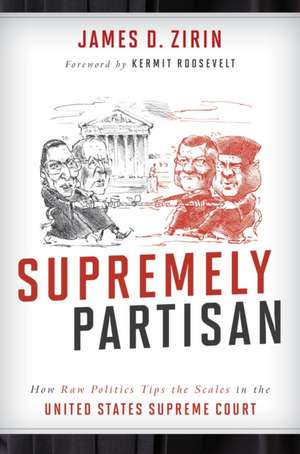
Supremely Partisan: How Raw Politics Tips the Scales in the United States Supreme Court
Autor James D. Zirin Cuvânt înainte de Kermit Roosevelt IIIen Limba Engleză Hardback – 15 sep 2016
Preț: 143.16 lei
Preț vechi: 171.25 lei
-16%
Puncte Express: 215
Preț estimativ în valută:
25.34€ • 29.51$ • 22.02£
25.34€ • 29.51$ • 22.02£
Carte tipărită la comandă
Livrare economică 23 februarie-09 martie
Preluare comenzi: 021 569.72.76
Specificații
ISBN-13: 9781442266360
ISBN-10: 1442266368
Pagini: 314
Dimensiuni: 160 x 230 x 30 mm
Greutate: 0.62 kg
Editura: Bloomsbury Publishing
Colecția Rowman & Littlefield Publishers
Locul publicării:New York, United States
ISBN-10: 1442266368
Pagini: 314
Dimensiuni: 160 x 230 x 30 mm
Greutate: 0.62 kg
Editura: Bloomsbury Publishing
Colecția Rowman & Littlefield Publishers
Locul publicării:New York, United States
V-ar putea interesa
-
 We Are Doomed: Reclaiming Conservative PessimismJohn DerbyshirePreț: 96.24 lei
 -
 Preț: 121.64 lei
 -
 State of Emergency: The Third World Invasion and Conquest of AmericaPatrick J. BuchananPreț: 130.51 lei
 -
 Preț: 121.68 lei
 -
 East Asia and the Trials of Neo-LiberalismKevin HewisonPreț: 414.92 lei
 -
 The Conservatives Have No ClothesGreg AnrigPreț: 204.13 lei
 -
 TrainwreckBill PressPreț: 189.21 lei
 -
 Radical Conservatism: The Right's Political ReligionRobert Brent ToplinPreț: 455.98 lei
 -
 Preț: 422.21 lei
 -
 Jeb Bush: Aggressive Conservatism in FloridaRobert E. Crew Jr.-22%Preț: 306.03 lei394.75 lei
 -
 Do as I Say (Not as I Do): Profiles in Liberal HypocrisyPeter SchweizerPreț: 117.02 lei
 -
 Preț: 108.25 lei
 -
 Preț: 173.48 lei
 -
 Leo Strauss and the Conservative Movement in AmericaPaul E. GottfriedPreț: 203.17 lei
 -
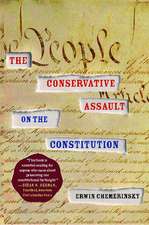 Conservative Assault on the ConstitutionErwin ChemerinskyPreț: 115.22 lei
 -
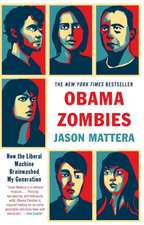 Obama ZombiesJason MatteraPreț: 103.02 lei
 -
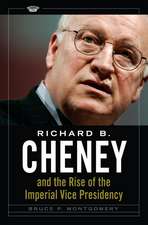 Richard B. Cheney and the Rise of the Imperial Vice PresidencyBruce P. Montgomery-35%Preț: 237.24 lei366.33 lei
 -
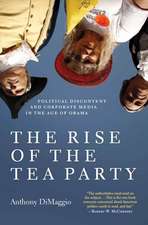 The Rise of the Tea PartyAnthony DimaggioPreț: 144.62 lei
 -
 Left Turn: Forging a New Political FutureStanley AronowitzPreț: 413.99 lei
 -
 Preț: 82.70 lei
 -
 The Young Conservative's Field GuideBrent StranskyPreț: 117.49 lei
 -
 From Tax Populism to Ethnic NationalismJens Rydgren-23%Preț: 714.45 lei927.86 lei
Cuprins
Foreword
Introduction
1 What the Supreme Court Is Supposed (and Not Supposed)
to Do
2 Identity Politics and the Partisan Court
3 Religion and the Partisan Court
4 Two of the Eighty-Nine WASP Male Justices: Marshall and
Holmes
John Marshall-Elaborating the Rule of Law
Oliver Wendell Holmes-Elaborating the Rules for Free
Speech
Campaign Finance and Deregulation-Speech Unknown
to Marshall and Holmes
5 The Catholic Seat
6 The Jewish Seat: Tradition, Tradition!
7And Goldberg Begat Fortas: End of the Jewish Seat
8The Supreme Court Tackles the Middle East: Is Jerusalem
Part of Israel?
9 The Female Seat and Ruth Bader Ginsburg
10The Black Seat: Finding The "Best Qualified"
Thomas and Natural Law
Thomas and the Voting Rights Act
Thomas and Affirmative Action
11 Antonin Scalia (1936-2016): "More Catholic Than the Pope"
12 Sonia Sotomayor: The Wise Latina Woman and Identity
Politics
13 Hobby Lobby: Religious Freedom v. Reproductive Rights
14 The Obamacare Cases: The Chief Rides to the Rescue
15 Gay Marriage: "The Times They Are A-Changin'"
16 Capital Punishment: Death Is Different
Conclusion
Acknowledgments
Index
About the Author
Introduction
1 What the Supreme Court Is Supposed (and Not Supposed)
to Do
2 Identity Politics and the Partisan Court
3 Religion and the Partisan Court
4 Two of the Eighty-Nine WASP Male Justices: Marshall and
Holmes
John Marshall-Elaborating the Rule of Law
Oliver Wendell Holmes-Elaborating the Rules for Free
Speech
Campaign Finance and Deregulation-Speech Unknown
to Marshall and Holmes
5 The Catholic Seat
6 The Jewish Seat: Tradition, Tradition!
7And Goldberg Begat Fortas: End of the Jewish Seat
8The Supreme Court Tackles the Middle East: Is Jerusalem
Part of Israel?
9 The Female Seat and Ruth Bader Ginsburg
10The Black Seat: Finding The "Best Qualified"
Thomas and Natural Law
Thomas and the Voting Rights Act
Thomas and Affirmative Action
11 Antonin Scalia (1936-2016): "More Catholic Than the Pope"
12 Sonia Sotomayor: The Wise Latina Woman and Identity
Politics
13 Hobby Lobby: Religious Freedom v. Reproductive Rights
14 The Obamacare Cases: The Chief Rides to the Rescue
15 Gay Marriage: "The Times They Are A-Changin'"
16 Capital Punishment: Death Is Different
Conclusion
Acknowledgments
Index
About the Author
Recenzii
A leading litigator engagingly explores what many readers already know: the Supreme Court votes along party lines. In this highly knowledgeable and entirely accessible book, Zirin (The Mother Court: Tales of Cases that Mattered in America's Greatest Trial Court, 2014) shows that what many readers thought they knew about our nation's highest court only touched the surface. At the beginning, the author apologizes to all-knowing attorneys for his brief but comprehensive history of the court. This is not just a list of famous cases, but rather explanations of their origins and far-reaching results. Many of us knew Marbury v. Madison established judicial review, but Zirin explains how President John Adams' 'midnight appointments' at the end of his term set it off. Politically motivated decisions are not especially new; the Lochner era represented 40 years of the court tilting toward big business to strike down New Deal legislation. Zirin notes that traditional tools of judicial analysis-text, meaning, original understanding, and precedents-are supposed to be the criteria to say what the law is. The use of originalism, textualism, and natural law skews those tools, bending them to what the justice wants them to mean. The author cites Citizens United, Burwell v. Hobby Lobby, Bush v. Gore as modern cases of a highly partisan ilk, and he agrees with historians who claim that Dred Scott was a principal cause of the Civil War. It not only denied a slave's humanity, but also declared the Missouri Com promise unconstitutional. The chapters on the current justices-including the Catholic Seat (five are Catholic), the Jewish (three are Jewish), the Female, the Black, and now the Latina Seat-are crisp, insightful, and spot-on. A top-notch book about the Supreme Court. Zirin has his finger on its pulse, and he shows the rest of us how it works and how it doesn't.
Former Assistant US Attorney James Zirin presents an interesting discussion of the impact of partisanship on the current US Supreme Court. The book is timely considering the controversy surrounding the replacement of Justice Scalia. One benefit of the book is that it is well-researched. Excellent information is provided in an accessible manner (without much legal jargon). Zirin also focuses on some of the most important Supreme Court decisions in recent years, such as health care and freedom of religion. . . .Summing Up:Recommended. Upper-division undergraduates through faculty.
[Supremely Partisan: How Raw Politics Tips the Scales in the United States Supreme Court] is a worthwhile book that provokes thought on what the bar and body politic should reasonably expect from our public courts.... It is written for lay readers, but lawyers will also find it useful.... [T]he author displays an articulate grasp of the personalities and arguments that have produced the court's most controversial decisions. The book is written in an evocative style that readers will find entertaining ... [This book] is informative and useful.
As the future of the Supreme Court hangs in the balance, James Zirin has given us an extraordinarily timely, riveting, and historically informed work about how the Court has become a supremely political and partisan body. A must read in these times -- and all times.
A vivid, no-holds-barred portrait of the politicization of the Supreme Court. Jim Zirin takes the robes off the justices and reveals why Democrats and Republicans, liberals and conservatives, Senators and Presidents, business and labor, evangelicals and atheists, look to the Supreme Court to further their public policies and private beliefs. Read it. It's a WOW! Book.
"A particularly timely book! With the raging partisan battle over Justice Scalia's replacement as a backdrop, Jim Zirin raise the vexing question of whether we may be moving towards a more politicized judiciary in a Supreme Court deeply divided over difficult constitutional questions."
"An important and engaging examination of how the Supreme Court has acted in a partisan fashion and failed to protect our rights. James Zirin's book powerfully shows why the composition of the Supreme Court matters for all of us, often in the most significant and intimate aspects of our lives. Everyone, whatever their degree of knowledge of the Supreme Court can benefit from reading Zirin's compelling analysis."
"Jim Zirin has written a bracing and provocative account of the ideological cross-currents in the Supreme Court at an especially pivotal point in the Court's 227-year old history."
"How politicized has the Supreme Court become? Is it - and has it ever been - truly an independent tribunal protecting our sacred rights to justice under the Constitution? Or is it basically a collection of predictable political partisans? How has the Court's shifting ethnic and religious composition altered its character? James Zirin offers some provocative reflections on these questions and many more, in a book marked as deeply by his patriotic passion as his historical acuity. Supremely Partisan should be required reading for every citizen concerned about the state of our democracy."
Partisanship on the Supreme Court is an all-important issue that is both timely and timeless. Jim Zirin goes to the heart of the most important question about the Court today: In shaping all of our lives, how much do its decisions turn on who's doing the deciding, rather than on the facts and the law? And, in doing so, he shines a spotlight on why the life experiences of those we consider to serve as Justices matter as much as their legal abilities or their resumes.
"Once again, Jim Zirin has produced a vividly written and pungently argued book on the development of American law, this time through the lens of the political backgrounds of the members of the U.S. Supreme Court. A good many readers will find their opinions about a 'politicized court' reinforced by this book and challenged by the superb foreword by Kim Roosevelt."
A brisk and spirited book.
"[W]ithin the next eighteen months . . . . three of the US justices will be in their eighties, giving Trump, with a compliant Senate, an opportunity to reshape a court whose legacy will inevitably outlast his own. Zirin's book explains just why the stakes are so high."
Former Assistant US Attorney James Zirin presents an interesting discussion of the impact of partisanship on the current US Supreme Court. The book is timely considering the controversy surrounding the replacement of Justice Scalia. One benefit of the book is that it is well-researched. Excellent information is provided in an accessible manner (without much legal jargon). Zirin also focuses on some of the most important Supreme Court decisions in recent years, such as health care and freedom of religion. . . .Summing Up:Recommended. Upper-division undergraduates through faculty.
[Supremely Partisan: How Raw Politics Tips the Scales in the United States Supreme Court] is a worthwhile book that provokes thought on what the bar and body politic should reasonably expect from our public courts.... It is written for lay readers, but lawyers will also find it useful.... [T]he author displays an articulate grasp of the personalities and arguments that have produced the court's most controversial decisions. The book is written in an evocative style that readers will find entertaining ... [This book] is informative and useful.
As the future of the Supreme Court hangs in the balance, James Zirin has given us an extraordinarily timely, riveting, and historically informed work about how the Court has become a supremely political and partisan body. A must read in these times -- and all times.
A vivid, no-holds-barred portrait of the politicization of the Supreme Court. Jim Zirin takes the robes off the justices and reveals why Democrats and Republicans, liberals and conservatives, Senators and Presidents, business and labor, evangelicals and atheists, look to the Supreme Court to further their public policies and private beliefs. Read it. It's a WOW! Book.
"A particularly timely book! With the raging partisan battle over Justice Scalia's replacement as a backdrop, Jim Zirin raise the vexing question of whether we may be moving towards a more politicized judiciary in a Supreme Court deeply divided over difficult constitutional questions."
"An important and engaging examination of how the Supreme Court has acted in a partisan fashion and failed to protect our rights. James Zirin's book powerfully shows why the composition of the Supreme Court matters for all of us, often in the most significant and intimate aspects of our lives. Everyone, whatever their degree of knowledge of the Supreme Court can benefit from reading Zirin's compelling analysis."
"Jim Zirin has written a bracing and provocative account of the ideological cross-currents in the Supreme Court at an especially pivotal point in the Court's 227-year old history."
"How politicized has the Supreme Court become? Is it - and has it ever been - truly an independent tribunal protecting our sacred rights to justice under the Constitution? Or is it basically a collection of predictable political partisans? How has the Court's shifting ethnic and religious composition altered its character? James Zirin offers some provocative reflections on these questions and many more, in a book marked as deeply by his patriotic passion as his historical acuity. Supremely Partisan should be required reading for every citizen concerned about the state of our democracy."
Partisanship on the Supreme Court is an all-important issue that is both timely and timeless. Jim Zirin goes to the heart of the most important question about the Court today: In shaping all of our lives, how much do its decisions turn on who's doing the deciding, rather than on the facts and the law? And, in doing so, he shines a spotlight on why the life experiences of those we consider to serve as Justices matter as much as their legal abilities or their resumes.
"Once again, Jim Zirin has produced a vividly written and pungently argued book on the development of American law, this time through the lens of the political backgrounds of the members of the U.S. Supreme Court. A good many readers will find their opinions about a 'politicized court' reinforced by this book and challenged by the superb foreword by Kim Roosevelt."
A brisk and spirited book.
"[W]ithin the next eighteen months . . . . three of the US justices will be in their eighties, giving Trump, with a compliant Senate, an opportunity to reshape a court whose legacy will inevitably outlast his own. Zirin's book explains just why the stakes are so high."