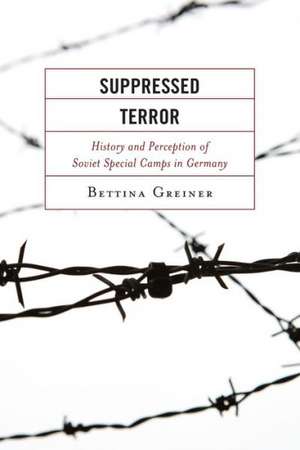
Suppressed Terror
Autor Bettina Greineren Limba Engleză Hardback – 24 apr 2014
How can one write the history of victims in a "society of perpetrators?" This is only one of the questions Displaced Terror: History and Perception of Soviet Special Camps in Germany raises in exploring issues in memory culture in contemporary Germany. The study begins with a detailed description of the camp system against the backdrop of Stalinist security policies in a territory undergoing a transition from war zone to occupation zone to Cold War hot spot. The interpretation of the camps as an instrument of pacification rather than of denacification does not ignore the fact that, while actual perpetrators were a minority, the majority of the special camp inmates had at least been supporters of Nazi rule and were now imprisoned under life-threatening conditions together with victims and opponents of the defeated regime. Based on their detention memoirs, the second part of the book offers a closer look at life and death in the camps, focusing on the prisoners' self-organization and the frictions within these coerced communities. The memoirs also play an important role in the third and last part of the study. Read as attempts to establish public acknowledgment of violence suffered by Germans, they mirror German memory culture since the end of World War II.
Preț: 767.45 lei
Preț vechi: 1103.77 lei
-30%
Puncte Express: 1151
Preț estimativ în valută:
135.82€ • 158.73$ • 117.92£
135.82€ • 158.73$ • 117.92£
Carte tipărită la comandă
Livrare economică 20 februarie-06 martie
Preluare comenzi: 021 569.72.76
Specificații
ISBN-13: 9780739177433
ISBN-10: 0739177435
Pagini: 418
Ilustrații: 1 BW Illustration
Dimensiuni: 163 x 236 x 32 mm
Greutate: 0.71 kg
Editura: Bloomsbury Publishing
Locul publicării:New York, United States
ISBN-10: 0739177435
Pagini: 418
Ilustrații: 1 BW Illustration
Dimensiuni: 163 x 236 x 32 mm
Greutate: 0.71 kg
Editura: Bloomsbury Publishing
Locul publicării:New York, United States
Cuprins
Contents
Preface to the English Edition
Chapter One - Introduction
The Camp System
Internees and SMT Prisoners
Explorations
Detention Measures
Detention Experiences
Detention Memories
Chapter Two - Detention Measures
Internments
"Mobilization" and "Cleansing the Rear Area" between December 1944 and April 1945
The NKVD Order No. 00315 or the End of "Mobilization"
The Primacy of the Pacification Policy
Isolation as "Political Prophylaxis"
Soviet Military Tribunals (SMTs)
The Work of the SMTs
Functional Changes in the Camp System
The Logic of Judicial Terror
Judicial Prosecution of "Class Enemies"
"Political Purges" and the Struggle against "Deviationists"
Russian Roulette
Chapter Three - Detention Experiences
Arrest
Dawn Raids
Denounced
In Shock
In the "GPU Cellars"
Detention Conditions
Interrogations
Traitors
Verdicts
In Special Camp No. 7/No. 1 Sachsenhausen
Parallel Worlds: "Politicals" and "Criminals"
The Divided Camp Community
Daily Life in the Sachsenhausen Special Camp
Fragments
Chapter Four - Detention Memoirs
Freedom
The Closure of the Special Camps, 1950
The Combat Group against Inhumanity
The Price of Recognition
"Empty" Memory Sites
"Second-Class Victims" or Self-Imposed Isolation
A Last Attempt: The Publication Offensive after 1989-1990
"Gray" Literature
The Dependency Trap
"Documentarism" as Narrative Style
"Alternate Framings" and Other "Narrative Templates"
Self-devised Traps-Memoirs after 1989
Chapter Five - The Special Camps and Their Place in History
Internment Camps
The POW Camps of the GUPVI
The Soviet GULAG
National Socialist Camps
Notes
Abbreviations
Bibliography
Index of Names
Subject Index
Author Note
Preface to the English Edition
Chapter One - Introduction
The Camp System
Internees and SMT Prisoners
Explorations
Detention Measures
Detention Experiences
Detention Memories
Chapter Two - Detention Measures
Internments
"Mobilization" and "Cleansing the Rear Area" between December 1944 and April 1945
The NKVD Order No. 00315 or the End of "Mobilization"
The Primacy of the Pacification Policy
Isolation as "Political Prophylaxis"
Soviet Military Tribunals (SMTs)
The Work of the SMTs
Functional Changes in the Camp System
The Logic of Judicial Terror
Judicial Prosecution of "Class Enemies"
"Political Purges" and the Struggle against "Deviationists"
Russian Roulette
Chapter Three - Detention Experiences
Arrest
Dawn Raids
Denounced
In Shock
In the "GPU Cellars"
Detention Conditions
Interrogations
Traitors
Verdicts
In Special Camp No. 7/No. 1 Sachsenhausen
Parallel Worlds: "Politicals" and "Criminals"
The Divided Camp Community
Daily Life in the Sachsenhausen Special Camp
Fragments
Chapter Four - Detention Memoirs
Freedom
The Closure of the Special Camps, 1950
The Combat Group against Inhumanity
The Price of Recognition
"Empty" Memory Sites
"Second-Class Victims" or Self-Imposed Isolation
A Last Attempt: The Publication Offensive after 1989-1990
"Gray" Literature
The Dependency Trap
"Documentarism" as Narrative Style
"Alternate Framings" and Other "Narrative Templates"
Self-devised Traps-Memoirs after 1989
Chapter Five - The Special Camps and Their Place in History
Internment Camps
The POW Camps of the GUPVI
The Soviet GULAG
National Socialist Camps
Notes
Abbreviations
Bibliography
Index of Names
Subject Index
Author Note
Recenzii
This translation of a 2010 German book is a deeply sourced, sophisticated analytical study of the imprisonment of German civilians in the Soviet military occupation zone in East Germany and the German Democratic Republic between 1945 and 1950. POWs and war criminals convicted by Soviet military courts were forced to work. But over 120,000 German civilians, arrested ostensibly for denazification procedures and kept in "special" camps, were not permitted to work. . . .What purpose did these special camps serve? Greiner thinks they began as pretrial sites for suspected Nazis of minor standing and evolved into long-term prisons for unconvicted inmates. . . .Greiner reflects on changes in the historical memorialization of political captivity in Germany and warns against equating Nazi and Soviet political confinement, especially with regard to guilt and victimhood. Summing Up: Recommended. Upper-division undergraduates and above.
The significant contribution of Greiner's book lies in its focus on the individual experiences and memories of those detained. Based on memoirs and oral testimonies, Suppressed Terror carefully reconstructs the experiences of denunciation, [and] arrest. . . .Greiner has thus written an excellent and insightful book that scholars in the fields of postwar central European history and memory studies will benefit from reading with care.
Bettina Greiner's admirable and comprehensive study of the Soviet special camps in occupied Germany is a crucial contribution to our understanding of Soviet repressive measures in Germany after World War II and their memory-and forgetting-since the Cold War. Her creative use of little-known German prisoner memoirs and accounts, combined with thorough research in Soviet and German sources on camp policies and practices, produce unparalleled insights into this revealing corner of the history of Soviet terror in postwar Europe.
Bettina Greiner's deeply researched study of Soviet secret police camps in Germany from 1945-1950 analyzes not just the Soviet policies and practices behind the 'special camps,' but connects them to prisoners' experiences and the German politics of memory. Anyone interested in political violence, concentration camp systems, and the fateful entanglements of Germany and Russia/USSR in the twentieth century should consider this important case.
Through the careful and critical analysis of published recollections from former detainees, Greiner outlines in detail the strategies developed to attain recognition as victims. . . .Overall, her study is an important addition to the existing literature on Soviet special camps in Germany, particularly with regard to the politics of remembering.
The significant contribution of Greiner's book lies in its focus on the individual experiences and memories of those detained. Based on memoirs and oral testimonies, Suppressed Terror carefully reconstructs the experiences of denunciation, [and] arrest. . . .Greiner has thus written an excellent and insightful book that scholars in the fields of postwar central European history and memory studies will benefit from reading with care.
Bettina Greiner's admirable and comprehensive study of the Soviet special camps in occupied Germany is a crucial contribution to our understanding of Soviet repressive measures in Germany after World War II and their memory-and forgetting-since the Cold War. Her creative use of little-known German prisoner memoirs and accounts, combined with thorough research in Soviet and German sources on camp policies and practices, produce unparalleled insights into this revealing corner of the history of Soviet terror in postwar Europe.
Bettina Greiner's deeply researched study of Soviet secret police camps in Germany from 1945-1950 analyzes not just the Soviet policies and practices behind the 'special camps,' but connects them to prisoners' experiences and the German politics of memory. Anyone interested in political violence, concentration camp systems, and the fateful entanglements of Germany and Russia/USSR in the twentieth century should consider this important case.
Through the careful and critical analysis of published recollections from former detainees, Greiner outlines in detail the strategies developed to attain recognition as victims. . . .Overall, her study is an important addition to the existing literature on Soviet special camps in Germany, particularly with regard to the politics of remembering.